THREE UNSUNG HEROES OF WWII
By David J. Cade
Colonel, USAF (Retired)
Merion Station, Pennsylvania
Last updated: October, 2024
TABLE OF CONTENTS
CHAPTER I. GENERAL OF THE ARMY GEORGE CATLETT MARSHALL
CHAPTER II. MAJOR GENERAL MAURICE ROSE
CHAPTER III. LIEUTENANT DAVID HUMMEL
CHAPTER IV. GENERAL MARSHALL AND THE COMBINED CHIEFS OF STAFF VISIT TO COLONIAL WILLIAMSBURG, 1943
Notable Tributes to George Marshall
The Marshall-MacArthur Relationship
David Cade Email to Kevin Williamson on his Article Like Ike
Notable Tributes to Maurice Rose
General Marshall and his WWII Contemporaries as Seen Through the Lens of an Ancient Military Custom
Foreword
I was two years old when Hitler invaded Poland on September 1,1939 triggering WWII, and four when Japan attacked Pearl Harbor on December 7, 1941, causing the U.S. to declare war on the Axis countries. My first real recollection of the war was when my mother picked me up at school on September 11, 1944 to tell me that our first cousin, 2/Lt David Hummel, U.S. Army, had died of his wounds in Belgium near the German border. At about that time, I remember being told that my uncle, Captain Herman Fischer, U.S. Navy, captain of the light cruiser USS Phoenix, had managed to get his ship safely out of the Pearl Harbor area during the Japanese attack.
Throughout the remainder of the war I was aware of the general turn of events. I well remember the derisive songs about Hirohito (Emperor of Japan) and Hitler, the school paper drives to raise money for the war effort, and the ration book kept by my mother with stamps to buy essentials such as gasoline, butter, sugar, meat, cooking oil, canned goods, etc. We often had to crush and massage a capsule of yellow dye into white oleomargarine to make it look like butter. When Japan surrendered on August 15, 1945, bringing an end to the two-theater global war (Germany surrendered on May 8, 1945), my dad took out his .45 automatic pistol from WWI and fired blanks into the air from our back porch in celebration.
And after the war, very popular Army Surplus stores sprung up all over – with a wide array of merchandise ranging from clothing gear to mess-kits, flashlights, tents, and bayonets.
So WWII was well-ingrained in my mind from an early age, and I subsequently devoured any and all information relating to that global conflict.....reading hundreds of books, and visiting scores of museums throughout the world.
Although not coming from a military background, my father was in WWI, my great-grandfather was in the Union Army in the Civil War, and I have five Revolutionary War Patriot ancestors. During my undergraduate time at the University of Illinois, I was the Air Force ROTC cadet colonel Wing Commander and was commissioned into active duty upon graduation. Not intending to spend a career in the Air Force, I was fortunate to have a track record of accelerated promotions, and by my 16th year made full colonel. I spent three years in a brigadier general's position at the Pentagon, and then decided to take early retirement after 22 years of service.
My own military experiences gave me a fuller understanding and appreciation of WWII. As a student at the National War College, I was one of a small group of senior officers selected to visit the Soviet Union in 1977....which was the first official high level military exchange between the two countries since WWII. In Leningrad (now St. Petersburg) we saw the plots where 10,000 Russians are buried in each of numerous mass graves as a result of the 900 day Nazi siege of the city; we also visited the impressive Soviet war memorial on Mamayev Hill in Stalingrad (now Volgograd), which includes a giant statue of Mother Russia (with upraised sword) that is taller than the Statue of Liberty. At the Malinovsky Tank Academy in Moscow, we were hosted by a Marshall of the Soviet Union who fought in WWII -- which the Russians to this day refer to as "The Great Patriotic War." In smaller private sessions with Soviet generals and colonels, when the alcohol was flowing freely, I was told of the many unbelievable hardships experienced by, and the sacrifices made by, the mothers and fathers of these officers following the Nazi invasion in 1941. It was quite moving. Prior to leaving the Soviet Union, as the senior student, together with an Army colleague, we laid a wreath at the tomb of the Soviet unknown soldier at the Kremlin wall in Red Square.
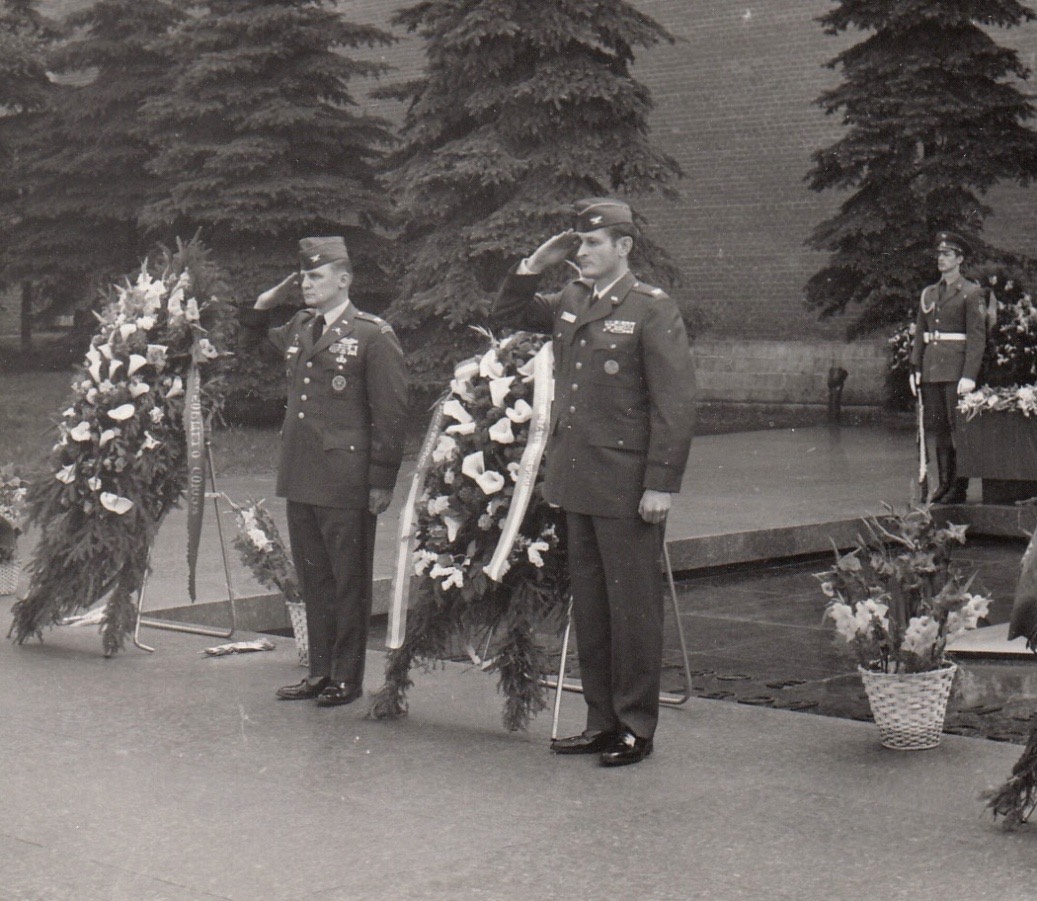
The author on right laying wreath at tomb of Soviet unknown soldier
Later, as Commander of the 6931st Security Group in Iraklion, Crete, Greece (with a base population of some 3,000 people), I was the senior American official on the island and in that capacity represented the U.S. ambassador in Athens on a number of occasions. One such occasion involved laying a wreath at a war memorial in Cretan village where the Nazis had executed all the men in retaliation for the kidnapping of the German lieutenant general who commanded all Nazi forces in Crete after the airborne invasion in May 1941. That general was spirited away from Crete in a midget submarine, and in the long run was actually appreciative since he spent the rest of the war as a POW in London instead of facing an almost certain death on the eastern front.
These and many other related experiences compelled me to focus on what interested me most about WWII – the high level command and personal relationships between and among the senior political and military leaders of the Allies. In researching this topic, one name always crops up more than the others –General of the Army George Catlett Marshall, Army Chief of Staff, whom Churchill referred to as "the true organizer of victory", yet who to this day remains in the shadow of his WWII subordinates, Theater Commanders Generals of the Army Eisenhower and MacArthur.
The George C. Marshall Foundation in Lexington, Virginia is committed to perpetuating the legacy of this noble American whom Harry Truman called "the great one of the age." The Association of the U.S. Army (AUSA) also gives enduring recognition to Marshall's legacy by naming their most prestigious award the George Catlett Marshall Medal, which is presented every year at their annual convention to an outstanding individual who embodies Marshall's qualities in providing sustained commitment to America's armed forces.
In researching the circumstances surrounding the combat death of my cousin, Lt. David Hummel of the 3rd Armored Division in WWII, I came to appreciate the outstanding abilities and deeds of his Division Commander, Major General Maurice Rose, another amazing and unsung American military hero.
Beginning in the early 1990s, from time to time during my research I would feel compelled to put pen to paper and write vignettes, articles, and reviews about various WWII topics. There are many amazing unsung American military heroes of WWII. This paper is a compendium of those pieces I wrote focusing on three such men in U.S. history, Generals Marshall and Rose, and Lieutenant Hummel -- two of whom gave the last full measure of devotion to their country, and the other.....the greatest soldier in American history, excepting George Washington!
Preface
Most Americans today would recognize the name of Dwight D. Eisenhower (Ike) as a former President of the United States, and as the triumphant General of the Army and Supreme Allied Commander, Europe in World War II. But ironically, the majority of Americans today probably would not recognize the name of the man who made it possible for Ike to get that position and later become President…General of the Army George Catlett Marshall...Ike's boss throughout the war, the master architect of global victory, and one of the most towering and yet least-appreciated figures in U.S. history.
General Marshall greatly admired an even lesser known unsung hero of WWII – Major General Maurice Rose, Commander of the 3rd Armored Division ("Spearhead"), VII Corps, 1st U.S. Army, whose unique leadership qualities in combat mirrored those of his former boss, General George Smith Patton, Commander of the Third U.S. Army in WWII. General Rose, like Patton, always led from the front, and this quality ended up resulting in his premature death from hostile fire during an ambush. Indeed, he was the senior American officer killed by enemy fire in the European theater during WWII – a fact not well known or appreciated today.
It is hoped that this paper will shine some additional light on these two forgotten heroes of WWII, and introduce the reader to Lt. David Hummel, a junior grade infantry officer who – like so many others – was a hero in his own right by giving up his life at an early age to the cause of victory over a brutal totalitarian dictatorship.
It must be noted that two other first cousins of mine also fought in WWII, but survived the conflict. David Hummel's brother John served in Italy as a Sergeant with the Army Air Corps, and Robert J. ("Jim") Nolan served in the European Theater of Operations as a PFC with General Patton's Third Army until the war in Europe was over in May 1945, and then in the Pacific Theater of Operations until the war ended in September 1945. After the war, Jim had a dairy farm near Joliet, Illinois, and later, one in Baraboo, Wisconsin. He always loved horses, and was a circus aficionado – often boarding elephants owned by trainers under contract to Ringling Brothers on his farms along with his horses......in addition to befriending circus equestrians, performers, and animal trainers.
George Patton was a lifelong expert horseman; as a Cavalry Second Lieutenant he participated in the modern pentathlon competition at the 1912 Stockholm Olympics, and was a key member of the Army polo team during the 1920s-30s. Even in WWII, when the army had long since replaced the horse cavalry with armored forces, Patton always had a horse or two with him for his personal use. My first cousin Jim Nolan, with his lifelong affection for horses, had a dream job in Patton's Third Army, taking care of the general's steeds. Although the specifics are lost in the mists of time, he gave Jim the following photo after the war in Europe was over. Patton's personal inscription on the photo, which shows riding crop in hand, refers to Jim as one of his "mighty midgets" - obviously a tongue-in-cheek reference to Jim's 6'3" height!!!
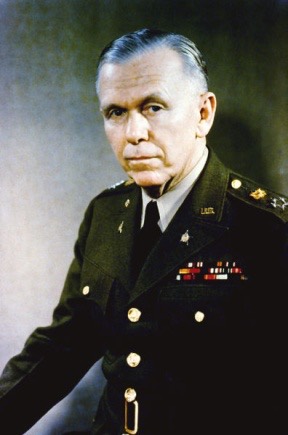
CHAPTER I
GENERAL OF THE ARMY GEORGE CATLETT MARSHALL
Simply put, George Marshall was the most unique and accomplished public servant in American history. Not only was he the most competent, effective, and challenged Army Chief of Staff of all time – always delivering superior results for Presidents Roosevelt and Truman, the nation, and the global Allied war effort – but he was the only person ever to serve as both Secretary of State and Secretary of Defense. There are not enough superlative words in the English language to adequately describe his collective achievements in these three posts.
An overview of this man’s impact on U.S. history is eloquently captured in the following excerpt from the George C. Marshall Foundation’s 1997 exhibition commemorating the 50th anniversary of the seminal Marshall Plan:
GEORGE C. MARSHALL
SOLDIER OF PEACE
"Few Americans in the twentieth century have left a greater legacy to world peace than George C. Marshall (1880-1959). As chief of staff of the United States Army during World War II, it fell to Marshall to raise, train, and equip an army of several million (actually 8.3 million) men. It was Marshall who selected the officer corps and it was Marshall who played a leading role in planning military operations on a global scale. In the end, it was Marshall whom British Prime Minister Winston Churchill hailed as "the true organizer of victory."
Yet history will associate Marshall foremost as the author of the Marshall Plan. The idea of extending billions of American dollars for European economic recovery was not his alone. He was only one of many Western leaders who realized the tragic consequences of doing nothing for those war-shattered countries in which basic living conditions were deplorable and still deteriorating two years after the end of the fighting.
But Marshall, more than anyone else, led the way. In an address at Harvard University on June 5, 1947, Marshall, in his capacity as Secretary of State, articulated the general principles of the Marshall Plan. Between 1948 and 1951, the United States contributed more than thirteen billion dollars of economic, agricultural, and technical assistance toward the recovery of free Europe. The Marshall Plan was generally acclaimed a success in its day and has admirably withstood the rigors of historical inquiry. Moreover, it gave impetus to the formation of the North Atlantic Treaty Organization and to the European Common Market. In recognition of Marshall's world leadership, he was awarded the Nobel Peace Prize in 1953."
It is interesting to note that since the Nobel Peace Prize was first awarded in 1901, George Marshall is the only military man to win the award.
David L. Roll's 2019 book GEORGE MARSHALL DEFENDER OF THE REPUBLIC, is the most definitive and authoritative work on Marshall in a generation and makes use of first-hand source material that was not available to previous scholars, authors and biographers. The book also corrects discrepancies and misconceptions, contradicts earlier claims, and amplifies the views contained in works by many previous authors, including WWII generals. Roll's prologue brilliantly summarizes the unparalleled impact of this extraordinary man:
”General George C. Marshall, who served under ten presidents, occupies a singular place in the history of the twentieth century, yet his significance is fading from public memory. His achievements, and particularly his character, must never be forgotten. As a soldier, Marshall influenced the course of each of the two world wars that swept away the European system of power, colonialism, and international order. As a statesman, he husbanded the policy of 'containment' of Soviet aggression, and faced up to the limits of American power in Asia. He lent his name and reputation to the Marshall Plan, arguably the most significant initiative in American diplomacy since the Louisiana Purchase.....No one person comes close to matching Marshall's ubiquitous yet selfless presence throughout the history of the last century." (Other notable tributes to General Marshall are in the APPENDIX.)
In my view, this is the first book which properly articulates the full extent to which Marshall orchestrated and dominated the global Allied strategy, command arrangements, and force deployments in WWII, and was empowered and relied upon by Franklin Roosevelt throughout the course of the conflict.
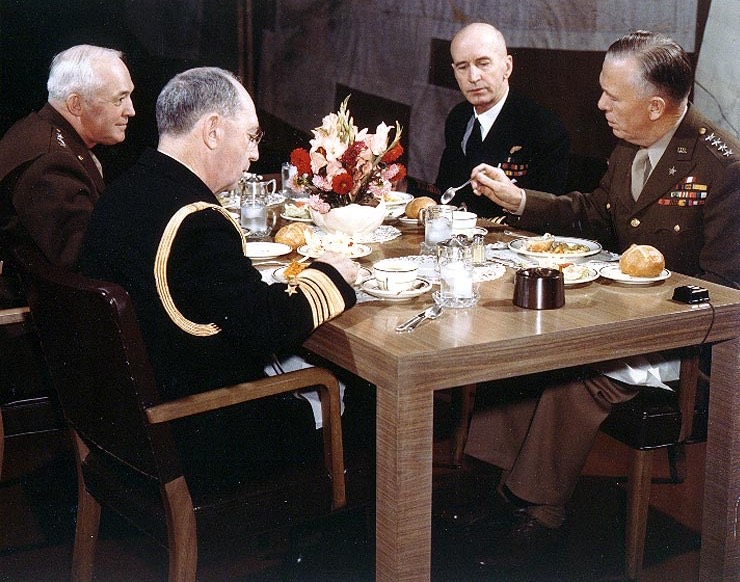
General Marshall, the "de facto" leader of the U.S. Joint Chiefs of Staff and the "first among equals" on the Allied Combined Chiefs of Staff
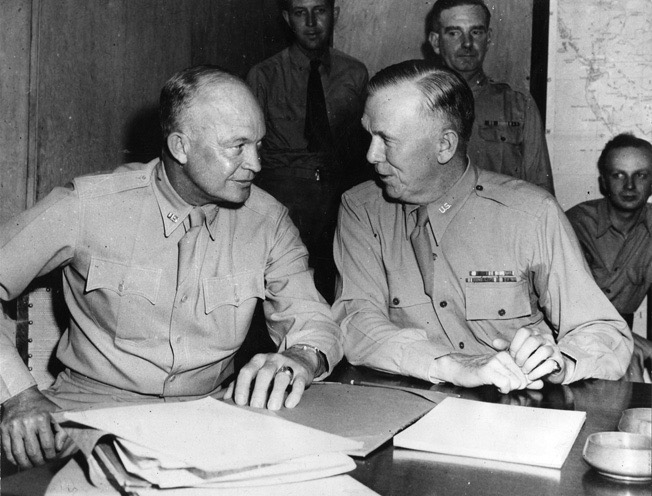
Ike on a "short leash" throughout the war
So just what were Marshall’s specific contributions that generated such words of praise and warranted such reverential treatment? Let us examine the historical record, focusing on his role as Army Chief of Staff in World War II, which provided the foundation for his subsequent roles as Secretary of State and later as Secretary of Defense…the only American in history to hold both positions!
Marshall's significant contributions in World War I foreshadowed his later WWII role and achievements. Here is how David Roll described it: "In the Great War, Marshall (on Pershing's staff) planned and executed the sixty-mile nighttime movement of more than half a million men, together with guns and supplies, so that they were in place to fight the decisive battle that led to the armistice – the forty-seven day Meuse Argonne offensive. Were it not for the Meuse-Argonne victory, it is likely that the war would have ended with Imperial Germany as the prominent power in Europe, in control of the greatest concentration of European industry on its side of the Rhine."
Marshall's role here warrants further amplification. The U.S. entered the war in 1917 as the American Expeditionary Force, and initial use of American troops was limited to shoring up French and British units. But by the Summer of 1918, with over 2 million U.S. troops in theater, General Pershing, with President Wilson's concurrence, insisted with allied military chief Marshall Foch that henceforth our troops would only fight as part of an American army. In an early battle, Major George Marshall of the 1st Infantry Division had so impressed his superiors in orchestrating the movement of troops and supplies that he became Pershing's chief planner as a temporary colonel. He was charged with constructing a battle plan for the attack on the Saint-Mihiel salient which the Germans had held for four years. Just as that battle kicked off, Foch and Pershing compromised on a strategy to continue the Saint-Mihiel attack while at the same time rapidly shifting to a larger Meuse-Argonne offensive some 30 miles away two weeks later employing the same troops! So Marshall had the unenviable task of planning how to pull this off with the American First Field Army - some 550,000 men in 3 corps and 15 divisions. By the time the Meuse-Argonne campaign was over, 23 American divisions were involved. Complicating this task was the fact that it was the first time in military history that a large armed force employed the combined arms concept - the coordinated use of infantry, artillery, tanks, fighter and bomber aircraft, together with intelligence and combat support elements. And these combat units all had new weapons systems, manned by relatively green soldiers, going against a German standing army with seasoned professionals. The challenge was staggering, but George Marshall came through with flying colors.
Later, as Pershing's aide for five years during and after World War I, Marshall learned first-hand about the levers of power in the entire Army establishment and in the Washington, D.C. civilian power structure....and how to manage them. For five months in 1923-4 while Pershing – then Army Chief of Staff – was in Paris working on the American Battle Monuments Commission, Marshall virtually ran the office as the de facto Deputy Chief of Staff. These experiences gave him unparalleled credentials which would serve him and the nation well twenty years later in World War II.
World War II was the most cataclysmic event in all of human history, in which 70-78 million people – civilian (67%) and military (33%) – lost their lives. Marshall's undisputed record in orchestrating the allied victory in World War II, as characterized by Winston Churchill, is astounding. On the very day Hitler invaded Poland, September 1, 1939, Marshall was tapped by FDR to be Chief of Staff over 33 more senior generals....which turned out to be the most important personnel selection in his presidency.
Although the U.S. did not get in the war until Pearl Harbor two years later, the gathering war clouds foretold American direct involvement sooner or later, which Marshall (and Roosevelt) clearly perceived. From a national security standpoint, Roosevelt came to rely on Marshall for effectively conducting the global war effort and adroitly handling the Allies. From that point until the end of the war in 1945, Marshall’s foresight, brilliance, exacting standards and tenacity enabled him to accomplish the following:
Persuaded FDR to support his extensive mobilization plans for manpower and materiel, and secured congressional approval to finance this buildup, despite a powerful isolationist bloc in congress and the country.....which made it a difficult political challenge for the president. Marshall devoted an extraordinary amount of time and energy interacting with Congress to get the Selective Training and Service Act of 1940 passed -- basically on his own since FDR had little or no credibility in the Senate and House on this matter. But Marshall's words – all without notes – were like gold, and the Act passed by one vote! Many historians believe that his pre-1941 initiatives and efforts were his most important achievements in assuring the ultimate Allied victory. Marshall's integrity, straightforwardness, and apolitical posture enabled him to establish unparalleled confidence and valuable bilateral relationships in congress. He was noted for being able to brief senators and congressmen for hours on army upgrading and modernization requirements and rationale without any notes.
By the middle of 1941, the Selective Service Act had brought 1.4 million draftees into the army; now they had to be trained. Based on his World War I experience in successfully planning and executing the combat movement of half a million soldiers in the Meuse-Argonne offensive, and in recognition of the need to be able to counter such modern offensive warfare strategies as the 1940-1 Nazi blitzkrieg operations, Marshall realized that The U.S. must build and train multiple field armies (each with 100,000+ soldiers). Thus, he formulated several massive field army exercises in the second half of 1941– the most prominent of which were the Louisiana maneuvers involving some 500,000 men and supplies; this was the exercise in which Dwight Eisenhower and George Patton first demonstrated their abilities to plan and lead large scale combat operations. Fortuitously, this series of large scale maneuver exercises concluded just one month before Pearl Harbor.
Recruited, trained, equipped, and fielded an army that mushroomed from 170,000 in 1939 to 8.3 million in 1945. This meant going from zero fully equipped and effective combat divisions to 91 in six years, a mind-boggling feat. It is interesting to note that in 1939 the German Wehrmacht had 90+ complete combat capable divisions and the Japanese 50+. And by way of comparison, the high-water mark for fielded Wehrmacht divisions in WWII was 280 in February, 1943 – although German divisions tended to be a bit smaller than allied divisions.
Totally revamped and reorganized the army, including the forced retirement of senior officer “deadwood” to make room for younger, more dynamic general officer combat leadership; hand-picked senior commanders in all theaters of war.
Immediately after Pearl Harbor, brought Ike, a newly minted one-star general, to Washington on his War Plans staff; groomed Ike for high command, promoting him to three stars within 8 months and assigning him to Europe as commanding general of the U.S. European Theater of Operations.....directly leading to his eventual role as Supreme Allied Commander in Europe.
Dramatically expanded the U.S. industrial production base to provide vast numbers of new weapons systems and support equipment. Two examples – in 1939, the army had 3 tanks and 3,100 aircraft, while in 1945 these numbers were 74,079 and 297,199. In addition, as the “Arsenal of Democracy”, the unparalleled U.S. industrial base also supplied key allies (most notably England and the Soviet Union) with huge quantities of war materiel, from ammunition to tanks, artillery, aircraft, trucks and fuel. It took many months (1941-3) to find the right industrial players, settle on one organizational structure, and end administration infighting to properly leverage and exploit the tremendous U.S. industry potential for war production. During this period, Marshall jawboned key industrial leaders to deliver the vast array of materiel on time and on budget.
According to David Roll, as early as the end of 1941, Churchill "realized that George Marshall had emerged as the dominant and most influential figure of the Allied war commanders." The two men often butted heads on strategic military matters because Churchill was his own Minister of Defense, but Marshall never questioned, challenged, or interfered with Churchill in his role of Prime Minister.
Based on his experiences with allied armies in WWI, and contrary to British policy, practice, and wishes, Marshall insisted on and ultimately secured Allied approval of Unity of Command – a single supreme commander in each theater responsible for all ground, air and naval operations. Churchill, who initially was vehemently opposed to this, had to give in, and ultimately accepted the concept – which ended up being very successful.
Had FDR’s ear and confidence as the most respected and listened-to senior military officer. He was the universally acknowledged first among equals of the military chiefs, and the only person in his inner circle whom FDR never called by his first name – it was always “General Marshall.” But it didn't start out that way. At a key meeting of all senior Army officials when Marshall was Vice Chief of Staff, Roosevelt made a point regarding aircraft production numbers, and asked him: "Don't you think so George?" Marshall responded coldly: "I am sorry Mr. President, but I don't agree with that at all." All attendees thought that was the end of Marshall's career. But one of FDR's strong suits was the penchant to find subordinates who would stand up to him and tell it like it really was even if that was diametrically opposed to the president's stated position. So not only did FDR never again call him by his first name, but he reached far down the seniority list to select Marshall as the next Army Chief of Staff.
Marshall quickly learned to read and adjust to all of the president's idiosyncrasies, aided by his astute close relationships with FDR's key civilian advisors, the prime one being Harry Hopkins. According to the Runkle book, he insisted that he not be addressed by his first name since "Marshall understood Roosevelt's way of suborning people by misrepresenting their intimacy, and deliberately observed a formality with the president so he wouldn't be manipulated as 'one of the boys'." When allied political and military circles were almost certain that FDR would tap Marshall to be the Supreme Allied Commander, Europe, at the last minute Roosevelt balked mainly because the President said he wouldn’t be able to sleep at night knowing Marshall was not in Washington orchestrating the global war effort. Moreover, all key players in Washington were in agreement with FDR that they did not want the indispensable Marshall to take the subordinate European Theater Commander's position for the same reason....and so Marshall's protégé, Ike, got the job....eventually paving his way to the White House.
Convinced FDR that he needed to name a Chairman of the Joint Chiefs of Staff, and adroitly suggested that Admiral Leahy be selected to even the number of Army and Navy representatives - even though Roosevelt and the other chiefs knew that Marshall was the key decision maker, and the "first among equals."
Devised the structure of, and was the key driver in the deliberations of, the Combined Chiefs of Staff – collaboration of the American and British Chiefs of Staff in developing and executing the allied military conduct of the global war. By the end of the war, all key players on both sides - as well as historians today - agree that no other American or British officer could have managed the group with the same success as Marshall did.
Throughout the war, astutely and deftly moved key generals around the globe like chess pieces, suggesting candidates to his two theater commanders (Eisenhower and MacArthur) for army group, field army, corps and division command positions, always acceding to their preferences if there was a difference of opinion. One very important non-combat role was the general officer in charge of supply - which became increasing vital as the army fielded multi-millions of soldiers across two continents. This was an unprecedented logistical challenge, and Marshall needed an officer with exceptional drive, energy, and thick skin. Once again, his choice proved to be up to the task – Lt. General Brehon Somervell.
Determined that the "OVERLORD" cross-channel invasion of France was the best way to win the war in Europe with the fewest possible Allied casualties; while this strategy was opposed by the British high command until late in the war, it was strongly supported by Stalin as providing an all-important second front in Europe; the Soviet dictator came to greatly admire Marshall's strategic acumen and supreme generalship. Marshall singlehandedly assured that Overlord would eventually go forward as planned despite Churchill's continuing efforts to postpone it or cancel it and shift the invasion resources to the Mediterranean Theater/Balkans. Marshall was "big enough" to realize that he would have to adjust his original timetable for the invasion in 1942, and then 1943 because the allies simply weren't ready with enough combat and support forces or landing craft to be successful. Moreover, he also admitted that he originally did not appreciate FDR's domestic political need to demonstrate that American forces were actually in combat against the Third Reich rather than languishing in the US or UK waiting to be used – and in this light, Marshall wholeheartedly supported the Mediterranean offensive desired by the British, encompassing North Africa, Sicily, and Italy.
Kept Ike on a short leash during the war in Europe – regularly providing “back channel” guidance, “holding his hand”, bolstering his confidence which flagged from time to time, and encouraging him not to go overboard in meeting British demands at the expense of US war-winning strategies and interests….a facet of Ike’s “political modus operandi” which greatly concerned other senior U.S. military leaders. The crucial and often contentious interrelationships among U.S. and British political and military top leadership – in which Marshall played the most dominant role – is a fascinating subject, and is still not properly understood or appreciated many decades later! Moreover, because he placed Ike in a position to become the most famous face of victory in World War II, Marshall was instrumental in ultimately putting Ike into the Oval Office!
Ultimately prevailed over Churchill (who was Minister of Defense as well as Prime Minister), the British Imperial General Staff, and senior British field commanders who had a different agenda and mind-set with respect to global military strategy, the optimal way to invade the European Continent, the conduct of the multi-theater war, and the preservation of the British Empire at all costs. The cautionary British were conscious of their limited manpower base, and were still mindful of their terrible loss of men in WWI, especially at the Battle of the Somme in 1916. This risk-averse mindset was reinforced by the humiliating evacuation of 338,000 British troops at Dunkirk in early June, 1940; these were factors in their hesitance to aggressively conduct a direct invasion of the continent through France, but rather follow Churchill's strategy of a "soft underbelly" offensive through the Mediterranean, Italy, and the Balkans. Incidentally, this same ingrained mindset made Field Marshall Montgomery reluctant to engage in battle unless and until he felt that he had overwhelming operational superiority.
From 1942 on, Marshall had to juggle and reconcile FDR's changing military priorities, many times based on Churchill's never-ending backdoor communications and remonstrations with the president. This often led to FDR's ambivalence and reluctance to overrule Churchill.....but ultimately, FDR sided with Marshall.
FDR (and later Truman) astutely recognized that Marshall's gravitas and sterling reputation with the general public and with politicians of all stripes enabled him to get initiatives through a Republican congress that the president otherwise would not have been able to do.
Regarded George Patton as the Allies best fighting general, based on Marshall's recognition of Patton's unique armored force credentials and audacious offensive mindset. This perspective dated from their WWI experiences and was reinforced in the interwar years by Patton's superior performances during military exercises. After Marshall became Chief of Staff, he promoted Patton twice by the end of 1941 – to Brigadier General and then Major General. With this background, Marshall promoted Patton to Lt. General and selected him to lead the U.S. 7th Army in the invasion of Sicily in July, 1943 – this was important since it made Patton the first commander to lead a U.S. field army into combat in WWII.
But Marshall also realized that the flamboyant Patton could sometimes be a 'loose cannon' and needed to be carefully monitored. When Patton became embroiled in a series of embarrassing incidents in 1943 and early 1944 that caused a tremendous backlash in Washington (soldier slapping and inappropriate briefings to British civilians), he left Patton's fate up to Ike – but he told Ike that the key decision factor should be to not weaken Overlord's combat capabilities. Ike got the message and retained Patton in a key command role for his fighting abilities. Marshall's forbearance basically saved Patton's career, enabling him to gain fame and glory as commander of the powerful Third Army.
In this role, Patton exercised his aggressive offensive "shock and surprise" approach to battle by employing a brilliant ahead-of-its time combined arms strategy (armor, infantry, artillery, close air support, and timely reconnaissance/intelligence). Patton's modus operandi was to: (1) use armor as the lead battle force followed by infantry; (2) hit the enemy's weak spots rather than attack his strength; and (3) employ decentralized command and control - all of which kept the enemy off balance. These tactics contradicted army doctrine and ran counter to the overly cautious strategy employed by Eisenhower, Bradley, Montgomery, and most other combat generals in the European theater. Indeed, the German Wehrmacht feared Patton more than any other allied general, including those in the Soviet Army.
Played the key role in planning and prioritizing global operations, including the Pacific theater as well as the European theater. In the Far East, this included deftly keeping General of the Army Douglas MacArthur fully supported but under control – in fact, Marshall was widely recognized as being the only general officer who could do so in light of MacArthur’s monumental ego and “rogue” operating style. MacArthur was too self-centered to appreciate the fact that his best ally in Washington during the war was George Marshall. Without Marshall's approval, MacArthur would never have been allowed to lead a second Pacific theater thrust toward Japan in addition to that of the U.S. Navy, which vehemently opposed this two-pronged approach. Moreover, Marshall assured that MacArthur had top-notch combat generals to head his field armies - Walter Krueger (Sixth), Bob Eichelberger ((Eighth), as well as his Pacific Air Force - George Kenney, who controlled three numbered Air Forces (Fifth, Seventh, and Thirteenth). (See the Appendix for a more detailed account of the Marshall-MacArthur relationship.)
Marshall's relationship with the acerbic Fleet Admiral King, C-in-C of the U.S. Fleet and CNO, was crucial in orchestrating a balance in U.S. strategy between the European and Pacific theaters, and controlling the MacArthur-Fleet Admiral Nimitz interaction on the primacy of command & control over Pacific military operations. Marshall deftly solved a petty argument between King and Arnold over aircraft assets involved in anti-U-boat operations, which became increasingly critical in early 1942. All senior general and flag officers came to agree that Marshall was the only Army general who could "manage" the volatile King.
As of December 2, 1943, General Marshall thought he would be designated Supreme Allied Commander of OVERLORD, but just two days later Marshall heard from Harry Hopkins that General Arnold and Admiral King had expressed their reservations to Roosevelt about allowing Marshall to leave his post for the job in Europe. This, and his singular capability to handle MacArthur, probably were key factors in FDR's mind when he decided to name Eisenhower as Supreme Allied Commander in Europe and leave Marshall in place in Washington.
As Chief of Staff, Marshall also deftly handled military (and even some political) aspects of the tricky China issue – which included the stormy relationship between Chinese Generalissimo Chiang Kai-shek and U.S. General Joe Stillwell. His China experience would lead to another presidential assignment immediately following his retirement.
FDR gave Marshall the sole responsibility of raising the enormous amount of money for the Manhattan Project, the development of the A-bomb, which had the highest security classification. Only a handful of senators and congressmen had clearances to even know about the Project, but because of the trust Congress had in him he was able to raise the money without any questions ($2 billion in 1945 dollars, about $30 billion in 2023 dollars).
With Roosevelt close to death in early April 1945, Marshall was the final arbiter in the strategic decision proposed by Eisenhower to forego a drive to Berlin in light of three principal factors: (1) Soviet forces were already close to the German border; (2) The Yalta agreements made it impractical; and (3) It would have meant many more U.S. casualties, which were not necessary to the winning of the war. This meant that the primary focus of the campaign was shifted from Montgomery to Bradley, which did not please the British.
So George Marshall not only had to orchestrate the global two-theater war against Germany and Japan, but he constantly had to "do battle" over resources, strategies, and priorities with FDR, Congress, the U.S. Navy, the British High Command, and Douglas MacArthur – clearly mastering all of these relationships and challenges. It's no wonder that Churchill regarded and recognized him as the "true organizer of victory."
Perhaps the most succinct and comprehensive description of Marshall's singular contributions in the winning of World War II is embodied in the powerful citation accompanying President Truman's award of the Distinguished Service Medal to him after the war:
Citation for Distinguished Service Medal: "In a war unparalleled in magnitude and in horror, millions of Americans gave their country outstanding service. General of the Army George C. Marshall gave it victory. By the favor of Providence, General Marshall became Chief of Staff of the United States Army on the day that Germany attacked Poland. His was the vision that brought into being the greatest military force in history. Because he was able to make the Allies understand the true potentiality of American greatness in personnel and materiel, he was able to exercise greater influence than any other man on the strategy of victory. It was he who first recognized that victory in a global war would depend on this Nation’s capacity to ring the earth with far-flung supply lines, to arm every willing Ally and to overcome the aggressor nations with superior fire power. He was the first to see the technological cunning and consequent greater danger of the Nazi enemy. He was the master proponent of a ground assault across the English Channel into the plains of Western Europe directed by a single Supreme Allied Commander. He insisted on maintaining unremitting pressure against the Japanese, thereby preventing them from becoming entrenched in their stolen empire and enabling our timely advances across the Pacific. He obtained from Congress the stupendous sums that made possible the atomic bomb, well knowing that failure would be his full responsibility. Statesman and soldier, he had courage, fortitude, and vision, and best of all rare self-effacement. He has been a tower of strength as counselor of two Commanders in Chief. His standards of character, conduct, and efficiency inspired the entire Army, the Nation and the world. To him, as much as to any individual, the United States owes its future. He takes his place at the head of the great commanders of history."
Harry S. Truman
November 26, 1945
Washington, D.C.
Marshall's preeminent reputation was such that when he walked down the aisle of Westminster Abbey at the coronation of Queen Elizabeth II in June, 1952, the entire audience of world dignitaries arose spontaneously. When Marshall asked the other member of the U.S. delegation, General Omar Bradley, why everyone was standing, Bradley answered succinctly: "You!" (Winston Groom, The Generals, 2015, p. 442; and Stanley Weintraub, 15 Stars: Eisenhower, MacArthur, Marshall, 2007, p. xiii.)
The Weintraub book contains one of the best descriptions of the decades-long complex interrelationships among the three five-star generals. Another book which presents all the relevant facts and captures the many interesting historical intricacies and nuances involving all the top U.S. military personalities in WWII, is the fairly recent GENERALS in the MAKING by Benjamin Runkle, 2019. In many books and articles, authors often overstate Eisenhower's role and position in winning the war in Europe, and undervalue Marshall's role. The same holds true in the Far Eastern theater where authors often fail to recognize the role of George Marshall in providing the resources and strategic backing to assure MacArthur's success, while at the same time assuring accommodation with the role of Admiral King and his naval offensives in the Pacific.
The title of Chapter 8 in Runkle's book, "The Right Man in the Right Place at the Right Time", perfectly describes Marshall's place in the pantheon of allied leaders in WWII. The closing of the chapter is equally noteworthy: "The Army's officer corps was reinvigorated by Marshall's determination to advance a whole new leadership generation into the general officer ranks......A confidant of Churchill's told Phillip Graham, owner of the Washington Post, 'I often saw the President and Marshall together and was left with the impression that Roosevelt held Marshall in awe.' Indeed as Russell Weigley concludes [in his book History of the United States Army] , during this period Marshall became 'the principal military architecht of the Western democracies' ultimate victories over the Axis powers'."
On a photo given to Marshall after the war, General of the Army Dwight Eisenhower wrote: “To my war-time Chief, George C. Marshall, the greatest figure of World War II, with admiration and lasting gratitude.” (Credit: Courtesy of the George C. Marshall Foundation)
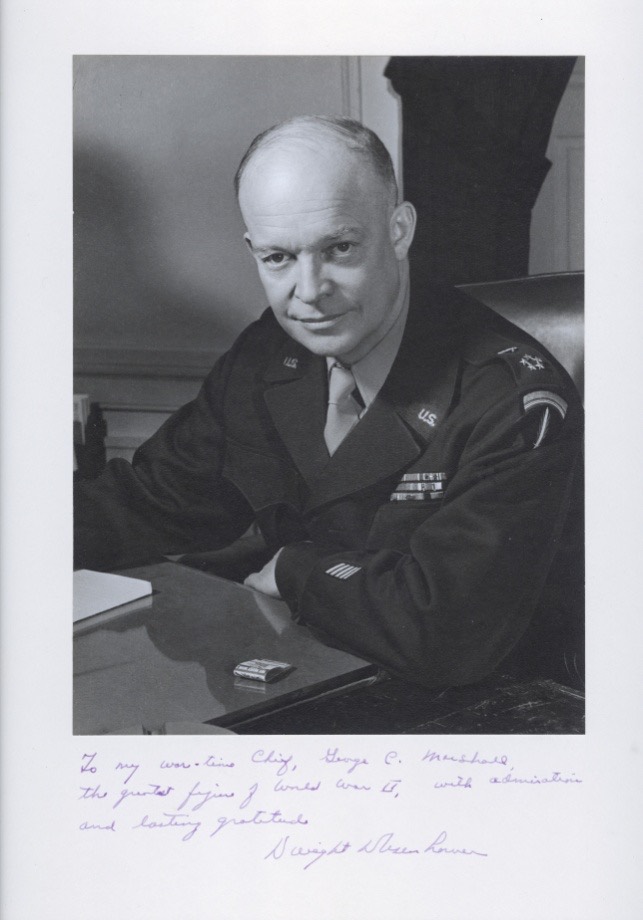
In November, 1945, within one month of his retirement as Chief of Staff, Truman tapped Marshall for a special China mission in an effort to unite the country which was on the brink of a civil war. This turned out to be a Gordian Knot that not even Marshall's unparalleled credentials and reputation could untie -- the animosity that the Nationalists and the Communists had for each other left no room for compromise since neither side was willing to cede national control or military supremacy to the other. However, David Roll contends that Marshall's experience in that situation had a lasting effect on his subsequent performance as Secretary of State in containing the global spread of communism and shaping the Marshall Plan as a counterbalance.
In his two years as Secretary of State, he deftly dealt with a staggering series of challenges not faced by any Secretary before or since – an escalating confrontation with the Soviet Union, including communist domination of Eastern Europe and the Berlin blockade; the threatened global spread of communism; European economic recovery, culminating in the Marshall Plan, which ultimately led to the European Common Market and the European Union; role of the U.S. in the China civil war; and role of the U.S. in the Arab-Jewish conflict regarding Palestine and the founding of Israel as an independent state. He created the first policy organization in the State Department, which has played an important role to this day. It should be noted that the Marshall Plan wasn't simply altruistic – it resulted in the creation of viable new trading partners for the U.S., which figured prominently in America's tremendous economic boom in the 1950s.
In his one turbulent year as Secretary of Defense, he also had some singular accomplishments, including: restoration of a close relationship with the Department of State; tripling defense expenditures and doubling armed forces manpower to confront the growing Soviet military threat, an emerging "Red China" and an increasingly hostile North Korea; instrumental in establishing a NATO led by a U.S. general, and assuring a "Europe first" U.S. strategy amid multiple global challenges. Marshall laid the foundation for the Department of Defense as we know it today.
An excellent overview of Marshall's storied career is George C. Marshall: The Indispensable Man by Eric Hammel, in the Winter 2011 issue of WARFARE HISTORY NETWORK. Following is a salient excerpt regarding his WWII role:
"Forget Eisenhower, forget Patton. The man most responsible for the Allies’ victory was a quiet, desk-bound warrior. From the very moment Marshall ascended to the head of the United States Army, his was the brain at the center of the orderly, measured growth that created the wartime field armies and all the organizations that supported them until the moment of final victory. His was the voice, second only to the president’s, that reasoned with and brilliantly cajoled a tight-fisted, antiwar Congress toward making available all the resources it took to even begin the mind-boggling undertaking of laying the foundation for the organization that, by 1945, had trained, equipped, transported, and launched millions of Americans toward his own unbreakable goal of total victory. Marshall had a hand in every aspect of the vital strategic planning that guided his armies across battlefields around the world. He personally approved the retention or elevation of every general officer who served in the wartime army he led, and of course he selected wisely from among the hundreds and hundreds of men he had commanded and taught all across his prewar career."
While never harboring any political ambitions at all, many people thought he would make an ideal president. In fact, Chief Justice William O. Douglas in a letter to Marshall in 1944 said this: "Of all the men he had been associated with in government, President Roosevelt thought you would be the best qualified to take his place as President of the United States." But it wasn't meant to be. George Catlett Marshall – a man for all seasons…an American Patriot for all time!
(A shorter version of this article was published in ARMY magazine, April 2020)
![C:\Users\user\Desktop\GEORGE Marshall\george_c_marshall[1] - Copy.jpg](assets/image8.jpeg)
CHAPTER II
MAJOR GENERAL MAURICE ROSE
The Forgotten U.S. Military Hero of WWII
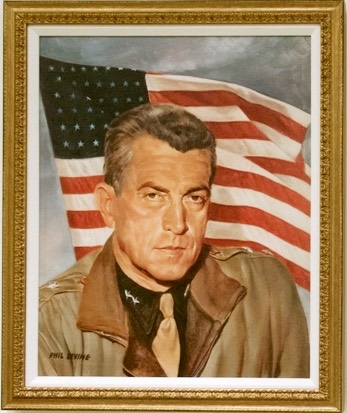
This is not intended to be a brief biography of General Rose, but rather an effort to put his unique role and contributions to winning the war in Europe in the proper perspective, especially vis-a-vis his contemporaries and the German Wehrmacht.
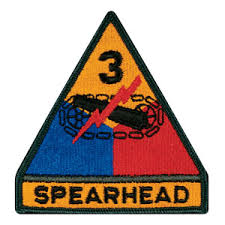
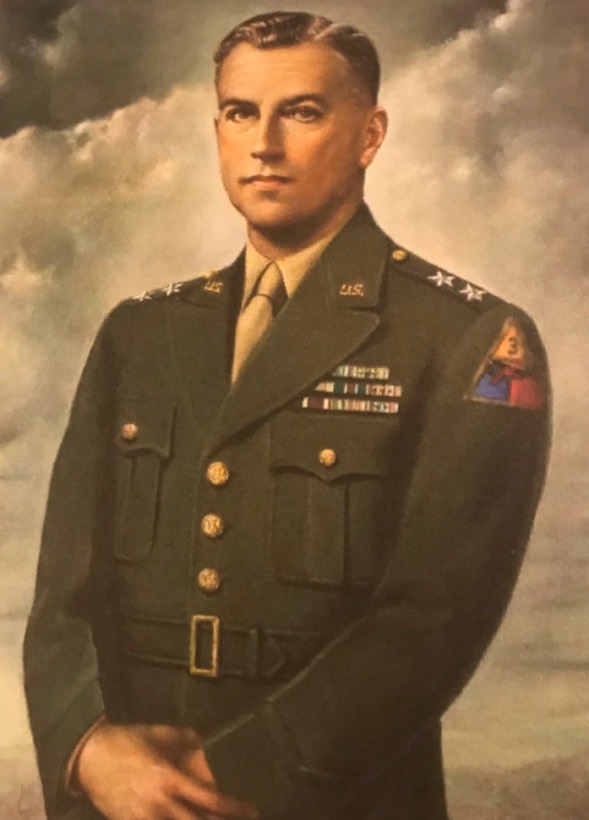
Although General George Patton's U.S. Third Army received more widespread publicity and acclaim for its rapid advance through France and Germany in 1944-5, the most potent and effective tactical U.S. armored force in WWII was the 3rd Armored Division ("Spearhead"), led by the incomparable Major General Maurice Rose – a Patton protege who became known as the “Immaculate Killer of Nazis", liberated many European cities and towns, and played a key role in bringing the war in Europe to a close.
American military historian Martin Blumenson characterized General Rose as "a legend in his own time." Author of the first important book on Maurice Rose, Steven Ossad, in referring to Rose's relentless drive to keep his troops moving to crush the enemy – constantly issuing radio orders to from his jeep near the front lines – said: "It was because of this that Rose became the greatest, most decorated, battlefield Armor commander ever produced by our country, recognized as the American Rommel in the Armored Forces." (Jeeps were colloquially referred to by armored forces as "peeps", which had a connection to its common use as a reconnaissance vehicle).
The most definitive book to date on Maurice Rose, THE PANZER KILLERS, by retired Army Lieutenant General Daniel Bolger, highlights Rose's unheralded record as a fighting general who possessed "coup d'oeil", the ability to size up ground at a first glance, envisioning combat moves in time and space – a capability shared by very few other general officers, notably 3rd Army Commander General George Patton and 7th Corps commander, Lieutenant General J. Lawton Collins. Bolger provides a detailed description of Rose's battlefield heroics from Normandy to the heart of Germany, which struck fear into the hearts of Nazi panzer crews.
Under Maurice Rose, the Spearhead Division had a number of remarkable "firsts." As the "Spearhead" of General Courtney Hodge's First Army and Lt. General "Lightning Joe" Collins' VII Corps, the Division truly lived up to its name under the aggressive and inspiring leadership of General Rose:
The lead Allied force in finally closing the infamous "Falaise Gap" in France, trapping some 40 - 50,000 Wehrmacht soldiers; this number would have been considerably higher – up to 100,000 – if General Montgomery, in charge of all ground operations, had not issued a halt order to U.S. forces on the left since his British forces on the right were well behind schedule and he didn't want to embarrass the U.K. This delay allowed a significant number of German troops to escape the Falaise pocket and live to fight another day (Aug 1944). Nevertheless, at this point, the VII Corps, with the 3rd Armored usually in the lead position, began a relentless drive across northern France and Belgium into Germany.
The lead Allied armored unit instrumental in defeating a German Panzer Corps and capturing Mons, Belgium in one of the most decisive yet under-reported battles on the Western Front (Aug 1944). Liberated Liege, Belgium and other Belgian towns while storming east toward the German border (Sep 1944).
First Allied force to enter Germany, first to capture a German town (Roetgen), and first to breach the dreaded, fortified, well-mined Siegfried Line (Sep 1944).
The key Allied force in stopping the German offensive in the fierce fighting at the Battle of the Bulge (Jan 1945). The 3rd Armored, as a "heavy" division, and because of its overwhelming success under the leadership of Maurice Rose, was often augmented by units from other divisions to the point where it was nearly Corps size, such as during the Battle of the Bulge.
First Allied force to capture a major German city, Cologne (Mar 1945).
Advanced 101 miles through Germany in one day – the longest one day move in the history of mechanized warfare (Mar 1945).
The key Allied unit in encirclement of the Ruhr Pocket, resulting in the largest single capture of Axis forces in all of WWII – some 374,000 Wehrmacht soldiers (Mar 1945). During that operation, General Rose was killed in action on March 30 near Paderborn, the heavily defended location of the SS Panzer Training Center. While his jeep was attempting to pass through a German tank column in search of a Task Force that had been cut off, it was forced off the road and he was shot by multiple rounds from a machine pistol fired by a jittery and trigger-happy Tiger tank commander. (Depiction below).The Ruhr Pocket was renamed "The Rose Pocket", and the war in Europe was over five weeks later.
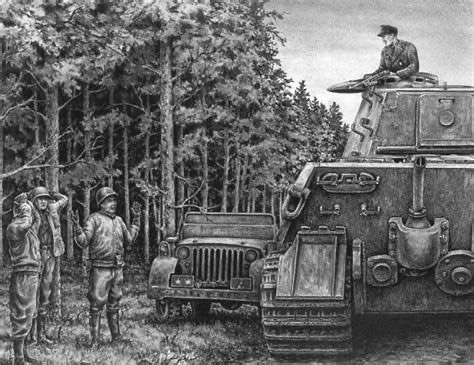
General Rose was buried in the temporary American cemetery at Ittenbach, Germany. Later in 1945, his remains were reinterred in the large American cemetery at Margraten, The Netherlands.
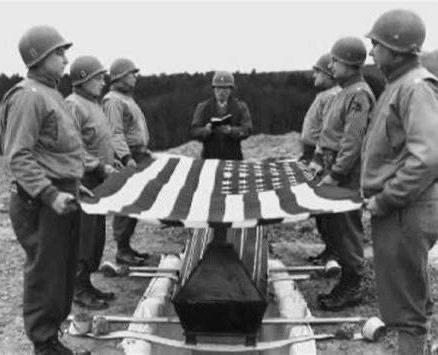
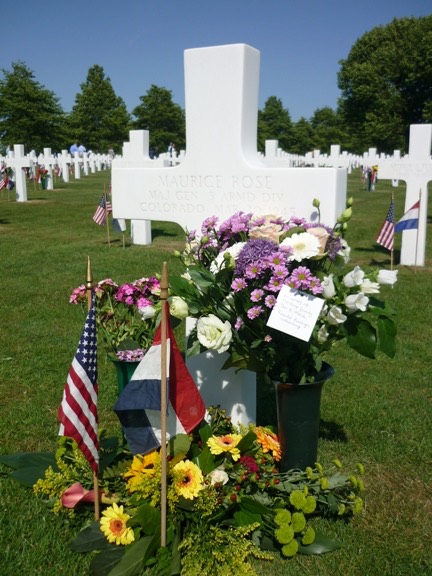
General Rose's gravesites
There is some controversy regarding his religious affiliation. The son and grandson of Jewish rabbis, he was raised in the Jewish faith. For some reason – conceivably because he was trying to sidestep the anti-semitic prejudice prevalent in the army at the time – he cited his religion as protestant in his medical records. During his military career, this matter never came up since he was a very private person. Upon his death, his first cemetery marker was a Star of David at the insistence of his family and the Denver Jewish community. However, this was later replaced by a cross based on his military records, and with the support of his second wife who insisted that that was his preference. Despite this, over the years, he has been widely embraced by the Jewish people and acclaimed as the most prominent Jewish war hero. His legacy lives on in Denver, where the Jewish community built the hospital that still bears his name.
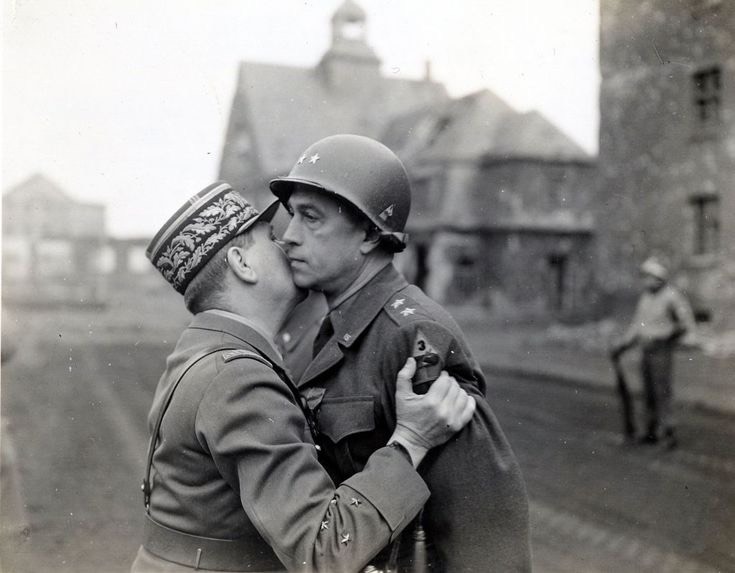
General Rose was a highly decorated officer. He was awarded three silver stars for valor, two in North Africa, and one in Sicily. For his leadership and bravery in repeatedly directing lead elements of the 3rd Armored to secure bridges across the Meuse river and liberate Mons, Belgium, he was awarded the Distinguished Service Cross – the nation's second highest military award behind only the Congressional Medal of Honor. After the capture of Cologne, Rose was presented with the French Croix de Guerre with Palm. When a French general pinned on the medal during the award ceremony, the look on Rose's face (below) reflected his apparent discomfort with the traditional ceremonial kiss on each cheek.
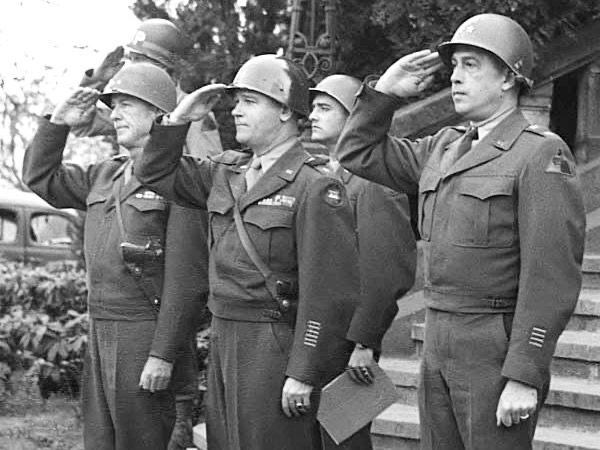
The Presidential Unit Citation was presented to the 3rd Armored Division on March 24, 1945 near Remagen, Germany. The ceremony was attended by General Hodges (Third Army). Lt. Gen. Collins (VII Corps) and Maj. General Rose (below). Rose would be killed in action six days later.
Rose never gained the prominence of many of his contemporaries (including Patton) for a number of reasons, including the fact that he did not survive the war, and never sought personal publicity. Moreover, during WWII, Army censorship rules dictated that operations and successes of Field Armies could be publicized in the media, but operations and successes of Divisions could not; unfortunately, this meant that General Rose, who always led from the front of his troops as the "Tip of the Spearhead", and was the senior Allied officer killed by enemy fire in WWII, never got the recognition or fame that he deserved at the time.
So as the years and decades passed, he became an unknown and forgotten hero. It wasn't until 2003 that a book was written about his superb leadership and unique record: Major General Maurice Rose – World War II's Greatest Forgotten Commander, by Steven L. Ossad and Don R. Marsh. The authors had a difficult time finding a publisher willing to publish a book about an "unknown" general. However, that book, combined with other more recent books (especially the brilliant 2021 work by General Bolger, THE PANZER KILLERS) and material now available online, has finally provided a complete and authoritative record of his many outstanding accomplishments. While this has helped rectify the historical oversight regarding the lack of recognition of this great American hero, in the eyes of the general public his legendary status and fame as a top combat commander remain elusive. The Appendix includes documents chronicling his stellar career and unparalleled combat record, as well as notable tributes to General Rose.
![C:\Users\user\Desktop\MG Rose 008439_soldier[1].jpg](assets/image16.jpeg)
General Rose at his temporary command post in Stolberg, Germany Oct 1944
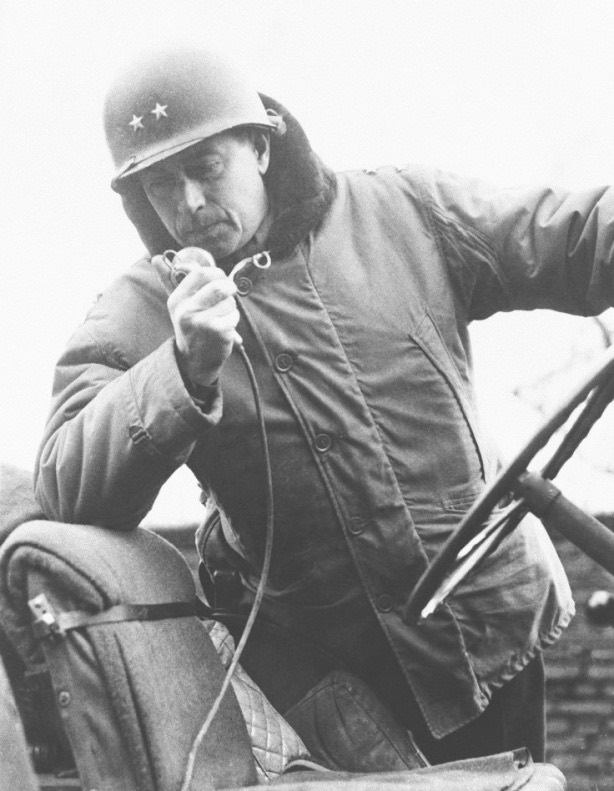
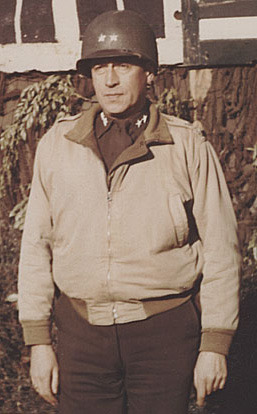
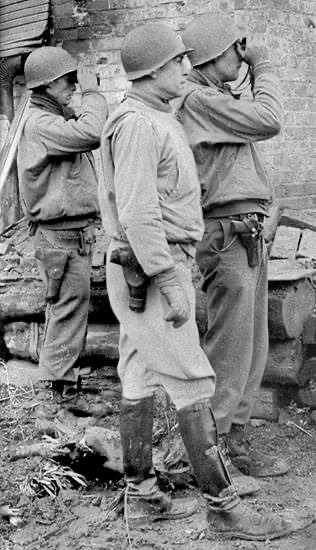
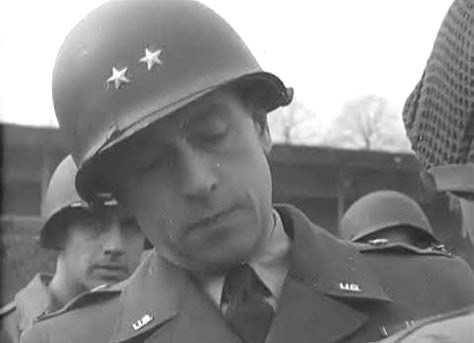
General Rose, the front line battlefield commander, in action
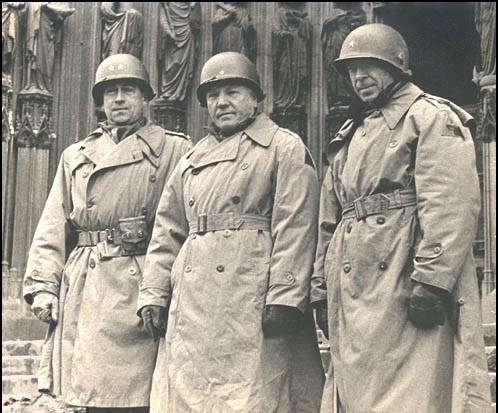
Major General Rose and his two brigadier general combat commanders
at ruins of Cologne Cathedral
At age 17, Maurice Rose enlisted in the Army and was selected for Officer Candidate School. Commissioned as a 2/Lt, he saw combat and was wounded in WWI. Rose returned from the war as a captain in 1919 and after a short stint in civilian life as a salesman, rejoined the army in 1920 as an infantry officer. During the interwar period, he languished in grade as a captain for 16 years as did many of his contemporaries.
In 1930 he joined the Cavalry Branch as part of the Army's first attempt to create a mechanized force, allowing him to master the theory and practice of armored warfare. In 1940, as the blitzkrieg war in Europe raged, Major Rose was one of the first few officers selected to join the newly formed Armored Force, and hence was on the ground floor in the formation and manning of the first armored divisions -- 1st and 2nd Armored, in each of which he would play key roles during WWII. His demonstrated prowess and growing reputation as a highly competent armored officer led to two promotions within a little more than a year, and by January 1942, Colonel Rose was Chief of Staff of General George Patton's 2nd Armored Division before it was deployed overseas in January 1942. Patton selected Rose from more than fifty lieutenant colonels and promoted him to Colonel. He then held leadership positions with the 1st Armored Division in North Africa and the 2nd Armored Division in Sicily.
Promoted to brigadier general in May, 1943 just before the invasion of Sicily, his Combat Command A was the first allied unit to enter Palermo, giving George Patton bragging rights over British General Montgomery. Rose's elevation to general officer by Army Chief of Staff General George Marshall was heartily supported by Eisenhower and Bradley. Rose had distinguished himself in Tunisia as 1st Armored Chief of Staff by negotiating and accepting the surrender of the Afrika Korps – the first large scale Nazi unconditional surrender to an American in WWII.
Following the successful Sicily operation, General Rose and his Combat Command A headed to England as the 2nd Armored's advance party in planning and preparing for the division's Overlord landing on D-Day in 1944. And in fact, Rose organized and orchestrated the landing of the 2nd Armored on Omaha Beach on June 9, 1944. But his combat fame on the continent was just beginning. Four days later, his Combat Command A was instrumental in holding the crucial beachhead position at Carentan, thus preventing allied airborne troops from being overrun by German tanks. Post-war captured German documents revealed that this action may very well have saved the entire Normandy beachhead from a catastrophic Nazi counterattack.
The Ossad book brings out an interesting and little known sidelight regarding Rose's participation in the Carentan operation. It wasn't revealed until 25 years after Rose's death and the end of the war that he had a close connection with "Ultra" intelligence. Allied cryptographers furnished the crucial "Ultra" signals intelligence which enabled him to position his Combat Command A of 2nd Armored to block Nazi Panzer units from the beachhead. Later, as commander of the 3rd Armored, he was able to do the same thing at the Battle of Mons. Thus, General Rose was one of the very first Allied commanders to effectively exploit "Ultra" intercepts for his tactical advantage against the enemy.
Even more impressive than his performance at Carentan was the fact that Rose's aggressive moves resulted in the first successful breakout from Normandy as part of Operation Cobra. Combat Command A's daring breakthrough of German defenses caused the senior American commanders – Generals Bradley, Hodges and Collins – to change their plans and send all U.S. forces south immediately...thus beginning the rapid drive through France and Belgium and into the Third Reich itself.
As a result of his formidable successes with Combat Command A of 2nd Armored and the frustrating lack of aggressiveness on the part of the 3rd Armored Division commander, Rose was given command of the 3rd Armored and promoted to Major General in early August, 1944. Shortly after assuming command, he himself gave the division its famous nickname "Spearhead" – which reflected his own spirit, character and combat modus operandi.
It was no surprise that General Patton chose Maurice Rose as his Chief of Staff of the 2nd Armored Division - Rose was Patton's kind of combat general, audaciously aggressive and always leading from the front. And for Rose's part, he absorbed and employed Patton's aggressive offensive "shock and surprise" approach to battle by employing a brilliant ahead-of-its time combined arms strategy (armor, infantry, artillery, close air support, and timely reconnaissance/intelligence). Patton's modus operandi was to: (1) Use armor as the lead battle force followed by infantry; (2) Hit the enemy's weak spots rather than attack his strength; and (3) Employ decentralized command and control with maximum individual initiative – all of which serve to keep the enemy off balance. These tactics contradicted army doctrine and ran counter to the overly cautious strategy employed by Eisenhower, Bradley, Montgomery, and most other combat generals in the European theater. (Much of this paragraph is a repeat of a paragraph on Patton in Chapter 1)
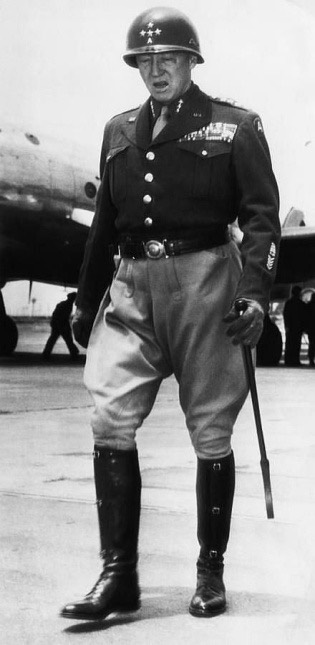
Rose's mentor – the indomitable General George Patton
As only a general officer who has commanded units at the division and corps level could do, General Bolger in his book THE PANZER KILLERS, provides a number of useful insights into Maurice Rose's continuing battlefield successes. Rose demanded "violent action" on the part of his subordinate commanders, and always went to the scene of the action, witnessing key fire fights at crucial locations and intervening when required to make things happen. He typically arose at 4:00 AM to begin each day, and then spent most of the day in his peep going from firefight to firefight and interacting with his two principal Combat Commanders and their subordinate task forces, especially the lead ones. Rose charged his 83rd Armored Recon battalion to constantly scout forward, and relied on their feedback. Being the aggressive combat commander that he was, he took calculated risks such as crossing possibly mined bridges. Rose himself believed that the 3rd Armored was successful against superior and larger forces because it always attacked instead of just defending. According to Bolger, the outfit that made the First Army successful was Collins' 7th Corps, and the outfit that Collins relied on to carry the heaviest load was Maurice Rose's 3rd Armored Division. With the Division that was always the "spearhead" of any major 7th Corps offensive as its motto suggested, Rose had to constantly manage the high attrition rate of company grade officers and key sergeants, and juggle supply shortage compromises among all units.
General Bolger made the observation that most American generals – including Ike, Bradley and Hodges – ran the war from their command posts, and led through their staff officers passing on orders and receiving battlefield inputs. Those generals tended to be "map readers", and directed the battle accordingly. A minority – including Patton, Collins, and Rose – worked through their subordinate commanders, not the staffs. These generals relied on personal supervision of the battlefield, and their successes spoke for themselves.
The U.S. Sherman tanks were decidedly inferior to the German Panzers and Tigers in terms of firepower and impenetrability. To compensate, U.S. Armored commanders had to rely on air support and artillery as well as maneuver. Rose was a master in employing this combined arms capability. The two advantages U.S. armored forces had were the robustness and easier maintainability of the equipment (which meant less downtime), and superior tank crews, particularly in the later stages of the war with the Wehrmacht losses on the Eastern Front. The German tanks suffered from faulty transmissions, lack of spare parts and lack of standardization.
By the time of Rose's untimely death, "Lightning Joe" Collins considered him "the top armored commander in the army."
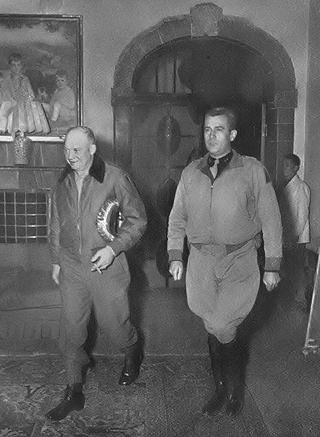
![C:\Users\user\Desktop\WWII stuff\Gen_Rose_Eisenhower[1].jpg](assets/image23.jpeg)
Ike with Maurice Rose
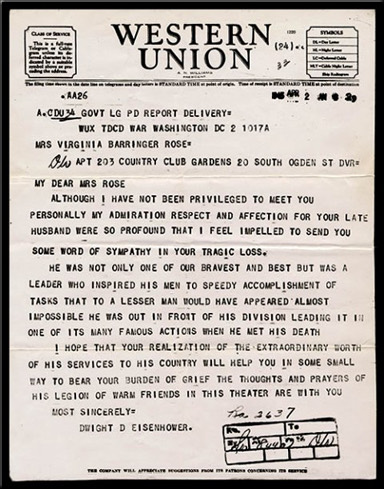
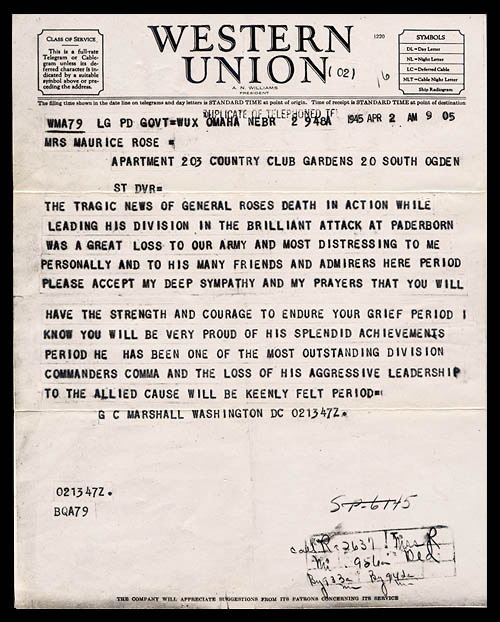
It goes without saying that WWII was replete with countless numbers of tragedies, but from the standpoint of the U.S. Army, none was more tragic and far-reaching than the untimely death of General Maurice Rose who was widely acclaimed as the top division commander in the Army at the time. Rose was idolized by his men, and in the eyes of his superiors and peers, he was destined for bigger things after the war since he was only 45 years old when he died. Although fate intervened, it is easy to see him in the mind's eye as a four-star general....perhaps Supreme Allied Commander Europe or even Army Chief of Staff.
The following telegrams to Mrs. Rose from General of the Army Dwight D. Eisenhower, Supreme Allied Commander Allied Expeditionary Forces, and Ike's boss, General of the Army George C. Marshall, Army Chief of Staff, say it all about General Maurice Rose:
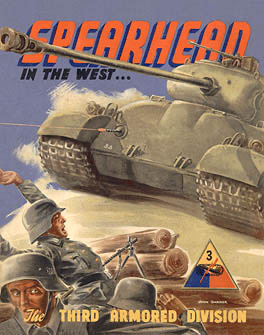
An excerpt from the frontispiece of the official 3rd Armored Division book chronicling its actions in WWII, SPEARHEAD IN THE WEST 1941-4, perfectly sums up Maurice Rose:
"During WWII, General Rose served with the three greatest of American armored divisions; in Africa and Italy with the 1st, "Old Ironsides", and the 2nd, "Hell on Wheels"; finally, throughout the climactic western European campaigns, at the head of his own 3rd Armored Division, the organization he claimed to be the greatest tank force in the world and one worthy of the sobriquet: "Spearhead." He was over six feet tall, erect, dark haired, and had finely chiseled features. He was firm and prompt of decision, brooking no interference by man, events, or conditions in order to destroy the enemy. No armchair strategist, General Rose directed operations from a peep [post-war commonly referred to as jeep] at the point of the cutting edge. He traveled with the forward elements of his command, up with the tankers and the blitz-doughs [short for blitzkrieg doughboys - the lead armored infantry]. General Rose went up front, and that's where he was on a dark evening in late March, 1945. He was killed in action at the head of his men."
Interestingly enough, the author's cousin, 2/Lt David Hummel, was a platoon leader in the 3rd Armored Division; he was in the famed 36th Armored Infantry Regiment which was the tip of General Rose's Spearhead, and was the unit for which the term "blitz-doughs" was coined. Lt. Hummel was severely wounded in action and died of his wounds on September 10, 1944 near the Belgian-German border. Researching David Hummel's 3rd Armored combat trail and death led me to "discover" the real story of the magnificent General Rose....a true military legend!
The following excerpt from p. 237 of the Ossad book caught my attention: "On September 9, as they neared the city of Verviers, General Rose again moved to the point of the most intense action, this time in full view of the enemy. In spite of extremely heavy mortar fire, he took the command group to a position on the forward slope of a hill. The shells followed his movement and one landed nearby, killing one officer and wounding four other men. After assisting in the evacuation of the wounded, he went back to the hill where he could best observe the action. For these and other actions, Maurice Rose was awarded Distinguished Service Cross, the nation's second highest decoration for bravery."
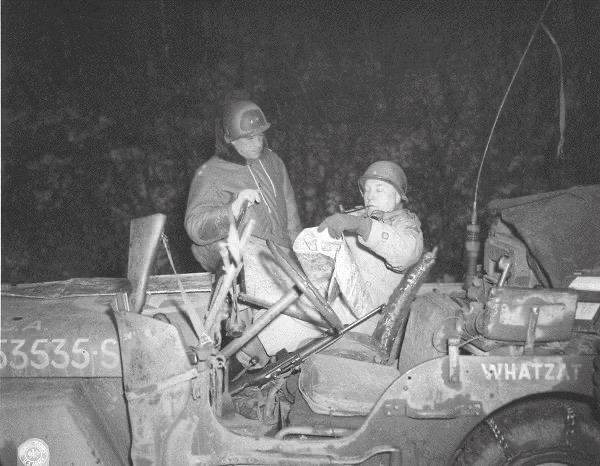
The Bolger book on p. 135 corroborates this account and adds more details, leading me to believe that Lt. David Hummel, who was wounded on September 9, and died of his wounds the next day, was one of those men hit in the mortar attack. Chapter III tells Lt. Hummel's story.
In WWII, the U.S. Army fielded 15 Armored Divisions in the European Theater. General Bolger, a former senior combat commander himself, in his 2021 article in the Military History Now online magazine, perfectly summed up the singular role of the 3rd Armored Division and its leader Maurice Rose:
"The 3rd Armored Division advanced all the way from the Normandy beaches to the heart of Germany. In 231 days of combat, they’d lost 2,540 soldiers killed and 7,331 wounded with 632 Sherman tanks destroyed — more than any other American armored division. They’d also taken 76,720 German prisoners and inflicted an unknown number of casualties on their foe. In all the big battles, the 3rd had been right there.
Major General Maurice Rose didn’t get to attend any VE-Day celebrations. In his characteristic manner, after dark on Good Friday, March 30, 1945, he was out front in a jeep when a wrong turn brought him face to face with a Waffen SS Tiger II tank. The enemy tank commander aimed his burp gun and killed Rose with one long burst. To the very end, he led from the front. His soldiers responded accordingly. In that regard, too, the Spearhead Division was unique.
Like their fallen commander, the division didn’t seek publicity; they had a war to fight. And fight they did. That’s why the 3rd Armored Division was the best in the West."
(A shorter version of this article was published in ARMY magazine, February 2020)
KEY SOURCE DOCUMENTS ON MAURICE ROSE
Spearhead in the West 1941-45, official book of the 3rd Armored Division in World War II, Frankfurt am Main, 1945.
3rd Armored Division History Foundation website (https://www.3ad.com).
3rd Armored Division Memorial Group website (www.36air-ad.com).
3rd Armored Division Association Archives at the University of Illinois (http://archives.library.illinois.edu/guides/3rdarmor/).
THE PANZER KILLERS, by Daniel P. Bolger, CALIBER, 2021 (The definitive combat biography on Maurice Rose to date).
Major General Maurice Rose - World War II's Greatest Forgotten Commander, by Steven L. Ossad and Don R. Marsh, Cooper Square Press, New York, 2003.
The Wartime Journal of Major General Maurice Rose, Xlibris Corp., 2004 (A fictional account of Rose's command of 3rd Armored).
Major General Maurice Rose - The Most Decorated Battlefield Commander in U.S. Military History, by Marshall Fogel, Frederic Printing, Aurora, Colorado, 2018 (A comprehensive view of Rose's life from the perspective of his Denver hometown and Jewish upbringing; contains many written tributes and excellent graphics).
Spearhead” – How the U.S. Army’s 3rd Armored Division Led the Allies to Victory in Western Europe, by Lt. General Daniel Bolger, MilitaryHistoryNow.com magazine, June 10, 2021.
SPEARHEAD, by Adam Makos, Ballantine Books, New York, 2019 (A gripping account of combat in 3rd Armored under Maurice Rose from the perspective of the Division's tankers and infantrymen).
Contents of a WWII Footlocker: A Memoir of the U.S. Army Third Armored Division, Colonel Oliver Brackman posthumously and Edit Nadine Brackman, Outskirts Press, Inc., 2019.
CHAPTER III
2/LT. DAVID W. HUMMEL, ARMORED INFANTRY
Unfulfilled hopes and dreams
![C:\Users\user\Desktop\WWII stuff\David Hummel\Purple-Heart-768x1024[1].jpg](assets/image31.jpeg)
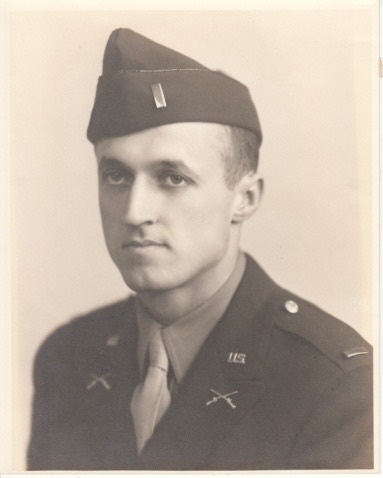
My first cousin David Hummel was a typical young American who answered the call of duty in WWII, and like many of his contemporaries tragically lost his life before ever having an opportunity to lead a "normal" life with a wife, family, and home of his own. In this sense, he is a typical unknown and unsung hero of the "greatest generation."
David W. Hummel of Joliet, Illinois, two generations removed from his German cousins, was a star high school scholar and athlete. He enlisted in the U.S. Army in June, 1942, and was subsequently selected to attend Officer's Candidate School in Ft. Benning, Georgia. Upon completion of OCS training, he was commissioned as 2/Lt. Infantry, on January 15, 1944. Lt. Hummel was assigned as a squad leader to the 36th Armored Infantry Regiment (2nd Battalion, Company E), a key part of the famed "heavy" 3rd Armored Division ("Spearhead"). The 36th Armored Infantry Regiment became known as the "blitz-doughs" -- a short form of "blitzkrieg doughboys." Following the D-Day invasion on June 6, 1944, the Regiment landed in France on June 25 -- the first sizeable 3rd Armored Division unit in France. Over the next three months, the Spearhead Division, a key component of the First U.S. Army's crack VII Corps, advanced rapidly through France and Belgium. By September, the Division, then led by legendary armored commander and Patton protege Major General Maurice Rose, was poised to cross into Germany and penetrate the heavily defended Siegfried Line. The 36th Armored Infantry Regiment was attached to Combat Command B, General Rose's "tip of the Spearhead" in that penetration.
In early September 1944, Lt. Hummel was promoted to platoon leader. On September 7, he was involved in a well-publicized event. Lt. General Konrad Heinrich, commander of the 89th German Infantry Division, was killed by troops of Lt. Hummel's platoon near Liege, Belgium, as he attempted to drive through a roadblock in a sporty convertible cabriolet. Lt. Hummel inspected the body and found a photo of a young woman, presumably the general’s daughter or girlfriend (see photo below). Lt. Hummel sent that photo home to his family.
At that time, Lt. Hummel’s 2nd battalion, 36th Armored Infantry Regiment, was attached to Combat Command B, which accompanied MG Rose on the way to Verviers, Belgium on September 9 preparing for the assault on the Siegfried Line. That afternoon near Verviers, about 17 miles from the German border, the group came under heavy fire from German panzers, kicking off an intense firefight, with General Rose right in the thick of the action along with several of his staff officers. According to General Bolger's book, THE PANZER KILLERS (cited in Chapter II), at 5:45 PM a batch of German mortar projectiles landed almost on top of the officers, with red-hot metal shards killing a captain and “cutting up (Lt. Colonel) Garton and three others.” I believe it is almost certain that one of the “others” was Lt. Hummel, who died of his wounds the next day, September 10, as Army records show.
Only two days later Combat Command B, with Hummel's platoon, entered Nazi Germany (the first allied force to do so) and the first to capture and occupy a German town (Roetgen). On September 15, the platoon was part of a Task Force that penetrated the supposedly impregnable Siegfried Line, and by the end of the day had established the first significant allied bridgehead behind that formidable defense barrier. Tragically, General Rose was killed in action by a trigger-happy Tiger tank commander on March 30, 1945 while trying to locate a forward unit that had been cut off by German Panzer tanks -- the senior Allied officer killed by enemy fire in WWII. The war in Europe would be over in five weeks.
Lt. Hummel was awarded the Purple Heart posthumously. His parents also received a citation signed by President Roosevelt, which reads:
IN GRATEFUL MEMORY OF
SECOND LIEUTENANT DAVID W. HUMMEL, A.S. # O-1325818,
WHO DIED IN THE SERVICE OF HIS COUNTRY
IN THE EUROPEAN AREA, SEPTEMBER 10, 1944.
HE STANDS IN THE UNBROKEN LINE OF PATRIOTS WHO HAVE DARED TO DIE
THAT FREEDOM MIGHT LIVE, AND GROW, AND INCREASE ITS BLESSINGS.
FREEDOM LIVES, AND THROUGH IT HE LIVES –
IN A WAY THAT HUMBLES THE UNDERTAKINGS OF MOST MEN.
//Signed//
Franklin D. Roosevelt
President of the United States of America
![C:\Users\user\Desktop\WWII stuff\David Hummel\fig11[1].jpg](assets/image32.jpeg)
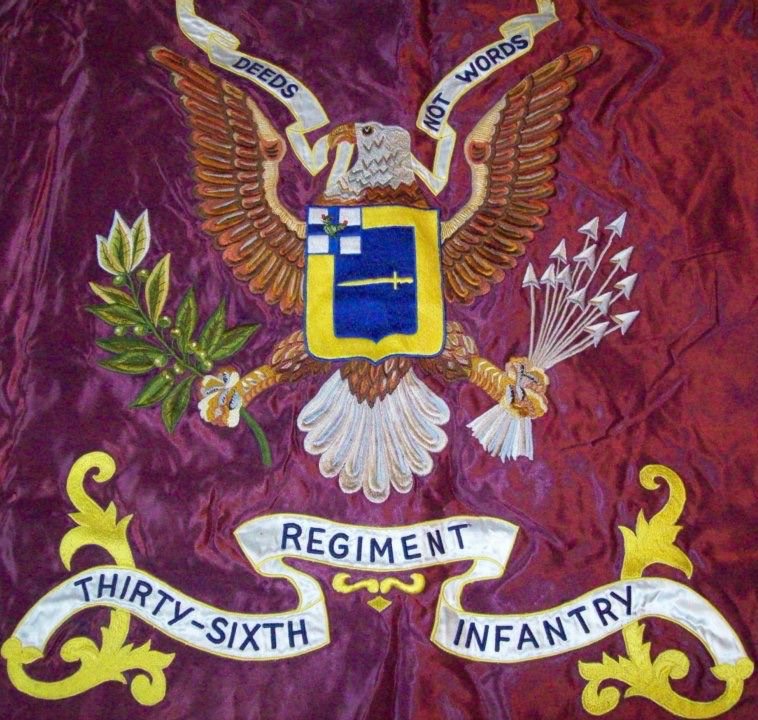
3rdAD Shoulder Patch 36th Armored Infantry Regiment
![C:\Users\user\Desktop\WWII stuff\David Hummel\3ad.landing.road[1].jpg](assets/image34.jpeg)
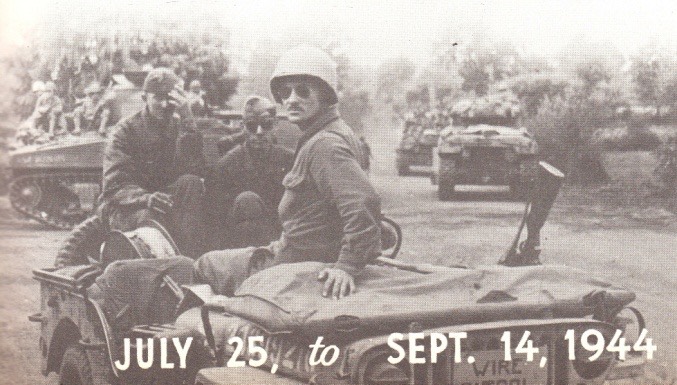
3rd AD tanks landing Jun 1944 3rd AD in France & Belgium Jul-Sep 1944
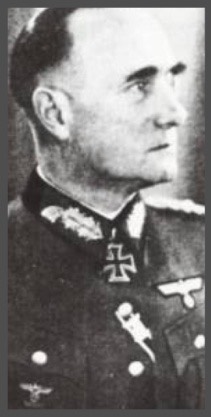
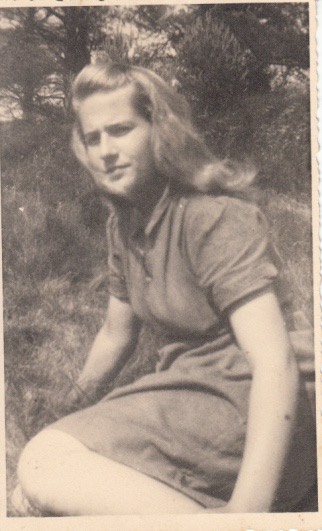
German Lt. General Konrad Heinrich, who was killed by soldiers of
Lt. Hummel’s platoon on Sep 7 1944 and photo found on him
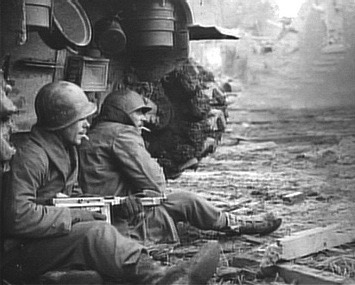
Two soldiers of 36th Armored Infantry Regiment used as opening graphic
in Ken Burns' acclaimed documentary "The War"
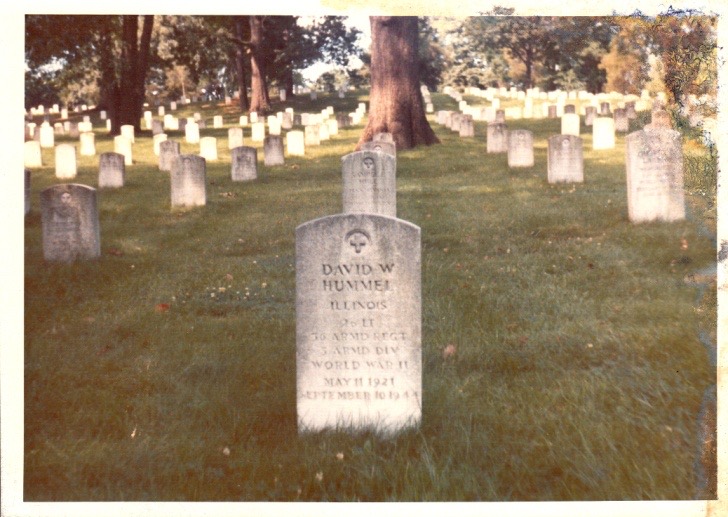
Arlington National Cemetery
Grave of 2/Lt. David W. Hummel, May 11, 1921-Sep 10, 1944
As a postscript, Lt. Hummel's 36th Armored Infantry Regiment faced many heavy combat situations throughout his tour of duty, and had a very high attrition rate of company grade officers (lieutenants and captains). Thus, even if he had survived his September 9, 1944 wounds, his chances of making to the end of the war in early May 1945 were not good, as the 3rd Armored penetrated deep into the heart of the Fatherland. In an email to me, General Bolger, author of THE PANZER KILLERS, said:
"Your first cousin's outfit was in the middle of several key actions. And you are sure right about the 36th Armored Infantry Regiment. They paid a high price in many engagements." This is an apt tribute to the Regiment's motto: Deeds, not words."
CHAPTER IV
GENERAL MARSHALL AND THE COMBINED CHIEFS OF STAFF VISIT TO COLONIAL WILLIAMSBURG, 1943
There is a very interesting and little known story involving George Marshall and the Combined Chiefs of Staff at the Trident Conference in Washington in May, 1943. That conference was intended to sort out the options for the allied war strategy going forward, including plans for a cross channel invasion. The first several days of the conference led to considerable acrimony between the U.S. and British chiefs, and Marshall came up with the brilliant idea of taking a weekend break to visit Colonial Williamsburg -- at one time the center of British power in North America. The visit turned out to be an unqualified success, and when the group returned to Washington to continue the conference, they were able to reach some consensus decisions which were presented to President Roosevelt and Prime Minister Churchill.
Fast forward to 2015 when my daughter was an apprentice harpsichord maker in the Historic Trades at Colonial Williamsburg (CW). During one of my visits, at the Williamsburg Inn I chanced upon a photo of George Marshall with other high ranking U.S. and British officers at CW, and recognized that some of the names and faces didn't match. I took a photo of the picture and when I got back home, did some research to find the correct identification of the principals. In doing so I discovered the reason for the photo, and was surprised to learn that virtually no account of that visit existed in the public domain. I did find a few books that mentioned the visit but provided few details. I then wrote the following article on the visit, including a proper caption for the photo, and forwarded it along with a letter of explanation to CW; that triggered a chain of events which ultimately resulted in the publication of an article in the CW magazine on the 1943 visit, which included a reference to my role in the process., beginning with the discovery of that old photo. (See "An Untold Story" in the Appendix).
Not only did CW have a large forgotten-about file on the visit, but I later learned that the Marshall Museum library archives in Arlington, VA also contain a detailed War Department report of that visit. Unfortunately, when the following article was written in 2015, I did not know about the existence of either of those files with the additional details....but at least now all the dots have been connected!
Combined Chiefs of Staff Gathering at Colonial Williamsburg,
May 15-16, 1943
The Trident Conference in Washington D.C. in May, 1943, the third Allied Conference during WWII, was a key event in determining global strategies for the balance of the war. President Roosevelt and Prime Minister Churchill met with the Combined Chiefs of Staff over a thirteen day period (May 12-24). The principal attendees, with their ranks at the time, were:
General (later General of the Army) George Marshall, U.S. Army Chief of Staff
Admiral (later Fleet Admiral) Ernest King, C-in-C, U.S. Fleet, and CNO
General (later General of the Air Force) Hap Arnold, Commanding General, U.S. Army Air Forces (who missed the Conference while recuperating from a heart attack)
Admiral (later Fleet Admiral) William Leahy, senior military advisor to the President, and Chairman of the U.S. Joint Chiefs of Staff
Lt. General (later General) Joseph McNarney, U.S. Army Deputy Chief of Staff
Field Marshal Sir John Dill, personal representative of the Prime Minister and the British Joint Chiefs of Staff in Washington
General (later Field Marshal) Sir Alan Brooke, Chief, Imperial General Staff
Admiral of the Fleet Sir Dudley Pound, First Sea Lord
Air Chief Marshal Sir Charles Portal, Chief of Staff, Royal Air Force
Lt. General (later General) Sir Hastings Ismay, Chief of Staff to The Minister of Defence (Churchill wearing his second hat)
Field Marshal Sir Archibald Wavell, C-in-C, British Army in India (later Viceroy of India)
Air Chief Marshal Sir Richard Peirse, C-in-C, RAF in India
Admiral (later Admiral of the Fleet) Sir James Somerville, C-in-C, Eastern Fleet, Royal Navy
At issue were a number of major strategic decisions, including the timing of a cross-channel invasion of France, the next steps in the Mediterranean following the allied invasion of North Africa and Sicily, and the nature and extent of further combat operations in the Pacific theater versus the European theater. After three days of intense discussions filled with mutual acrimony and distrust -- fueled by different national perspectives and points of view -- the American and British chiefs were unable to reach any agreements on these issues. To clear the tension in the air, General Marshall had a bright idea for a welcome respite -- he would take the group to Colonial Williamsburg for a weekend of sightseeing and rest & relaxation. Those who accepted General Marshall's invitation were the three British service chiefs and the three British Eastern Theater C-in-Cs, along with Generals Marshall and McNarney. Field Marshal Dill and General Arnold were ill and couldn't make the trip. Admirals King and Leahy also remained in Washington. (See photo of party visiting Colonial Williamsburg, below).
Flying into Langley field in Virginia on Saturday morning, the chiefs took two cars for the 30 mile drive to Williamsburg -- stopping along the way on Route17 to visit the Victory Monument at Yorktown, commemorating Cornwallis' surrender to Washington in 1781. General Marshall drew laughs when he remarked that he hoped the British were here now on a peaceful mission!
Upon arrival at Colonial Williamsburg, once the capital of the most important British colony in the world, the party checked into the famous Williamsburg Inn, built by John D. Rockefeller Jr. in 1936. At the time of this visit, the Inn was reserved for Army and Navy commissioned officers and their families -- a policy which was instituted in June, 1942, and continued to the end of the war. General Marshall purposely stayed in the rather unpretentious Room 212, while his counterpart, General Brooke was assigned to Room 215 down the hall. After settling in, the party proceeded to the Capitol and then walked down the Duke of Gloucester Street taking in all the sights and the stares of tourists. Following a stop for tea at the Raleigh Tavern, the group continued on to the Magazine, and then returned to the Inn. Before dinner, several British officers went for a swim at the Spa Pool (with Air Marshal Portal momentarily losing his overlarge borrowed swim trunks on a dive), while others played croquet on the back lawn at the Inn; this was followed by a round of Mint Juleps in the lobby. General Brooke, an ardent bird watcher, was in his element throughout the visit.
Dinner at the Inn on Saturday evening was a carefully orchestrated event. A 13-man round table was specially built for the occasion, and Rockefeller's butler flew down from New York to supervise the food and service....bringing a supply of fresh cream from the Rockefeller family estate. The gourmet repast was especially appreciated by the British chiefs, who had lived with food rationing for over two years. Crabmeat cocktail was followed by Terrapin ala Maryland, fried chicken in cream gravy, fresh asparagus, Virginia ham, Canadian cheddar, fresh fruit, and strawberry ice cream for dessert. One of General Marshall's staff came from Washington with a stock of bourbon for the Mint Juleps, which were served in silver goblets. After dinner the party adjourned to the drawing room for coffee and brandy. At 11:00 PM, General Marshall escorted the group to the Governor's Palace, where he suggested they put themselves in the mindset of the pre-revolutionary period when the Royal Governor was the most important British personage in North America; the British guests were extremely impressed with the period furnishings of the Palace. After they rescued poor Admiral Pound who got lost in the maze on the palace grounds, General Marshall entertained the party by playing "Poor Butterfly" on a period harpsichord -- which came from the collection of antique keyboard instruments at Colonial Williamsburg; these instruments are still being produced in the 18th century manner at the Cabinetmaker's Shop.
Sunday morning began with ham and eggs on the Inn terrace, followed by morning services at the Bruton Parish Church. Admiral Pound read the lesson (Matthew, verses 19-34) from a bible donated by King Edward VII in 1907 on the occasion of the 300th anniversary of the founding of the Episcopal church in America. Mid-morning, Generals Marshal and Brooke were summoned to fly back to Shangri-La in Maryland (now Camp David) to meet with the President and Prime Minister. The rest of the party took Sunday luncheon at the Inn, featuring lobster salad, Virginia ham, cold roast turkey, and crabflake souffle. With the pleasant weekend drawing to a close, the chiefs took the 160 mile flight from Langley back to Washington for a 5:30 PM meeting to continue deliberations at the Trident Conference.
During the last nine days of the Conference, the chiefs reached momentous compromises: a cross-channel invasion of France (Roundup renamed Overlord) by May 1, 1944; an intensified combined bomber campaign against Germany; in the Mediterranean Theater, the invasion of Sicily as the follow-up to North African operations, although a decision on the subsequent invasion of the Italian mainland was deferred; and in the Pacific theater, a central pacific island-hopping thrust moving westward capturing islands to support naval and air operations against Japan, and an expanded air supply corridor from India across the Himalayas into China. The results were presented to FDR and Churchill, and they approved. One can speculate as to whether or not the camaraderie enjoyed at Colonial Williamsburg had any impact on this conclusive decision-making process!
It is interesting to note that this Colonial Williamsburg visit by the Combined Chiefs is lost in the mists of WWII history -- it doesn't even come up on Google!
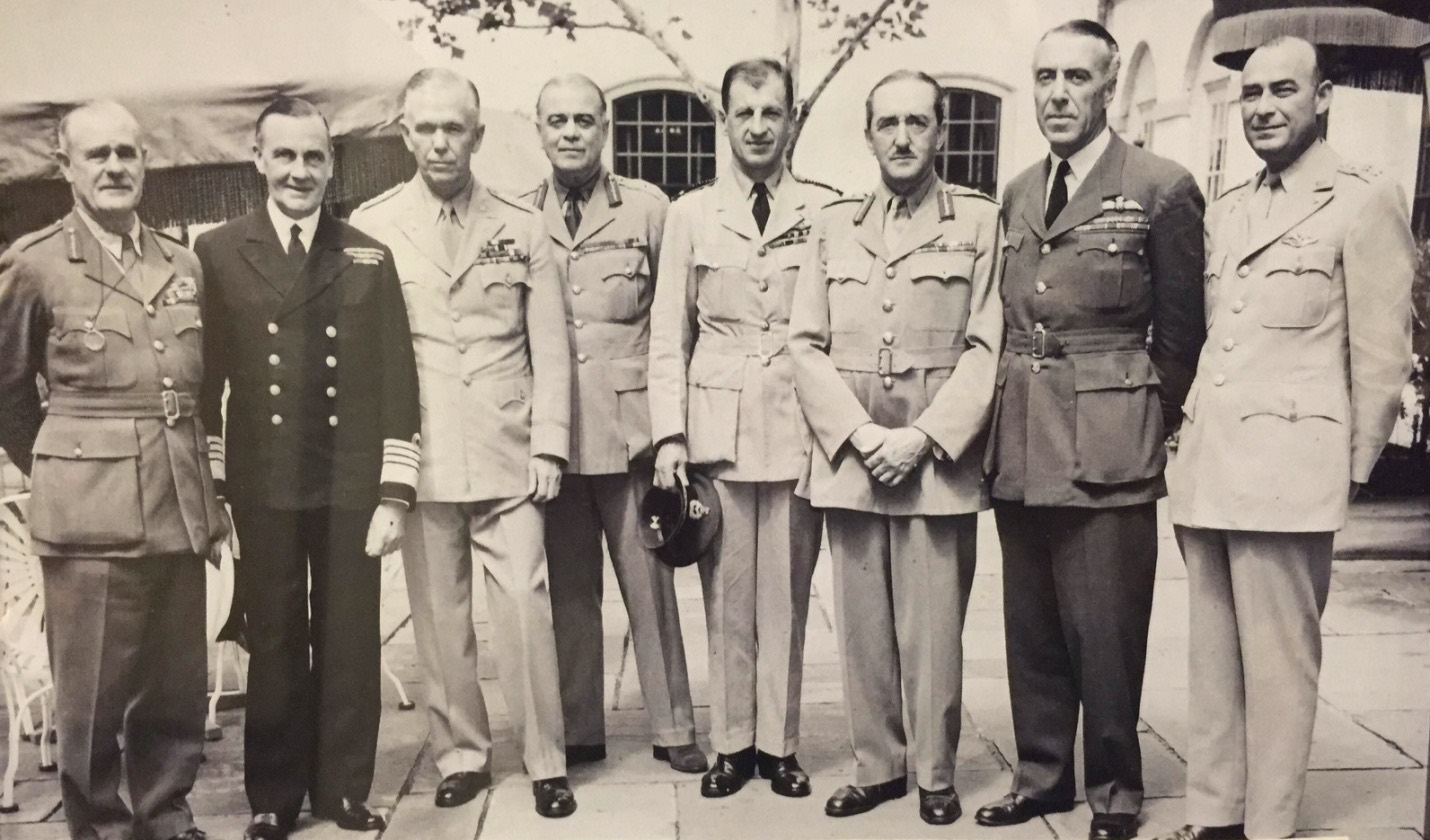
May 15-16, 1943
General George Marshall entertained the British Chiefs of Staff as they planned for D-Day
Left to right, Field Marshal Sir Archibald Wavell, C-in-C, British Army in India (later Viceroy of India); Admiral Sir James Somerville, C-in-C, Eastern Fleet, Royal Navy; General George Marshall, U.S. Army Chief of Staff; Lt. General Sir Hastings Ismay, Chief of Staff to The Minister of Defence (Churchill wearing his second hat); Air Chief Marshal Sir Charles Portal, Chief of Staff, Royal Air Force (RAF); General Sir Alan Brooke, Chief of the Imperial General Staff; Air Chief Marshal Sir Richard Peirse, C-in-C, RAF in India; Lt. General Joseph McNarney, U.S. Army Deputy Chief of Staff
Sources:
American Warlords, by Jonathan W. Jordan, pp. 356-373
Masters and Commanders, by Andrew Roberts, pp. 256-265
Roosevelt and Marshall, by Thomas Parish, p. 351
www.britishmilitaryhistory.co.uk/ (author and webmaster Rob Palmer)
WWII files of Col. David J. Cade
Colonel David J. Cade, USAF (ret.), December, 2015
APPENDIX
NOTABLE TRIBUTES TO GEORGE MARSHALL
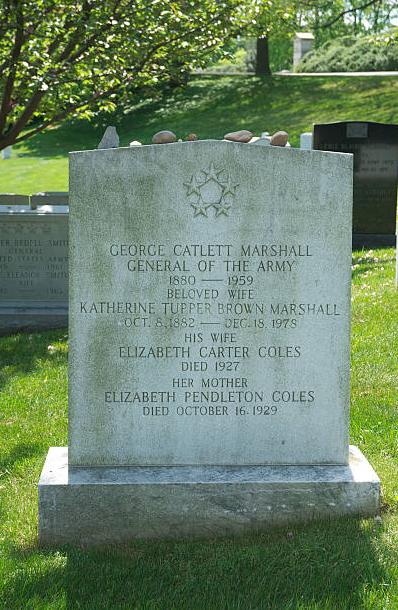
Upon hearing of Marshall’s death former President Truman stated: "Honor has no modifying adjectives. A man has it or he hasn’t. General Marshall had it. Truth has no qualifying words to be attached to it. A man either tells the truth or he doesn’t. General Marshall was the exemplification of a man of truth. Ability can be qualified. Some of us have a little of it and many have moderate ability, some men have it to the extreme. General Marshall was a man of the greatest ability … He was a man of honor, a man of truth, and a man of greatest ability. He was the greatest of the great in our time. I sincerely hope that when it comes my time to cross the great river, General Marshall will place me on his staff so that I may try to do for him what he did for me." (The George C. Marshall Foundation).
After Marshall’s death, Winston Churchill said in tribute: "Succeeding generations must not be allowed to forget his achievements and his example." (The George C. Marshall Foundation).
Omar Bradley said this about Marshall, his boss' boss: "The most impressive man I ever knew, one of the greatest military minds the world has ever produced.....In the army we often scoff at the myth of the indispensable man, for we have always maintained that Arlington Cemetery is filled with indispensable men. General Marshall, however, was an exception, for if ever a man was indispensable in a time of national crisis, he was that man." (A General's life: An Autobiography by General of the Army Omar N. Bradley and Clair Blair, 1983)
“All the big men of the age – Ike, Roosevelt, Churchill, Truman, Stalin, Patton, Bradley – thought George C. Marshall was the greatest man they ever met.” (Stephen E. Ambrose, author of D-Day and Citizen Soldiers, in reviewing General of the Army George C. Marshall, Soldier and Statesman, by Ed Cray, 1990).
By 1941, Marshall "....had become the most powerful figure in the government after the president himself. No soldier since George Washington commanded such political influence and public respect as did this soldier of sober optimism." (Ed Cray book, 1990).
As the global war progressed, FDR ceded increasing authority to General Marshall to manage the U.S. role in the conflict. By early 1944, "President Roosevelt no longer concerned himself with military questions.....Roosevelt had effectively placed global strategy in Marshall's hands....Allied strategy would henceforth be settled by the British Prime Minister and the American Chief of Staff." (Ed Cray book)
“…an American to whom Freedom owes an enduring debt of gratitude, a soldier and statesman whose ability and character brook only one comparison in the history of this nation.” (Harvard President James B. Conant in presenting an honorary doctorate degree to General of the Army and Secretary of State George Catlett Marshall, June 5, 1947, comparing him to George Washington)
“Marshall never got around to writing his own autobiography….It was a mistake for him, I think, to neglect to tell his story because it has created a gap in U.S. contemporary history and deprived modern Americans of knowledge of the facts about one of their greatest men – probably the greatest man since Lincoln.” (Leonard Mosley, author of Marshall: Hero for our Times, 1982)
In naming him Man of the Year for 1943, Time magazine said: "The U.S. people have learned they can trust General Marshall more than they have trusted any military man since George Washington." Four years later as Secretary of State and father of the Marshall Plan, he would be named Time's Man of the Year again for 1947.
In May, 1945, with the Allies victorious in Europe, Churchill wrote to Marshall: "There was no one whose good opinion at the end of the struggle I value more than yours. It has not fallen to your lot to command the great armies. You have had to create them, organize them, and inspire them. Under your guiding hand the mighty and valiant formations which have swept across France and Germany were brought into being and perfected in an amazing space of time...." (Ed Cray book)
At a birthday dinner for Truman in May, 1948, after a glowing tribute paid to him by Marshall, the obviously moved President "gestured toward Marshall and said simply: 'He won the war.' "(David Roll book)
Following Marshall's departure at State, Dean Acheson, his deputy and then successor wrote: "To say what makes greatness is very difficult. But when one is close to it one knows. Twice in my life it has happened to me. Once with Justice Holmes and once with you. Greatness is a quality of character and is not the result of circumstances. It has to do with grandeur and completeness of character." (David Roll book)
At the Allied conference in Tehran in November, 1944, Stalin pressed Marshall to take the OVERLORD supreme commander role. Marshall later said Stalin would "stand with his hand on my shoulder" while arguing for OVERLORD and "turning the hose on Churchill." (David Roll book)
On V-E day, May 8, 1945, Secretary of the Army Stimson asked Marshall to come into his adjoining office (between which the door was never closed), and in front of fourteen generals and other high ranking officials turned to him and said: "...and you, Sir, are the finest soldier I have ever known. It is fortunate for the country that we have you in this position because this war cuts deeper into the eternal verities than any other." (David Roll book)
"As chief of staff, Marshall oversaw the army's dramatic transformation from a small constabulary to the world's most powerful military force in six short years. Honorable, direct, and self-disciplined, Marshall possessed the extraordinary organizational and administrative skills that constructing a modern army required. His incisive mind enabled him to spot the weaknesses in any report or presentation and to ask probing questions that got to the heart of the problem. He dominated meetings and conferences with his obvious integrity, clarity in speech, and forceful manner, and used these talents to reach decisions and get things done.....Although Roosevelt was commander in chief of the American military and ultimately responsible for its personnel, he rarely interfered with Marshall's decisions once the United States entered the war." (Stephen R. Taaffee, MARSHALL and His Generals - U.S. ARMY COMMANDERS in World War II, 2011)
THE MARSHALL-MACARTHUR RELATIONSHIP
David Roll's book characterizes the intricate relationship between Marshall and Douglas MacArthur as being often-misunderstood , and states that the two military icons shared more mutual respect than many earlier accounts claimed. However, their interaction did have some rough spots over the years. They first met in 1909 when they were both at Fort Leavenworth - Marshall as an instructor at the Army War College, and MacArthur as a company commander on the post. During WWI, MacArthur distinguished himself as a battlefield commander for which he was promoted to brigadier general, while Marshall became the key planner on General Pershing's staff, and later, Pershing's aide. In the war, the vainglorious MacArthur felt he had been slighted by Pershing's staff on a number of occasions, and of course as the chief operations planner, Marshall was one of the main perceived culprits - and from that time forward, MacArthur carried a grudge.
MacArthur leveraged his decorated war hero status to land a series of post-war promotions, culminating as the four-star general Chief of Staff in 1930, when Marshall was still a Lt. Colonel. In 1933, Marshall was promoted to Colonel, and MacArthur had him transferred to the 33rd Division of the Illinois National Guard in Chicago as an instructor - a demeaning position for someone with Marshall's well known reputation as a key planner in the war and as the officer who had totally revamped the curriculum in Army's Infantry School. MacArthur later told a member of the Army General Staff that Marshall would never be promoted to brigadier general as long as he (MacArthur) was Chief of Staff. As Roosevelt was in the process of selecting a new Army Chief of Staff in 1939, MacArthur lobbied for Marshall's chief competitor.
Marshall, languishing as a field grade officer for 16 years, finally was promoted to brigadier general in 1936, the year MacArthur retired. MacArthur then went to the Philippines as a "hired gun" of the Philippine president to organize and command their armed forces. On September 1,1939, the very day Hitler invaded Poland, Marshall was sworn as Roosevelt's surprise but prescient choice as Army Chief of Staff. As Japan's military aggression intensified, Marshall recalled MacArthur to active duty in July 1941 as the senior Army officer in the Far East.
When the Japanese attacked Manila on the day after Pearl Harbor, MacArthur had not heeded Marshall's prior warning, and his Philippine command was severely damaged, especially his air force - including 18 precious B-17 bombers and 56 fighters destroyed on the ground. This blatant disregard of orders would have been grounds for Marshall to relieve MacArthur, but the Chief of Staff realized that there was no logical replacement as a competent theater commander. Nevertheless, as Roll points out, while Marshall remained deferential toward MacArthur, this episode changed the very nature of the relationship - Marshall was no longer the junior partner, and henceforth would call the shots in terms of which generals would command and which would be relieved in all theaters of the war.
Contrary to widespread belief, Marshall always supported MacArthur as best he could in view of: (1) the Allies "Germany first" strategy; (2) the U.S. Navy's efforts to undercut MacArthur in mounting a separate, second major strategic thrust in the Pacific (proposed as a compromise by Marshall and approved by the Combined Chiefs of Staff and the President); and (3) MacArthur's own frequent intransigence, self-promotion, and rogue operating style. Following MacArthur's arrival in Australia after the surrender of Corregidor, Marshall orchestrated the effort to award MacArthur the Medal of Honor, and personally wrote the citation - principally to give the American people a hero to rally behind in those early dark days of the war.
One known instance when Marshall had to take issue with MacArthur was when he reprimanded him in late 1944 for monopolizing cargo vessels which were needed for operations in other theaters. Both Roosevelt and Truman were leery of MacArthur's penchant for doing things his own way and his well-known political ambitions, and relied on Marshall to keep him in line.
Thus, during the war, Marshall set aside all of the acrimony of the past engendered by MacArthur, proving he was the bigger man. And when the top command leadership received promotions to 5-star grade in 1944, Marshall's date of rank was earlier than MacArthur's - a fitting culmination of the military relationship between the two men.
DAVID CADE EMAIL to KEVIN WILLIAMSON on his ARTICLE LIKE IKE in "NATIONAL REVIEW", MARCH 28, 2017
"Great article, but your characterization of Ike in WWII is somewhat misleading. First of all, he was always junior to and outranked by George Marshall, his mentor and boss, to whom he owed everything, and who orchestrated the global U.S. war effort for FDR. Marshall brought Ike to Washington in 1939, promoted him to Brigadier General, then to Major General, and sent him to Europe to ultimately become Supreme Allied Commander in that theater as a four star General and then as a five star General of the Army. Throughout the war, Marshall kept Ike on a short leash – constantly providing “back channel” guidance, “holding his hand”, bolstering his confidence which flagged from time to time, and encouraging him not to go overboard in meeting British demands at the expense of US war-winning strategies and interests….a facet of Ike’s “political modus operandi” which greatly concerned other senior U.S. military leaders. Moreover, because he placed Ike in a position to become the most famous face of victory in World War II, Marshall was instrumental in ultimately putting Ike into the Oval Office!" D.J. Cade
NOTABLE TRIBUTES TO MAURICE ROSE
GEORGE MARSHAL'S TRIBUTE TO MAURICE ROSE
Intermountain Jewish News, May 31, 1945
"A great soldier, a magnificent fighting leader - In paying tribute to General Rose, we honor the courage, skill and daring leadership which we feel are in the finest tradition of the American soldier. The character and the record of General Rose provided a splendid inspiration for all of us as we turn to the way to the final victory. We must never forget what he did for us, for our honor, for our world. The army is grateful for his great contribution to the honor of our fighting men. In their name, I salute Major General Maurice Rose as a great American Soldier."
LIGHTNING JOE REMEMBERS
THE 3rd ARMORED DIVISION
An excerpt from the autobiography
by
General J. Lawton Collins
(Published in the 3AD Association Newsletter of December, 1987)
"The 3rd Armored Division led off the VII Corps drive on Paderborn with Combat Commands Boudinot and Howze abreast, Boudinot on the right, each CC in two columns, separated by from three to five miles, preceded by the division Reconnaissance Battalion. CC Hickey followed in the center, prepared to assist either flank. General Rose, accompanied by his aide, Major Robert Bellinger, rode in a jeep close behind the leading elements. The artillery commander, Colonel Frederic Brown, and Lieutenant Colonel Wesley A. Sweat, the G-3, in another jeep, and an armored car with radio communications, completed Rose's party.
Boudinot's left task force, commanded by Colonel John C. Welborn, followed closely by General Rose's party, had tried to bypass Paderborn on a secondary road. Dusk was falling when enemy small arms and tank fire cut off Rose's party from Welborn's task force. Rose radioed to CC Hickey, which was following Welborn, to have Task Force Doan come up and clean out this opposition, but before Doan could arrive, four enemy tanks appeared, coming up the road from the south. Rose had Colonel Brown call for artillery fire on them, then led his party in a dash to get by the tanks. Brown succeeded in getting by in his jeep, but one of the tanks suddenly swerved, pinning Rose's jeep against a tree.
The German tank commander motioned with a "Burp" gun to the occupants to dismount with their arms up. They had no alternative. Then he shouted something about 'Pistolen.' Major Bellinger and the jeep driver, Tech. 5 Glen H. Shaunce, who like most officers carried their weapons in shoulder holsters, dropped their holsters without lowering their arms. Rose, who habitually wore a pistol belt, dropped his arms, presumably to remove his belt But the tank commander, evidently thinking that Maurice was reaching for his revolver, fired a stream of bullets at point-blank range. Rose, killed instantly, pitched forward in the dusty road. Bellinger and Shaunce dived for the ditches and in the confusion managed to escape. Colonel Sweat and the crew of the armored car were taken prisoner. The following morning Rose's body was found where he fell, his pistol still in its belt, and the abandoned jeep untouched. The German force had withdrawn without knowing that it had killed a division commander.
Maurice Rose was the top armored commander in the Army when he was killed. Tall, handsome, always dressed immaculately, even in combat, he was a commanding figure who claimed instant respect from officers and men alike. Somewhat stem, and wholly dedicated to defeating the Nazis, perhaps because of his Jewish origin, which I learned about only after his death, he was not given to easy comradeship. Yet I came to have great respect and affection for him. I will always remember him as he met me one day on the Cologne plain, outside his CP located in an exposed house at the very end of a small town.
'Maurice,' I said, 'do you always have to have your CP in the last house in town?'
He drew himself up as he replied: 'General, there is only one way I know to lead this division, and that's at the head of it.'
A few days later Bellinger made his way to our CP and gave me a detailed account of what happened. And that is how he died, at the head of his Spearhead Division. God rest his soul."
BELOVED BY HIS TROOPS
By Harold Denny, War Correspondent
By wireless to The New York Times
"LONDON, April 3, 1945 - The death in action of Maj. Gen. Maurice Rose, announced in Washington yesterday, has deprived the American Army of one of its most skilled and gallant officers. He was a man of rare personal charm besides.
General Rose was young for his rank, and war correspondents, including this writer, who accompanied him when he spearheaded the First Army's drive across Belgium and in Germany, felt that he was marked for an even more brilliant future.
General Rose was a driver, as every successful general must be, but he was also a leader in the literal sense and he was customarily in the thick of battle - in an open jeep equipped with a two-way radio. He required the utmost effort from his men but he never asked them to do anything that he was unwilling to do and they loved him as well as respected him. He took command of the Third Armored Division in the midst of the Normandy break-through and galvanized it into a striking force that certainly had no superior anywhere.
He was an exceptionally handsome man, with a fine military bearing and polished manner, unusual in this rough and ready time. He could fling his forces at the enemy with incredible speed yet he never seemed to be hurried and was never rattled even when his division was fighting for its very survival in last winter's Ardennes break-through by the Germans. He added a strong force of fighting vehicles to his division headquarters and led it into action as a combat element. He always placed his headquarters close to the front line so that he could visit his units without wasting time. Often the fighting swirled around his very headquarters.
This writer witnessed one such occasion when General Rose came back in a few minutes and instructed his subordinates, and then his tanks advanced, knocked out the enemy strong-point, and forged on to the center of the city. In exposing himself, as he so frequently did, General Rose not only knew that he was encouraging his men, but he felt that by seeing the actual fighting himself, he could make decisions more quickly and correctly and thus keep down his casualties."
EXCERPTS FROM MY WAR BY ANDY ROONEY, ESSAY PRODUCTIONS, INC., 1945
(Sergeant Andy Rooney, later a famous TV commentator, was a reporter
for the Stars & Stripes)
"On March 28th, 1945, I made a long drive from Bad Wildungen up to where the Third Armored Division was approaching Paderborn. The name Paderborn had a special mystique about it because it's where Werner von Braun and his team of scientists and engineers had made the V-1 and V-2 self-propelled bombs that hit London. I was familiar with the Third Armored Division because of my experience with them at Cologne and I decided to go out there alone.
Maj. Gen. Maurice Rose, who had been with the Second Armored Division at Saint-Lô, was now the commander of the Third Armored and he may have been the best tank commander of the war. He was a leader down where they fight.
Not all great generals were recognized. Maurice Rose was a great one and had a good reputation among the people who knew what was going on, but his name was not in the headlines as Patton's so often was. Rose led from the front of his armored division.
I was still alone when I joined Rose's Third Armored near Paderborn on March 29. My intention was to stay with the division until I had a story and then decide whether to go back or stay overnight. In view of the harrowing experience I'd had the day before, I was inclined to stay, the so I brought along a bedroll.
In the evening of the second day I was hanging around with a tank crew along the side of the road near Paderborn when a major came up in a jeep and said General Rose would like to see me in his headquarters, a German house that he'd taken over for the night. Here I was a sergeant reporting for the army newspaper and this tall, handsome, 45 year-old general was inviting me into his command post for an interview.
'When do you hope to reach your objective?' I ask General Rose, a little stiffly. We didn't talk about specific objectives because of censorship and I wouldn't have been allowed to name them in my story anyway. 'Tomorrow,' he said. 'I take orders from the corps commander,' he told me. 'He just tells me where he wants the Third Armored to go. He doesn't tell me how to get there.'
Maurice Rose was killed by machine-gun fire the next day and I felt as if I'd lost a friend. He wasn't a friend but he made me feel that way in our conversation."
WWII TANK GUNNER, NOW 95, PAYS TRIBUTE TO THE HIGHEST RANKING AMERICAN KILLED IN THE EUROPEAN THEATER
Condensed from article by Kevin Simpson, The Colorado Sun via the AP,
April 7, 2019
On March 30, 2019, tank gunner Clarence Smoyer, the principal subject of the SPEARHEAD book by Adam Makos, and hero of the famous tank battle in front of the iconic Cologne cathedral, came to Denver to honor his fallen commanding general as well as his other World War II comrades. This was exactly 74 years to the day since General Maurice Rose was gunned down by a German tank commander. "We had the greatest general of the war," Smoyer said of Rose. "Everybody liked him. He was right up front with us in battles. He always said he didn't want to be back with the cooks and supply people, he wanted to be up front where the action was."
As the battle for Cologne loomed, First Army movie man James Bates decided to follow one tank throughout the conflict. He picked the lead tank -- Smoyer's crew in the new Pershing tank which, unlike the Sherman tanks, finally gave the Army the firepower to go toe to toe with the Nazi Tiger and Panzer tanks. Bates' footage captured their defeat of a German Panzer near the city's famous cathedral, and was played in movie theater newsreels during the war and now exists in digital form available on the internet (https://www.youtube.com/watch?v=IaGpPB3lUEg).
AN UNTOLD STORY
A photograph was the beginning of a research project
(From Gen. George Marshall's Tactical Retreat - A World War II furlough in the Historic Area, by Todd Cohen, Colonial Williamsburg magazine Trend & Tradition, Spring 2017, p. 59)
When David J. Cade visited his daughter, Alexandra, an apprentice harpsichord maker in the Historic Area, he would often stay at the Williamsburg Inn. As he waited for her one day, he explored a small library tucked away on the first floor. He noticed a framed black-and-white photograph there and instantly identified George Marshall. Cade, a retired Air Force colonel, had long admired the World War II general, whom he considers one of the unsung heroes of the war — a military mastermind with keen political savvy. “I’ve always been a military historian of types, and for a long time, World War II has become my main focus,” Cade said. “I saw Marshall’s picture there and I started looking at the other people in the picture and I thought, ‘Something’s wrong here. These aren’t the right names.’ That began a personal research project that took him from his own military library in his Pennsylvania home to tapping into a trans-Atlantic friendship for help with the British military personnel pictured in the photograph. And that in turn led to his discovery of why the photograph existed in the first place — and the reason for the visit by Marshall and his military counterparts. Cade contacted the Foundation’s Education, Research and Historical Interpretation Department, which prompted our search for the little-known story. We found our answers in our own Archives Department in a 47-page report titled "A Report on the Visit of the British High Command to Colonial Williamsburg."
General Marshall and his WWII Contemporaries as Seen Through the Lens of an Ancient Military Custom
lineage was arguably a contributing factor in MacArthur's later rapid advancement. Marshall graduated from VMI at the top of his class in 1901 and entered the army as a second lieutenant, while MacArthur graduated first in his class at West Point in 1903, and also came on active duty as a second lieutenant. Both officers had exemplary records in WWI, although MacArthur distinguished himself in combat as a brigade and then division commander as a temporary brigadier general, while Marshall became Pershing's most celebrated planner as a temporary colonel. In this role he was recognized for planning and executing the movement of more than half a million soldiers with guns and supplies in the decisive Meuse-Argonne offensive which brought an end to the war.
MacArthur's battlefield bravery and prowess as the most decorated U.S. officer in the war, no doubt enhanced by his already sterling family reputation, facilitated his promotion to regular army brigadier general in 1920 – 16 years ahead of Marshall. While MacArthur's WWI peers, including Marshall, were demoted to their pre-war ranks, war hero MacArthur kept his with a plum assignment as Superintendent of West Point. MacArthur then went on to get promoted to major general in 1925 (youngest two-star in the army) when Marshall was still a lieutenant colonel.
Marshall finally made brigadier general in 1936 after MacArthur retired, and in 1939 was promoted to major general as Army Deputy Chief of Staff before being selected over a number of more senior officers as Chief of Staff by FDR on September 1, 1939, the day Hitler invaded Poland. Thus, his date of rank as a four-star general was September 1, 1939. For purposes of this narrative, it is important to note that when MacArthur was recalled to active duty in WWII, his date of rank as a four-star general was adjusted to September, 1936, which made him the most senior four-star general by date of rank. However, the Chief of Staff is always accorded the role of senior general in the army, regardless of date of rank.
As to Dwight Eisenhower, he was always junior to both other officers – coming on active duty in 1915 after his graduation from West Point. But once WWII started, he rose rapidly under George Marshall – getting promoted to colonel and then brigadier general in 1941, major general and then lieutenant general in 1942, and full general in 1943. Of course, in 1944 when the US was obligated to create a rank higher than four-star general to match British Field Marshals, Marshall's date of rank as five-star General of the Army was December 16, while MacArthur's was December 18, and Ike's December 20. So at that point, Marshall was the senior officer not only by position, but also by rank.
With that background, let's explore what all this means from the standpoint of personalities and military customs and courtesies, namely the practice of senior officers being on the right side. With MacArthur's family background, he was always steeped in military lore and traditions. In fact he was a stickler for discipline and doing things "by the book", and had a reputation for imperious behavior that dated from WWI. So it is not surprising that ever since his promotion to four-star general as Chief of Staff in 1930, he would always be (and expect to be) the officer on the right. In the early years of WWII, as we have seen, he had a date of rank that was earlier than Marshall's. But the Chief of Staff had primacy by virtue of position. So here are two photos during the war when they were both four-star generals; in one, Marshall apparently defers to MacArthur and is on the left, and in the other, he is on the right. (PHOTO 1) (PHOTO 2) And here are two later photos when they both were five-star generals, one late in the war, and one after the war, with Marshall clearly in the more senior position. (PHOTO 3) (PHOTO 4).
In all of these photos, MacArthur does not appear to be his usual flamboyant self with his typical "swagger", although that observation of course is a matter of conjecture. Compare those photos with these of MacArthur and officers clearly his junior – Lt. General Richard Sutherland, his chief of staff in the Pacific, and one with Ike when they were both five-star generals, but MacArthur was senior by virtue of date of rank. (PHOTO 5) (PHOTO 6) It's interesting to look back and see the same two in 1932 when Major Eisenhower was General MacArthur's aide in Washington. (PHOTO 7)
After his tour of duty as Army Chief of Staff, MacArthur declined retirement and took a position as military advisor to the President of the Philippines in a reduced rank as major general, taking Eisenhower with him. In an online article on February 12, 2020 (https://historycollection.com), Larry Holzwarth wrote: "Eisenhower and MacArthur were frequently at odds in the Philippines. 'Probably no one has had tougher fights with a senior than I had with MacArthur', Ike later said. Ike also disapproved of his commander’s theatrical behavior – he called it 'irrational' – and his vanity. To Ike, MacArthur had been 'raised in the conception of Douglas MacArthur superiority'."
That was MacArthur. Brilliant as he was in military strategy, he had serious character flaws. When the Japanese attacked Manila on the day after Pearl Harbor, MacArthur had not heeded Marshall's prior warning, and his Philippine command was severely damaged, especially his air force – including 18 precious B-17 bombers and 56 fighters destroyed on the ground. This blatant disregard of orders would have been grounds for Marshall to relieve MacArthur, but the Chief of Staff realized that there was no logical replacement as a competent theater commander. Nevertheless, as David Roll points out in his definitive 2019 book GEORGE MARSHALL DEFENDER OF THE REPUBLIC, while Marshall remained deferential toward MacArthur, this episode changed the very nature of the relationship – Marshall was no longer the junior partner, and henceforth would call the shots in terms of which generals would command and which would be relieved in all theaters of the war. One can almost sense this change in status in those photos.
As Army Chief of Staff and FDR's "go-to" global military maestro, George Marshall played a key role in planning and prioritizing operations in the Pacific theater as well as the European theater. This meant skillfully supporting MacArthur while keeping him under control. In fact, Marshall was widely recognized as being the only general officer who could do so in light of MacArthur’s senior date of rank, monumental ego, and “rogue” operating style. MacArthur was too self-centered to appreciate the fact that his best ally in Washington during the war was George Marshall. Contrary to widespread belief, Marshall always backed MacArthur as best he could in view of: (1) the Allies "Germany first" strategy; (2) the U.S. Navy's efforts to undercut MacArthur in mounting a separate, second major strategic thrust in the Pacific; and (3) MacArthur's own frequent intransigence, self-promotion, and presidential political ambitions.
In a Saturday Evening Post article of January 23, 2010, Douglas MacArthur: Controversial Hero, Jeff Nilsson captures the general's contradictory qualities: "MacArthur’s critics cannot be dismissed; they point to the general’s arrogance and self-absorption, his short-sighted preparations in the Philippines, his readiness to promote a war with China, and his political posturing in the ’40s and ’50s. They also compare MacArthur’s performance with those of Generals Eisenhower and Marshall – men who achieved greater things without his posturing or recklessness. Still, MacArthur was a powerful figure to Americans during the war years. He became a symbol of America’s strength and determination. He inspired devotion and confidence, both of which proved valuable to our success in the World War. Any man who draws such lasting admiration from so many Americans must represent something great about our country."
Indeed, George Marshall astutely recognized the importance of this fact. Following MacArthur's arrival in Australia after the surrender of Corregidor, Marshall orchestrated the effort to award MacArthur the Medal of Honor, and personally wrote the citation – principally to give the American people a hero to rally behind in those early dark days of the war.
Now, let's fast forward to 1950 when George Marshall had long since retired from active duty. Omar Bradley had been promoted to 5-star rank as Chairman of the Joint Chiefs, usually the senior military officer....but by date of rank he was junior to MacArthur, then Commander of the United Nations forces in Korea. And photos of the period had MacArthur back on the right! (PHOTO 8) (PHOTO 9) This latter photo is one of the unique times when the Chairman of the Joint Chiefs, the most senior officer by position in the military, is not placed on the right side in a formal ceremony setting. Bradley obviously deferred to MacArthur, with Secretary of Defense Louis Johnson on the far right.
Three other photographs from WWII follow the same theme. The Army's consensus top division commander, Major General Maurice Rose of the famed 3rd Armored "Spearhead" Division, is shown with his two brigadier general combat commanders on the steps of the Cologne Cathedral in March, 1945.....the first major German city captured by the allies. (PHOTO 10). Maj. General Rose and his chain of command are shown in the next photo, with First Army commander, General Hodges; VII Corps Commander, Lt. General Collins; and Rose. (PHOTO 11). And finally, Rose with Supreme Allied Commander, Europe, Ike (PHOTO 12).
So that's the story of a long-standing military custom and courtesy, as reflected in photographs of senior general officers of WWII. Trivia at its best!
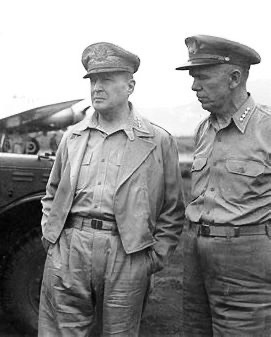
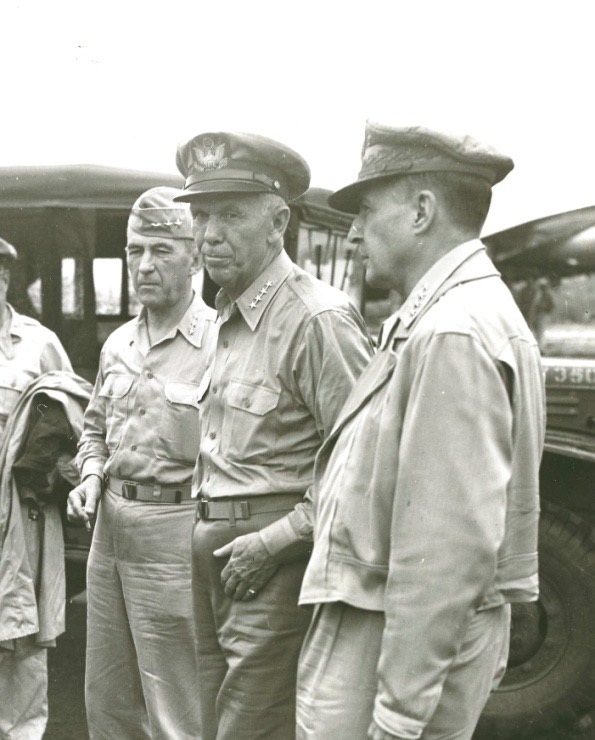
Photo 1 Photo 2
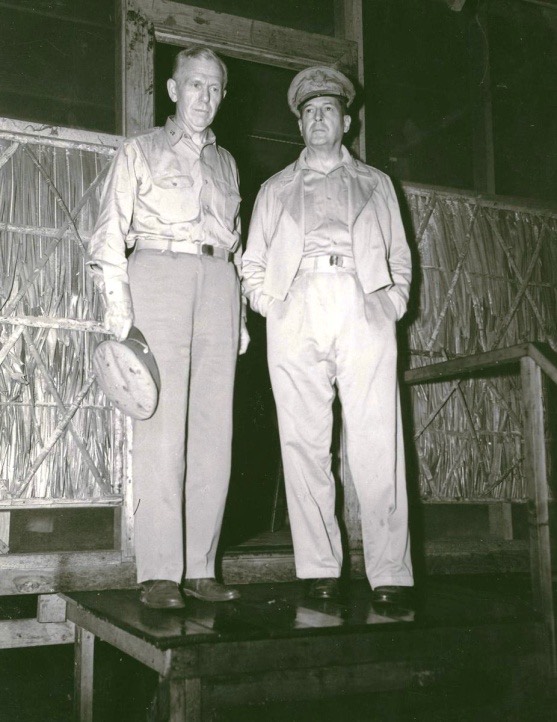
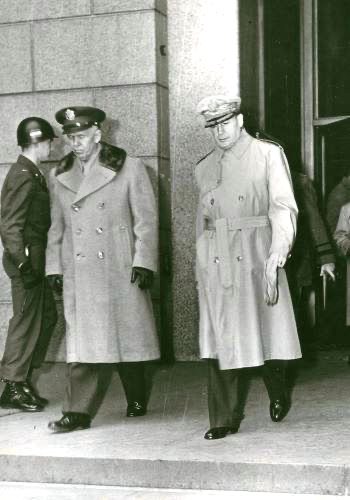
Photo 3 Photo 4
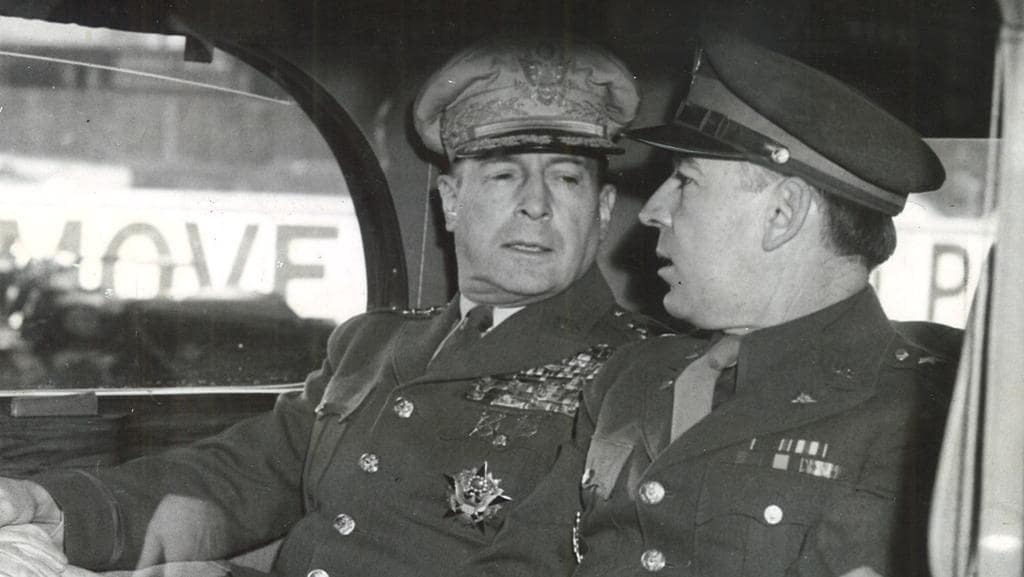
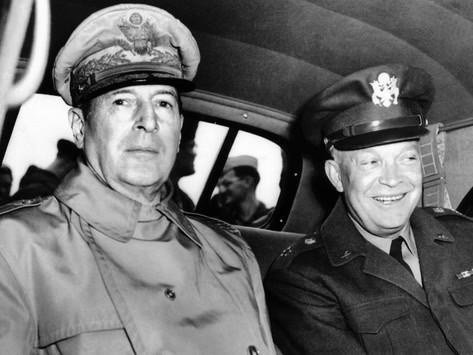
Photo 5 Photo 6
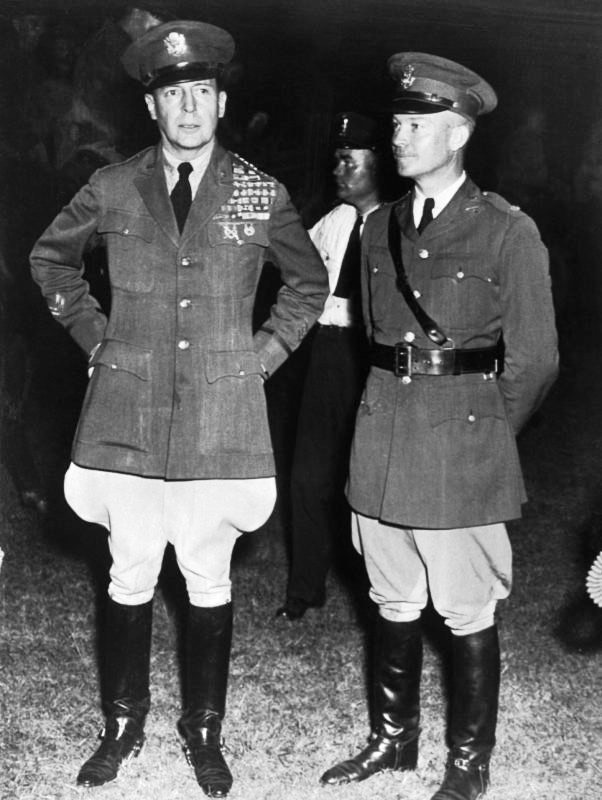
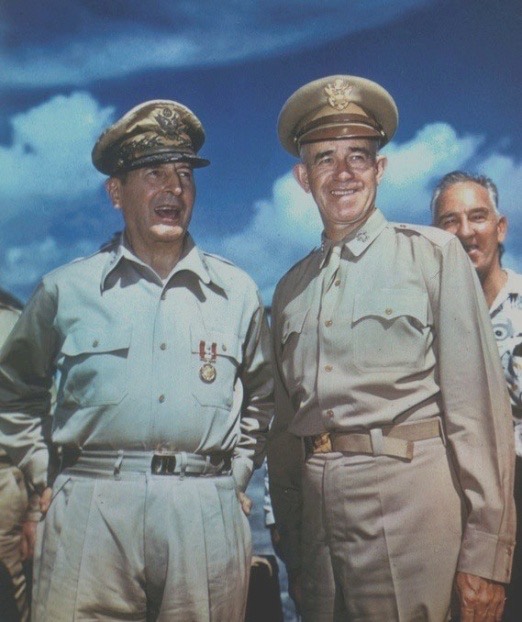
Photo 7 Photo 8
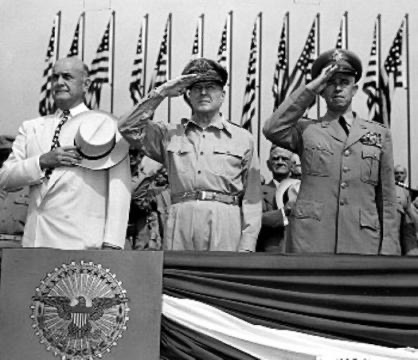
Photo 9 Photo 10
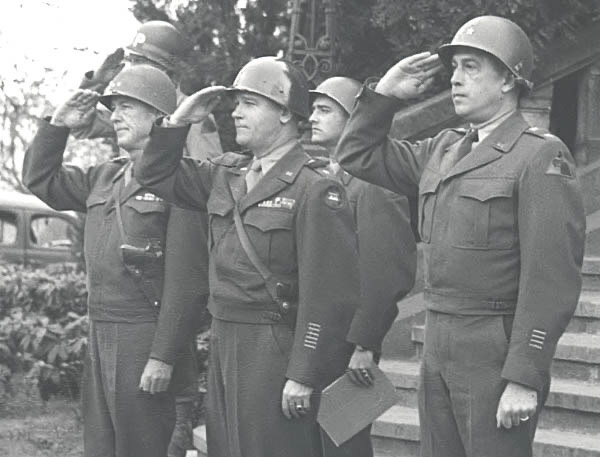
(A shorter version of this article was published in the Winter 2021-2022 issue of the MARSHALL magazine, a publication of the George C. Marshall Foundation, Lexington, VA.)