THE THOROUGHBRED RACEHORSE
By David J. Cade, Colonel, USAF (Retired)
Merion Station, Pennsylvania
Last updated: July, 2026
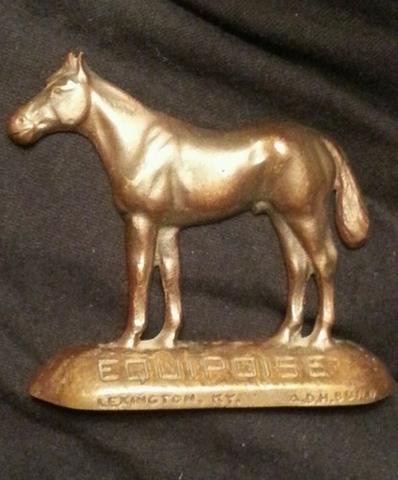
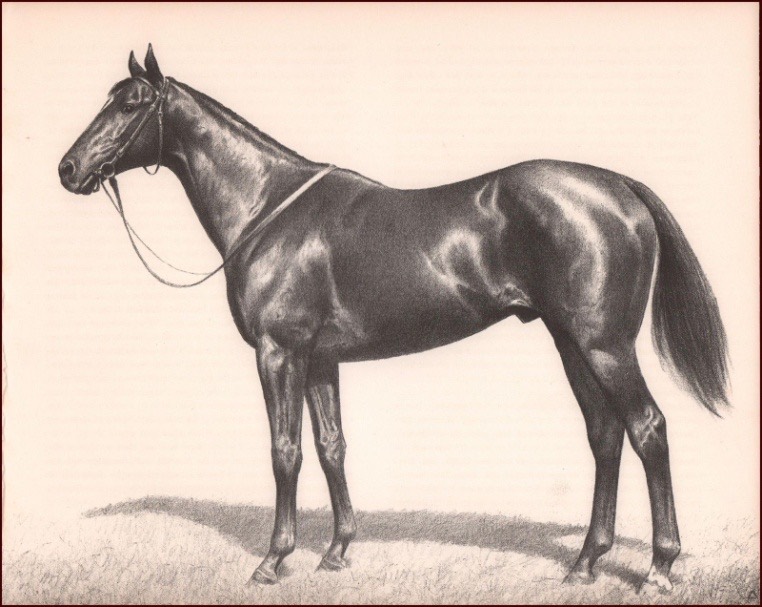
EQUIPOISE - The "Chocolate Soldier"
TABLE OF CONTENTS
CHAPTER II. THE INCOMPARABLE MAN O' WAR
CHAPTER III. MAN O' WAR'S CONTINUING POWERFUL PEDIGREE PRESENCE
CHAPTER IV. THE LEGENDARY AND UNIQUE DR. FAGER
NOTABLE TRIBUTES TO MAN O' WAR
THE UPSET OF MAN O’ WAR: A MOMENT IN TIME
THE MATCH RACE BETWEEN MAN O' WAR AND SIR BARTON
EXCERPTS FROM DR. FAGER: THE WORLD’S GREATEST RACEHORSE?
Foreword
Although never having worked with horses or spent a lot of time around them, from an early age they always fascinated me. As a young lad, Misty of Chincoteague was one of my favorite books, and Black Beauty one of my favorite movies. I was captivated by the noble steeds of the early radio and TV cowboys: Silver (The Lone Ranger), Champion (Gene Autry), and Trigger (Roy Rogers).
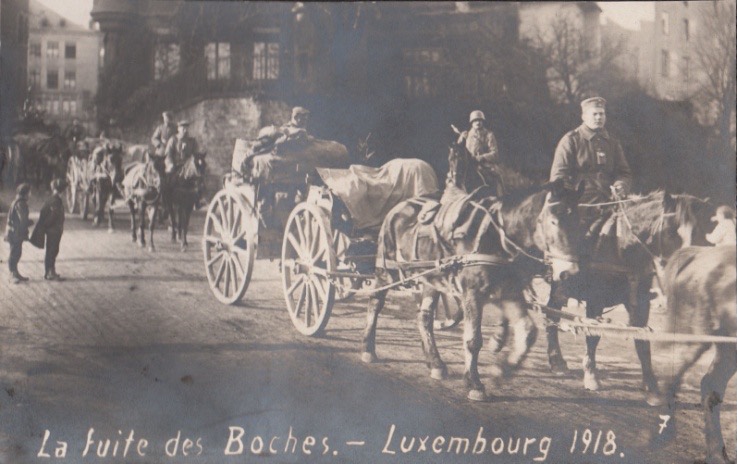
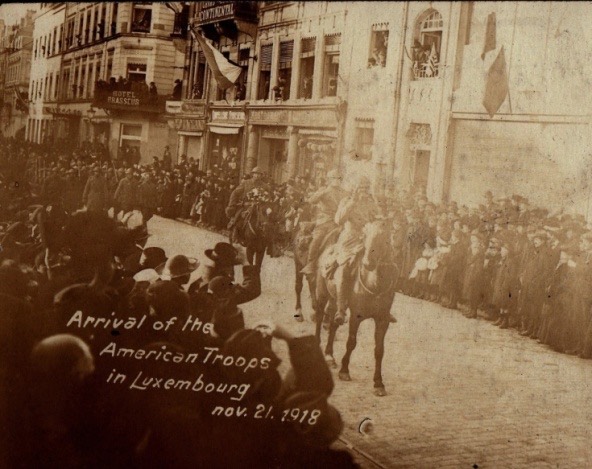
My dad Bert grew up in South Dakota and learned how to handle horses as a youngster. He fought in WWI, and the detailed scrapbook that he kept included photos of himself and fellow doughboys on horses; most impressive were his photos of the German army retreating from Luxemburg, and the American army entering Luxemburg -- with horses playing a prominent role (see following photos). In the 1930s, his favorite thoroughbred was Equipoise, and I treasure dad's bronze statuette of that noble steed. (See cover).
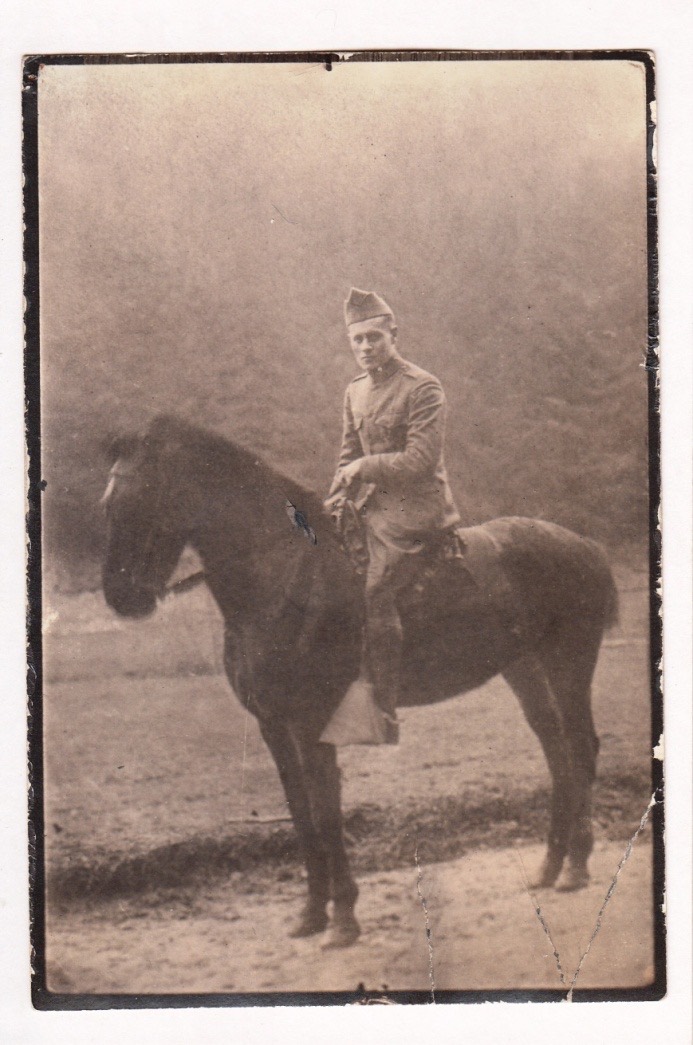
Bert Cade, "doughboy", WWI
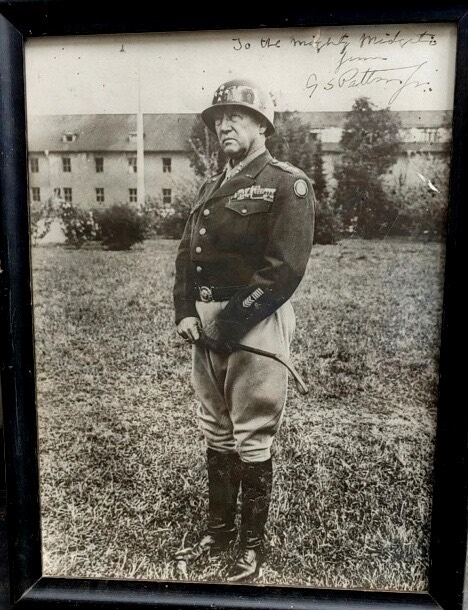
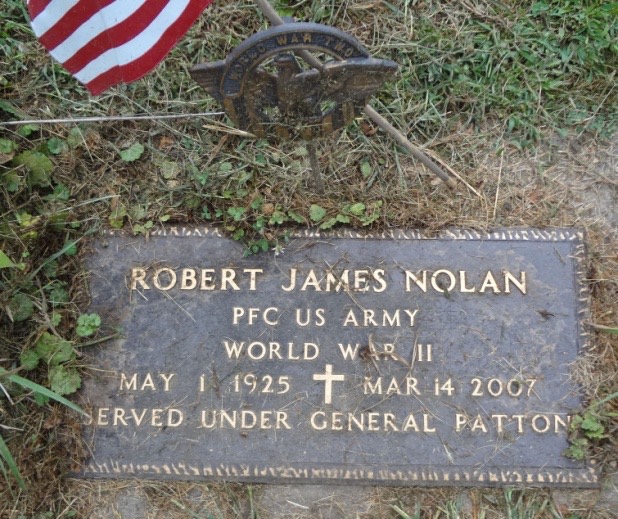
George Patton was a lifelong expert horseman; as a Cavalry Second Lieutenant he participated in the modern pentathlon competition at the 1912 Stockholm Olympics, and was a key member of the Army polo team during the 1920s-30s. Even in WWII, when the army had long since replaced the horse cavalry with armored forces, General Patton always had a horse or two with him for his personal use. My first cousin, Jim Nolan, who had a lifelong affection for horses, served in Patton's Third Army, and took care of the general's steeds. Although the specifics are lost in the mists of time, he gave Jim the following photo after the war in Europe was over. Patton's personal inscription on the photo, which shows riding crop in hand, refers to Jim as one of his "mighty midgets" - obviously a humorous reference to Jim's 6'3" height!!!
My first recollection of the power and majesty of racehorses was watching the exciting 1955 Kentucky Derby on television, won by Swaps (a Man o' War descendant) over the favorite Nashua. I became a faithful follower and devotee of the classic Triple Crown races, and other than those years when I was overseas as a U.S. Air Force officer, rarely missed watching a Kentucky Derby, Preakness, or Belmont Stakes on TV. Yes, I, too was mesmerized by Secretariat's 1973 Belmont mile and a half tour de force.
In the early 1990s, I began to research the history of thoroughbred racehorses, and study the exploits of the all-time greats, two of whom I came to admire more than all the others -- Man o' War and Dr. Fager. I perused the Blood-Horse website daily, and exchanged emails with one of the nation's foremost journalists on horse racing, Steve Haskin. Like millions of others in 2015, I was elated to see American Pharoah win the first Triple Crown in 37 years, and then win the Breeder's Cup classic to become the first and only winner of what was then coined "the Grand Slam." From time to time, I would feel compelled to put pen to paper and write little vignettes about thoroughbreds and their amazing deeds. This monograph is a compendium of those pieces.
My father had a small bronze figurine of the famous and durable Equipoise of the 1930s (colloquially nicknamed "The Chocolate Soldier" -- shown on cover page), who ran an astounding 51 races; this beautiful piece has remained with me to this day. A few words about this incredible thoroughbred. Just as Man o' War was the equine toast of the "Roaring Twenties", Equipoise was noted for lifting spirits during the grim depression years of the 1930's. Foaled in 1928, he raced at 7 years old, and in his 51 starts had 29 wins, 10 shows and 4 places......truly an iron horse the likes of which we will never see again. He had perfect conformation but unfortunately had delicate feet and experienced quarter cracks, which frequently had to be patched, and sidelined him during his 3-year-old "triple crown" season. His contemporaries included the famous Jamestown and Twenty Grand, but Equipoise was their superior. As a handicap racehorse from his 4th year on, he carried the top weight in every race, which often was 134 pounds, but still prevailed against horses carrying far less. In 1932 he set the world record for the mile - 1:34 2/5, which stood for 17 years. Equipoise, who twice was Horse of the Year, was noted for his calm demeanor, courage and determination - he lived to run and loved to dominate his opposition!
Preface
In all of human history, two animals have forged a unique symbiotic relationship with human beings -- dogs and horses. Although cats make great pets, and have intriguing, affectionate personalities, they are so independent and self-reliant that they typically do not enjoy the same degree of close interdependence, interaction and working partnership with humans as do dogs and horses. Dogs have been intimate human companions for some 30,000 years, and while the human-horse relationship goes back "only" some 5,000 years, that bond today is just as strong as with dogs -- albeit with a fewer number of people with "hands on" involvement since not everyone can have a horse around all the time for obvious practical reasons, including the cost of stabling and feeding them. The famous maxim by author Herman Melville says it all: No philosophers so thoroughly comprehend us as dogs and horses. They see through us at a glance.
As a lifelong historian, I am well familiar with the important role played by horses throughout the human experience -- from draft animals to means of transport, hunting partners, and warhorses. In fact, it is abundantly clear that civilization would not have advanced without the contributions of the horse.
Horse racing in England began in the 1500s, and by the 1600s people began racing horses as an organized sport; at this time, the practice of breeding them specifically for their racing abilities came into play, and thus the thoroughbred was born. It is hoped that this paper will give the reader a true sense as to how and why the power and splendor of racehorses has had such a mighty impact on the human spirit.
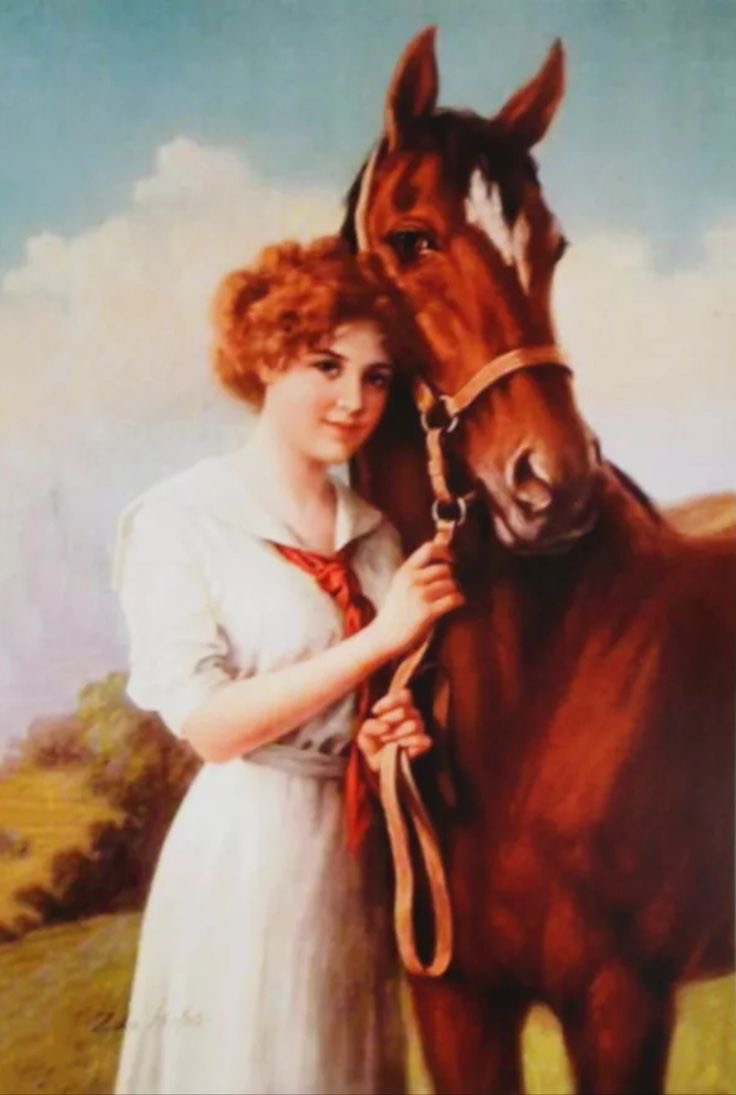
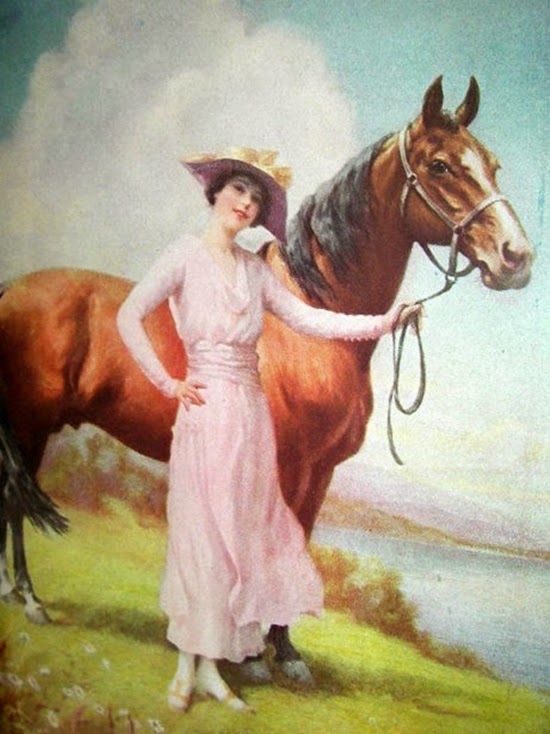
In my hometown of Joliet, Illinois, the Gerlach-Barklow Company was the largest manufacturer and premier supplier of art calendars in the world from the 1920s through the mid-1950s. My dad Bert was the Eastern Sales Manager for the company, with a sales force covering all states east of the Mississippi from 1926 until his untimely passing in 1951. Gerlach Barklow sold their calendars and other advertising products to companies and organizations who would give them to their customers. These calendars featured superb artwork, and so the company had a stable of topnotch artists who painted scenes of landscapes, animals and people. Two such artists were Zula Kenyon and Adelaide Hiebel. Their favorite subjects included horses, as shown in the following paintings which clearly reflect the closeness of the human-horse bond and the beauty and grandeur of the thoroughbred:
 -
-
By Zula Kenyon
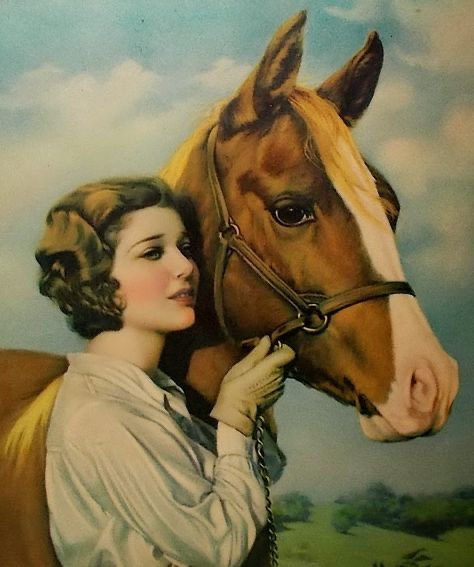
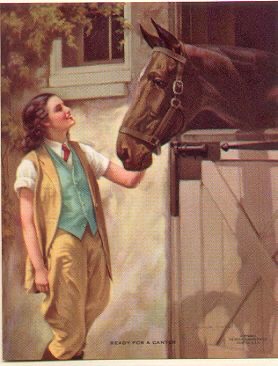
By Adelaide Hiebel
"Wherever a man has left his footprints in the long ascent from barbarism to civilization, we find the hoof print of a horse beside it"
-John Trotwood Moore
CHAPTER I
The Thoroughbred
Along with dogs, horses have enjoyed a unique symbiotic relationship with humans for thousands of years. The first recorded horse races were held at the Olympic Games in 648 B.C. But racing over fixed distances dates back to the 1100's when English knights returned from the Crusades with Arabian horses which then were bred with local mares, producing the thoroughbred horse as we know it today. The modern thoroughbred represents the epitome of equine power and majesty, and the following excerpts from The Thoroughbred describe this magnificent animal:
"Horse racing is the evolutionary result of war, chariot and the chase or pursuit of wild animals. The founding fathers of the Thoroughbred developed the horse best suited for the race. Competing against his equals in racing on the soil and on the turf is the hereditary function and work for which the Thoroughbred has been bred and fashioned by man. So that the Thoroughbred is able to meet and his peers on the race track, man has produced a courageous animal of the make and shape most conducive to racing, an animal intolerant of all opposition, an animal capable of performing the extraordinary when called upon by challenge. The historic function of Thoroughbred breeding and racing is to test the breeder's acumen, the trainer's skill, and the speed and stamina over turf and soil."
“The Thoroughbred is the aristocrat of the Equine. His lineage and heredity can be traced by his pedigree through sires and dams for many generations. The Thoroughbred gives evidence of his pure and high blood by his temperament, his high spirit, his elegance, symmetry and balance of external form, the silkiness of his skin, his lovely, prominent veins, his expression and his speed. The Thoroughbred was bred to race and race he must. His conformation, his speed, his stamina were established by the careful selection of successive parents, sires, grandsires, and great grandsires on the sire side and the distaff side for generations. Speed, stamina, and nervous energy are the objectives of some breeders. But each of these objectives is the result of the combination of many factors. These factors include:
Correct conformation (for speed or for stamina).
Soundness of the running gear (limbs).
Barrel capacity for heart and lung room for soundness of wind.
Good circulation.
Speed of nerve stimuli.
Courageous temperament and sweet disposition.
The will to run at high speed over a distance.
The will to win."
"The history of the Thoroughbred begins in England a little over 250 (now over 300) years ago. Every Thoroughbred of today traces back on its sire line to the Darley Arabian, the Byerley Turk, and the Godolphin Arabian. (James Darley, Robert Byerley, and Lord Godolphin were three English breeders who acquired these Arabian and Turkish stallions in the late 17th and early 18th centuries). The history of the development of these three foundation lines is equally as fascinating as it is enlightening. Both the English breeders and the American breeders have used good sense, high standards, and selective matings in establishing the permanency of the three foundation lines, as each was represented early in its development by animals which were proven successful race horses as well as prepotent sires. These were:
Eclipse....identified as the Darley Arabian or Eclipse line. (Eclipse was a great-great grandson of the Darley Arabian; some 90-95% of modern thoroughbreds descend from this line).
Herod....identified as the Byerley Turk or Herod line. (Herod was a great-great grandson of the Byerley Turk).
Matchem....identified as the Godolphin Arabian or Matchem line. (The Godolphin Arabian was the most famous of the Arabian stallions brought to England. Matchem was a son of Cade, who was a son of the Godolphin Arabian.)" (See following pictures)
The Godolphin Arabian is shrouded in legend. He supposedly was born in Yemen in 1724, and went through a series of owners in Africa and France until he ended up in England in 1730-2, where he became a leading sire in 1738, bred to the larger British mares.
"There is definite proof that the native mares of Britain contributed much 'cold blood' to the progeny of the matings to the 'hot blood' of the Eastern sires." (The Thoroughbred, E.S. Montgomery, Arco Publishing, New York, 1971; Pp. 33, 72-73, 314, 390-1.)
Horse racing was well established in England in the 16th century, and began there as early as the 14th century. The first horse races in North America were on Long Island, New York in 1665, and in Virginia in 1674. Importation of English Thoroughbreds into the America Colonies to improve the local racing bloodstock began in 1730. The first was Bulle Rock, a son of the Darley Arabian, and a grandson of the Byerley Turk on his dam's side, who was imported into Virginia. The Godolphin Arabian line first came to America in 1751 with the filly Selima (foaled in 1745) in Maryland. In 1755, a son of undefeated Regulus (son of Godolphin) named Brutus was imported to South Carolina, the first Godolphin Arabian sire bloodstock in the U.S. Two other grandsons of the Godolphin came to America in 1757 and 1764, establishing a strong foundation of Godolphin Arabian breeding in the American South.
The first Thoroughbred in Kentucky was Blaze, imported into Virginia in 1786 and brought into the Bluegrass state in 1797. Blaze was a grandson of the Darley Arabian on the sire side, known in the Thoroughbred business as the "tail-male" line. Blaze was the first of many Thoroughbreds brought into Kentucky in the 1800-time frame, providing the foundation for what would evolve as the Kentucky racehorse....the most prominent of all American Thoroughbreds!
Interestingly enough, several of the most prominent Civil War generals had favorite warhorses with pedigrees back to the foundation sires. U.S. Grant's most famous horse was Cincinnati, who was descended from The Byerley Turk through Herod, while R.E. Lee's favorite horse Traveller was also descended from The Byerley Turk through Herod. W.T. Sherman's primary horse Duke was descended from The Darley Arabian through Eclipse. The statues of General Sherman at the U.S. Capitol and in Central Park, New York City, show him mounted on Duke. (See following photos).
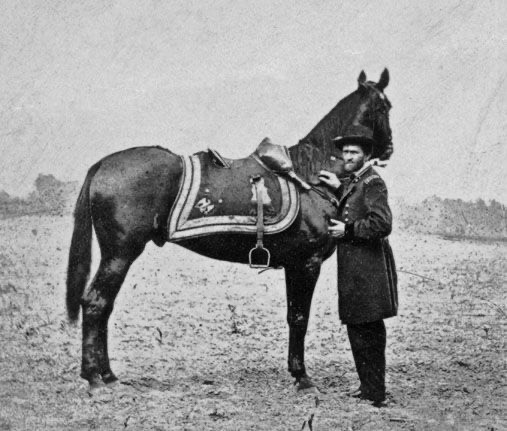
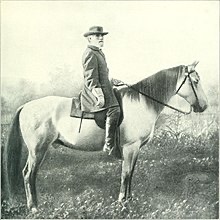
Gen. Grant and Cincinnati Gen. Lee and Traveller
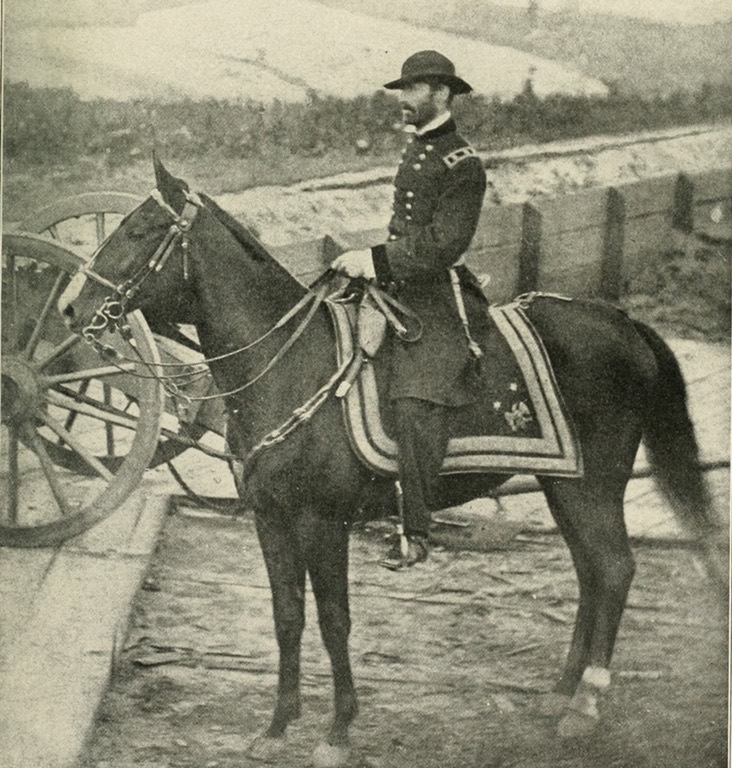
Gen. Sherman and Duke
A wonderful description of what makes thoroughbreds tick is captured in this quote from horseracing guru Steve Haskin: “.....horses are not forced to race. It is something that is as natural as breathing. Thoroughbreds were endowed with those spindly legs that pound the ground at great speed for a purpose -- to enable them run like the wind, faster than the next horse.” That is why human beings have bred and cherished these noble animals for centuries, and have thrilled to their exploits.
Of all the great racehorses in the last 150 years or so, one stands above all the rest - the legendary and larger-than-life Man o' War. A wonderful summary of his unique achievements and stature was penned by renowned equine photographer and author, Barbara Livingston, a six-time eclipse award winner (academy awards of horse racing), and featured in an article in the Daily Racing Form on March 24, 2017 ‘Chasing Man O’ War’s Ghost’:
"For me, there is one Big Red and he was born a hundred years ago, on March 29, 1917. If others of the same nickname preceded him, they were simply opening acts. Anyone since? Call them Big Red all you want, but, to me, they are imposters. Man o’ War looked as if his entire life’s performance was accompanied by the sound of trumpets.
He won 20 of 21 races, and the one time he was upset is legendary. The powerhouse chestnut son of Fair Play out of Mahubah set three world records, five American records, seven track records, equaled an eighth, once won by 100 lengths, carried 130 pounds or more nine times, and was odds-on in every race – that’s right, every race. The chart footnotes read “restrained at end,” “restrained in stretch,” “won under pull,” “eased final 1/8,” “under a pull,” “never extended,” “easing late,” “taken up final 1/16th,” “won easing up,” “speed in reserve”. . .
Man o’ War was truly the stuff of dreams – so grand that even 100 years after his birth, as other greats like Domino, Whirlaway, and Citation fade into the background, he remains the benchmark for greatness. In fact, when the Blood-Horse published a list of the greatest horses of the 20th century, he topped the list. In 1999, The Associated Press voted Man o’ War as the best 20th century racehorse, besting runner-up Secretariat by a 4-1 margin. In 1992, a similar poll by Sports Illustrated resulted in an “all-time greatest” honor for Man o’ War."
Man o' War is a 15-generation tail-male descendant of the fabled Godolphin Arabian through Matchem, while Citation, Secretariat, American Pharoah, Justify, Arrogate, and Flightline are all tail-male descendants of the Darley Arabian through Eclipse. However, Man o' War is also descended from the Darley Arabian through Eclipse, since Eclipse's dam was a grand-daughter of Regulus, a brother of Cade and a son of the Godolphin Arabian. While all of the great modern horses are descended from one or both of these two foundation Arabians (unfortunately the Byerley Turk sire line died out in the 1990s), only Man o' War is a tail-male descendant of the Godolphin Arabian, who had a unique conformation (see p. 39). Man o' War was also descended from the Byerley Turk through his 7th great granddam, Anticipation, daughter of Beningbrough, the first horse to carry the blood of all three foundation sires. Incidentally, Man o' War and Secretariat have one common modern antecedent: Man o’ War’s sire, Fair Play, was Secretariat’s great-great-great grandsire.
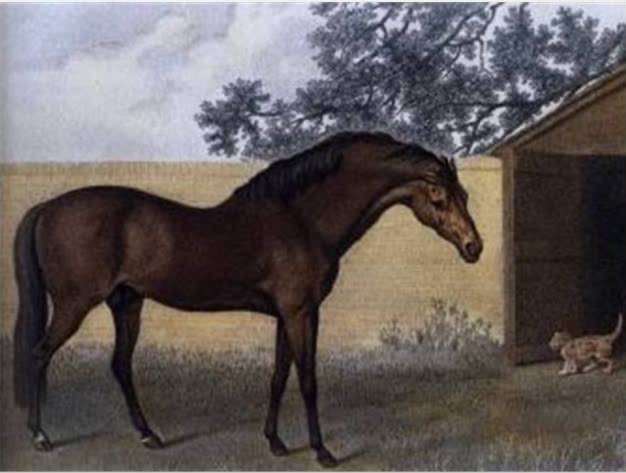
The Godolphin Arabian Matchem
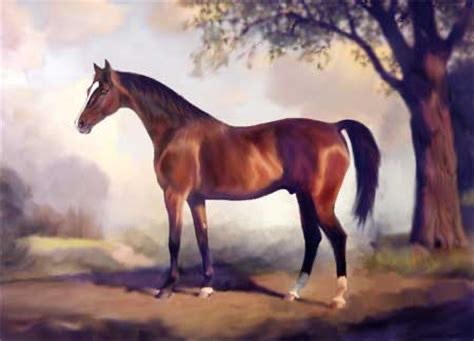
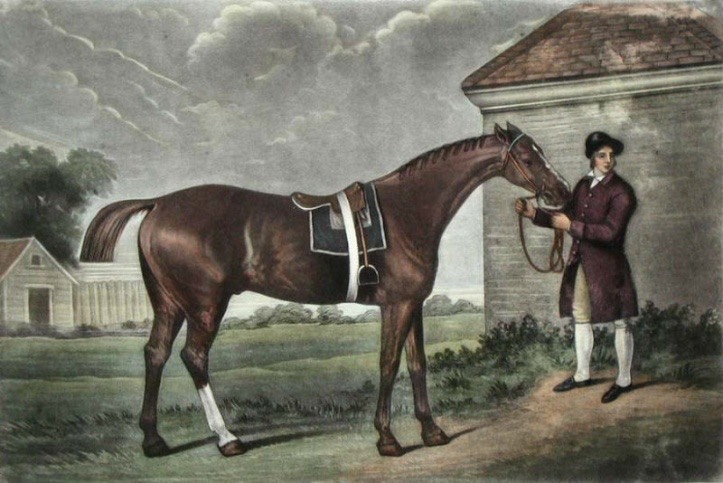
The Darley Arabian Eclipse
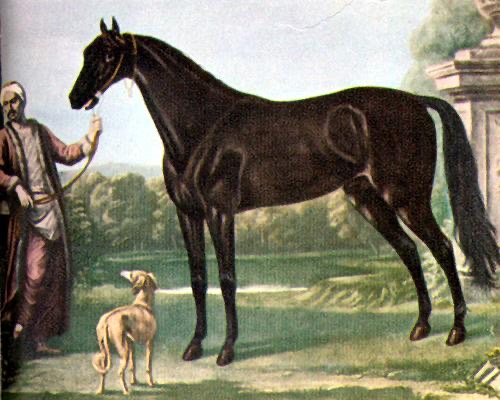
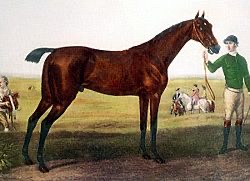
The Byerley Turk Herod
In the PAULICK REPORT of November 23, 2022, Frank Mitchell provided an excellent recap of the three Foundation Sires from the perspective of the 21st Century in his article Bloodlines: The Foundation Sires And The Genetic Lottery. Following are some relevant excerpts:
"As has become increasingly clear over the past century, the “three lines” is pretty much a thing of the past also. At least in the male line. That spot is nearly the private preserve of the Darley Arabian – Eclipse – Bend Or – Phalaris set of horses that make up about 90 percent of the male line in Thoroughbreds today.
Although the Godolphin Arabian is still out there, the best lines have nearly all retreated into the inner reaches of pedigree, and Man o' War's branch of the line through In Reality – Relaunch – Tiznow seems destined for the history books unless something quite unexpected happens to resurrect the line. Again. (Such as happened with Fair Play, Man o' War's sire.)
The line from the Byerly Turk has been lingering for a century, and it lost its last great chestnut hope when Precisionist, a champion sprinter who stayed 10 furlongs and was tough as hickory, proved all but sterile at stud.
Regarding sire lines, however, the “influence” of those lines is still around. These three and all those others that have died out in male line are still represented among the internal lines of pedigrees, so long as the performance of those strains continues to justify people using them. It's all about probability and opportunity.
The hard fact is that most stallions or stallion prospects do not have the genetic consistency to sire a reasonable proportion of good, highly successful racers. That's the probability side that allows horses like Danzig, Mr. Prospector, and Phalaris to come up trumps when they aren't world champions. Instead, they are pretty good racehorses but are genetic champions.
Opportunity is the other side of the coin. Without a fair number of reasonably good mares, a stallion cannot have consistent, high-quality success."
CHAPTER II
The Incomparable Man o' War
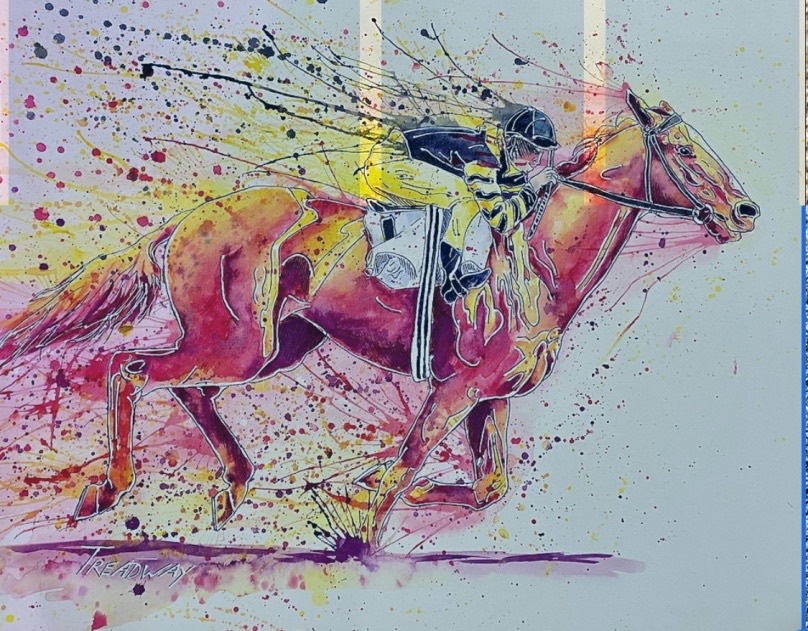
"The Mostest Horse There Ever Was"
Amy Treadway, equine artist
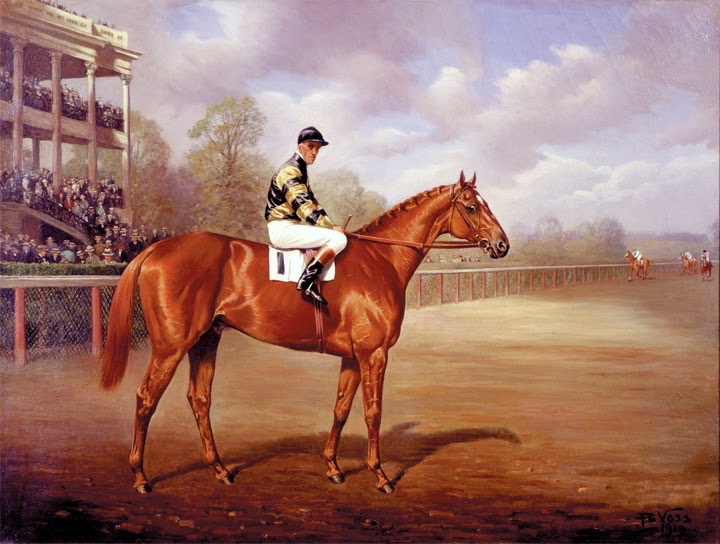
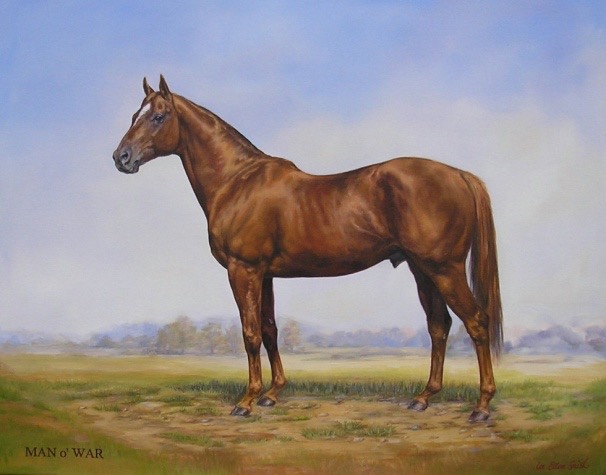
Hard as they may try to overcome it, Secretariat devotees must be chagrined that their record -setting Triple Crown winner must always be relegated to the runner up position in the pantheon of greatest racehorses of all time. The original "Big Red" still reigns supreme! 100 years later you don't even need to say his name. Everyone knows. And often lost in recounting his superior track performances is the unique role Man o' War played in the socio-economic fabric of American society which no other thoroughbred can claim.
In the wake of world class performances in recent years by Triple Crown winners American Pharoah and Justify, by Arrogate in 2017 at the Dubai World Cup and the Pegasus World Cup, and by undefeated and untested Flightline in 2022, it is inevitable that thoroughbred fans will compare these horses with the all-time greats of the past. In this regard, the most common name that comes up today of course is Secretariat, as though he were the ultimate benchmark against whom all others would be measured. But there was another horse called "Big Red" before Secretariat....who is a more legitimate all-time measuring stick - the immortal, incomparable, unequalled, and almost mythical Man o' War, foaled in 1917. The passage of time has dimmed his aura, but four consensus rankings by panels of world class experts who had the background to survey the entire history of American thoroughbred racing all had Man o' War #1 and Secretariat #2 (the BloodHorse poll, Associated Press, Sports Illustrated, and ESPN). Many of the voters in these polls were old enough to have seen both horses run. In 2017, the Dubai track announcer obviously had a similar mindset when he said of Arrogate: "Have we seen the anointment of the Man o' War of the 21st century?" As good as Arrogate was, it was not to be.....and there may never be another that will meet that criteria. Unfortunately, it is difficult for modern thoroughbred fans to grasp and appreciate the comparative differences between the two "Big Reds." One of the problems is that there is so little film footage of Man o' War's races, whereas Secretariat's races are readily available on many video venues.
A remarkable fact is that Man o' War was almost always under restraint in a hand ride, with no need for the whip. This is different from any other racehorse. It was common knowledge among horsemen of the day that Man o' War was never fully extended - finishing all of his races under a hard pull from the jockey, except for his fluke loss to Upset in the Sanford Memorial Stakes at Saratoga as an immature two-year-old. Even his 100+ length world-record-setting victory in the 1 5/8 mile Lawrence Realization Stakes was under a tight rein. Man o' War would not allow another horse to pass him. He was prevented from winning the Triple Crown in 1920 (which was not recognized as such in that day), by his owner Samuel Riddle's decision to skip the Kentucky Derby (which was no big thing then since it was far less famous than the older races -- Belmont Stakes, Preakness Stakes at Pimlico, or the Travers Stakes at Saratoga). Also, Riddle was not sure that 1 1/4 miles was a good distance for the first race in Man o' War's 3-year-old season, and he pointed toward the 1 1/8 mile Preakness.
So, for a Triple Crown, Man o' War had to wait until his son, War Admiral, accomplished the feat in 1937, followed by four other later descendants -- Seattle Slew, Affirmed, American Pharoah, and Justify.
But for the unconvinced, let's look at the facts. Both horses ran in 21 races. Man o' War won 20, his famous lone narrow defeat to Upset as a two-year old in August, -1919. How did that happen? It took a "perfect storm": a short ¾-mile race; a huge weight concession (130 pounds to 115); a fractious and headstrong two-year-old Man o' War who broke prematurely five times; a wire mesh barrier instead of today's starting gate; a fidgety substitute starter who dropped the barrier suddenly with Man o' War circling with his back to the starting line a length or more behind the barrier according to eyewitnesses. As a result, the field had at least a two-length lead before the favorite even took his first stride, and then quickly fell ten lengths behind until he got into his full racing mode. Yet in spite of all these factors, he still could have won the race if it hadn't been for a regrettable ride by Johnny Loftus, who let Man o' War get boxed inside of Upset and another horse, and had to pull up sharply to go outside, losing two lengths. In any case, Man o' War closed fast, was a head behind at the finish line, and charged past Upset just after the finish. So, if the race had been 1/16 of a mile longer, the result would have been reversed. There were other factors which may have contributed to the loss. One was the questionable pre-race guidance by Sam Riddle to Loftus to stay behind the early pace, which caused Loftus to get boxed in. Also, there is evidence that Loftus was laboring under a hangover from an all-night party the night before, Finally, there was some talk that Loftus had conspired with Upset's jockey Willie Knapp to throw the race, but no such substantiation ever turned up. Nevertheless, the loss would trouble Johnny Loftus for the rest of his life.
Interestingly enough, people at the event were not shocked that Man o’ War lost given the circumstances, but by the fact that he made it as close as he did. Although Man o’ War was a 1-2 favorite, he was still a raw two-year-old colt, more promise than legend. In any case, for all practical purposes, he "won" that race even though he came in 2nd on the books! (A great write-up of the race based on contemporary accounts is in the Appendix.)
Big Red got revenge by handily beating Upset the other five times they faced each other. Upset's jockey, Willie Knapp, said years later: "Sure I win the race all right - it was the biggest thrill of my life - but lookin' back at it now, there's one horse which shoulda retired undefeated. Never was a colt like him! He could do anything - and do it better than any horse that ever lived. If I'd moved over just an eyelash that day at Saratoga he'd have beat me from here to Jaloppy. Sometimes I'm sorry I didn't do it. Any other day he'd have beaten me carrying a piano." In 1920, Knapp and Loftus, who had deep regrets and took full blame for the fiasco, had their licenses suspended, supposedly in part for the Sanford debacle. Riddle replaced Loftus with Clarence Kummer as Man o' War's jockey.
Secretariat won 16 races, with 3 seconds, 1 third and 1 out of the money. Man o' War was slightly taller at 16.25 hands (66.5") and heavier (1250 pounds), with Secretariat at 16.2 hands (66", 1150 pounds). Man o' War set 3 world records, 5 U.S. records, and 7 track records while Secretariat set 2 world records, 3 U.S. records and 4 track records. Man o' War's largest victory margin was 100+ lengths, Secretariat's 32 lengths in his famous 1973 Belmont Stakes win with a time of 2:24 which still stands as a world record for 1 1/2 miles. When Man o' War won the Belmont Stakes in 1920 by 20 lengths, the race was only 1 3/8 miles. Man o' War's 100+ length win in the Lawrence Realization of 1 5/8 miles was in a time of 2:40 4/5; Secretariat's time at the same distance was 2:41 4/5. In terms of winning odds, Man o' War was the odds-on favorite in every race he was in, three times going off at 1-100. Secretariat's shortest odds were 1-10, and there were many races in which he was not the odds-on favorite. As an interesting aside, Man o' War was fueled by an enormous appetite: he ate 12 quarts of oats per day, three more than the average racehorse.
However, there are some other important factors which generally are not taken into consideration when comparing the two horses: Man o' War always carried far more handicap weight than his competition...more in fact than any horses are asked to carry today. At age two he carried 130 pounds six times, and as a three-year-old carried a staggering 131, 135 and 138 pounds -- conceding as much as 33 pounds to the competition!! Secretariat never carried more than 126 pounds. Track surfaces today (and in Secretariat's time) are far better and more cushioned than they were in the 1920s, with much better drainage.....resulting in surer footing and faster times.....2-4 seconds for distances of 1 mile to 1 1/2 miles. Finally, Man o' War, like all horses back in the day, wore heavy steel shoes, while Secretariat's shoes were aluminum. Less tangible but very important in any comparison is the fact that since 1948 there have been significant improvements in horse feed; vitamins and supplements, as well as medical treatment. Both horses had uncommonly long strides, Secretariat's at 25 feet, but Man o' War's was measured at an incredible 28 feet, believed to be the longest of all time.
Contrary to some modern claims, Man o' War's contemporaries were a highly talented crop. However, as a two-year-old, his dominance rapidly became so apparent to other owners and trainers that their sole focus was to figure out ways to beat him, including the first use of "rabbits" to tire him out in hopes a closer could finish him off.....but it never worked....he outran them all!
As a three-year-old, Man o' War broke record after record while carrying high weights and crushing all rivals. In the Miller Handicap, a new jockey, Earl Sande, replaced the injured Clarence Kummer. Sande, who became a Hall of Fame jockey and trainer, had ridden on Sir Barton and would later ride on another Triple Crown champion, Gallant Fox, was quoted as saying of Man o' War: "I never felt anything under me like that colt in my life. Why he is the greatest horse I've ever ridden." As his undefeated 3-year-old campaign wound down, several races are worth taking a closer look at, and are illustrative of why other owners wanted no part of being humiliated by this equine superstar.
As Man o' War's winning record kept increasing, even with the heavy handicap weights, fewer and fewer owners were willing to challenge him. A perfect example of this involving the 1920 Preakness was chronicled in the Montreal, Canada, The Gazette of May 15, 1920. “… It is not anticipated a very large field will go to the post against Man o’ War, but it will be select and probably number about 10, there being many eligible that will not risk the starting fee to run against Man o’ War.” And indeed at race time, only five others showed up.
Another example was the Belmont Stakes on June 12, 1920. Although there were a number of horses with resumes which would qualify them as being highly competitive in that prestigious race, their owners pulled them at the last minute, leaving only one to challenge Big Red, much to the disappointment of the 30,000 spectators who showed up. Nevertheless, despite no urging and a measured restraint by Clarence Kummer, he won the race by 20 lengths in world record time of 2:14 1/5.
Not only did his race performances scare off other owners and trainers, but two other factors also figured in. He had a penchant for long pre-race workouts. For example, the morning of the 1 1/8 mile Dwyer Stakes at Aqueduct on July 10, 1920, with no urging by the training jockey, he did a mile in 1:37, a time which would have won most races at that distance in those days. And then that afternoon Man o' War won the race in world record time of 1:49 1/5!!! Another testimonial to his fabled stamina was his propensity to burst right through the finish line as though it didn't exist and keep running at the same pace until being pulled up -- and still with enough in reserve to appear as fresh as when he started the race. He was renowned for his resilience and rapid post-race physical recovery. And how many more world and American track records would he have had with no restraint by the jockey?
There is yet another example of Man o’ War's dominance being such that no owner or trainer even wanted to enter their horse against him. In September, 1920, Man o’ War was entered into the highly acclaimed 1 5/8 mile Lawrence Realization Stakes at Belmont. As always, huge crowds were expected to come see him run. Several weeks before the race, an article in the New York Times almost pleaded with other owners to enter their thoroughbred: “It is expected to attract 10 or a dozen of the greatest three-year-old colts and fillies. Five or six of the best of these brilliant colts would make a field worthy of the best traditions of the Realization." Well, the pleading failed.....only one challenger entered, and that horse was scratched shortly before the event. It looked like the race would have to be cancelled.
At the last minute, a horse named Hoodwink was entered just so the race would be run. Man o’ War went off at an all-time low 1-100 odds. As if that wasn't enough to make this a historically unique race, one account said this: "No, the extraordinary part was that Man o’ War put on a one-horse show for the ages. In front of a large crowd, the two horses started relatively close and were close for the first furlong. Then Man o’ War took off. With no competition -- running just for the crowd and the joy of speed -- Man o’ War ran faster than any horse ever timed. He did not just break the world record for a mile and five furlongs (roughly 1.6 miles), he shattered it by almost two seconds. And, as numerous people pointed out, he broke the record carrying a formidable 126 pounds. War Mint, who had set the record a decade earlier, was carrying only 78. Man o’ War was so dominant that day, reporters literally did not know how to calculate his margin of victory. Some reporters calculated him winning by 100 lengths. Others said it was a quarter-of-a-mile. The Times writer put it most poetically: 'He got so far ahead of Hoodwink after the first 100 yards that no comparison could be made.'”
Exactly one week later, the 1 1/2 mile Jockey Club Stakes (predecessor of today's Jockey Club Gold Cup) at Belmont was supposed to be the race in which top older rivals such as Sir Barton and 1919 Kentucky Derby winner Exterminator would challenge the younger phenomenon. But again, the prospect of being trounced was too much for all but one owner. So, Damask became the designated victim. Per Sam Riddle's usual instructions, jockey Clarence Kummer was told to ride conservatively and keep a tight rein on the big chestnut so as not to embarrass the other owner (can one even imagine that today?). But in typical fashion, Big Red fought this approach, and by the one-mile mark had so thoroughly exhausted Kummer that the jockey had to give him free rein. Man o' War then went on to easily break the track and American record, just missing the world record - which experts believe he would have smashed if he had not been restrained for most of the race. Damask was left behind by an estimated 15-30 lengths depending on which observer one talked to. It's interesting to note that in his next race, Damask lost by a neck to the great Exterminator!
One month later was the world-famous Kenilworth Park Gold Cup match race in Ontario, Canada, against Sir Barton, 1919 "Triple Crown" winner and clearly the best older horse of his day. Man o' War went off at odds of 1-20, while Sir Barton was at 5 1/2-1. It was unheard of for a three-year old to post such odds over a champion older horse. On the inside lane, Sir Barton broke fast and put Big Red a length behind at the start, although he made up the lost ground quickly. Three furlongs into the ten-furlong race, Man o' War threw a shoe on one of his hind feet, compromising his propulsion ability. Then some unruly spectators in the infield trying to get a better view spilled onto the track, causing him to swing wide, losing at least two lengths. Moreover, after the race it was discovered that he had a bowed tendon. Despite all these adversities, Man o' War cruised to victory by seven lengths and shattered the track record by six seconds. (See the Appendix for a first-hand account of that famous match race).
That match race provided an important artifact which is still very prominent to this day. Because the event was so important in thoroughbred circles, the owner of Kenilworth Park, A.M. "Abe" Orpen, who also set up the match race itself, commissioned Tiffany to craft a large 18-carat gold cup to be awarded to the winner......there is a famous photo of Man o' War drinking out of that cup after the race (see photos below). The Riddle family kept that trophy for 16 years before they agreed to give it a permanent role in thoroughbred lore. William R. Travers was a highly successful and wealthy Wall Street lawyer who was the prime mover in the building of Saratoga Racetrack in 1864. That same year his namesake race, the Travers Stakes, was first run, and it came to be known as the "Mid-Summer Derby." In 1936, through a confluence of interests, the Man o' War Cup was awarded to the Stakes victor as the Travers trophy....and it has been awarded every year since to the winner of what is the oldest continuously run stakes race in America. The names of all the winners since 1864 are engraved on the Cup. Each year it is presented to the winning owner by a member of the Riddle family and the Governor or Lt. Governor of New York. The Cup is now held by the New York Racing Association (NYRA).
Samuel Riddle decided to retire him before having to face even higher handicap weights as a four-year-old; Riddle had asked famous handicapper Walter Vosburgh what weight he would give Man o' War as a 4-year-old, and was told it would be the highest ever carried, 145-150 pounds!!! (Vosburgh was the official handicapper for the Jockey Club from 1894-1934, and had seen all the great ones; he is memorialized in the Vosburgh Stakes, a sprint run at Belmont since 1940.) But just imagine what a four-year-old Man o' War in his prime could have accomplished even with such weights.....if any other owner would have dared to try him.
In The Kentucky Thoroughbred (1976, 1985) Kent Hollingsworth aptly wrote: "Of all the great horses which have thundered over the American turf, one towers above them all. 'If I wanted him to walk, he wanted to jog,' said his trainer, Louis C. Feustel. 'If I wanted him to jog, he would gallop. No matter what I wanted, he wanted to go faster.' That was Man o' War. His very name suggests strength, power. He was a superhorse, of greater dimensions than previous champions. He was taller than most horses......He held his head higher than most horses, and this, together with an impatience with restraint, lent pomp and circumstance to his way of going, an air of majesty. He did not beat his rivals, he conquered them."
Man o' War's unparalleled record as a sire and broodmare sire far exceeds that of Secretariat. Man o' War has had a profound influence on pedigrees to this day; he had 22 seasons in stud, siring 386 foals; he covered a small number of mares each year (25) compared to the practice today (American Pharoah covered 214 in his second season at stud). Nevertheless, he sired 64 stakes winners (with a total of 172 stakes victories), his sons won an unmatched 6 triple crown races - including Triple Crown winner War Admiral - and 69 of his daughters produced 128 stakes winners, including 8 champions. His name amazingly appears in the pedigrees of eight other BloodHorse Top 16 horses: Kelso (#4), Dr. Fager (#6), Forego (#8), Seattle Slew (#9), Affirmed (#12), War Admiral (#13), Buckpasser (#14), and Damascus (#16). One of his grandsons was media darling Seabiscuit (#25). It should be noted that Kelso, Man o' War's great grandson, amassed five Horse-of-the-Year titles, three more than any other thoroughbred in history.
Triple crown champions Affirmed and Seattle Slew both descended from Man o' War on both their sires' and dams' sides. Two legendary mares also carry Man o' War's blood -- Zenyatta through War Admiral, and Rachel Alexandra through American Flag. His enduring genes are still very much prevalent in today's champions (for example, 22 connections in American Pharoah's pedigree, 23 in Arrogate's and 23 in Justify's). And the latest thoroughbred wonder-horse, undefeated, untested 4-year-old Flightline -- who had a late career start but who won his 6 races by a combined total of 71 lengths, and compiled unparalleled speed ratings -- has 29 appearances of Man o' War in his pedigree. These Man o' War pedigree numbers for American Pharoah, Justify, Arrogate, and Flightline far exceed the appearances of any other champion sire in the four pedigrees. And Man o' War -- with his continuing powerful pedigree presence after 102 years -- appeared multiple times in ALL of the pedigrees of the top 23 derby point getters in 2023, including 25 appearances in Forte's, 42 in Tapit Trice's, and an astounding 49 in Kingsbarns'.
After Flightline's dominant 8 1/4 length victory in the 2022 Breeders' Cup Classic, the owner’s partnership decided to retire him to stud at Land's End Farm.....to the disappointment of his fans worldwide and those who wanted to see him cement his legacy with additional races to match the records of the all-time greats. While arguably the principal reason for this decision was based on the enormous financial considerations involved, there is a parallel with Sam Riddle, Man o' War's owner.
Based on the fact that Flightline humbled all the top older horses as well as the best three-year-olds, one of his owners and the founder/owner of Lands End Farm, Will Farish, asked rhetorically, "Who runs against him?", suggesting that the owners and trainers of opposing horses would be hesitant to even want to run against him. This is the same dilemma faced by Sam Riddle in 1920, who saw the fields challenging Man o' War steadily diminish in number, and was confronting unheard of handicap weights for his star's prospective 4-year-old season in 1921.
Adding to Big Red's singular legacy, another one of his sons, Battleship, won the famous British Grand National Steeplechase at Aintree in 1938 - the first and to this day only the second American-bred horse to ever do so in a race that has been run since 1839. Last but not least, the two stallions who have sired the most Grade 1 winners (both at 84), Danehill and Galileo, have Man o' War blood on each of their sire's and dam's sides. And Galileo's most accomplished son, undefeated Frankel, is already making his own reputation as a top stud (8 Grade 1 winners in 2021). Whenever I see Man o’ War in a pedigree, I am reminded of this powerful anonymous ode:
“Hold your strength till the barriers fly, then close with the leaders eye to eye.
Thundering hooves and the mad jammed race, blood in the nostrils, sweat in the face.
And children, remember wherever you are, you carry the blood of Man o’ War.”
Now, admittedly, the farther back we go in history, the less important genetic influence normally becomes. But Man o' War is the greatest horse not only for his performances on the track but also because he had an immediate genetic influence on many of the greatest horses of the 20th century. One of the reasons he is always ranked at the top by equine experts is that he produced an unmatched number of sons, daughters, grandsons, granddaughters, great grandsons, great granddaughters, who were also legendary. His genetic influence on those closest to his lifespan was profound and unequaled. No other horse even comes close, including Secretariat.
It must be noted that Man o' War was no American Pharoah in terms of having an overly friendly demeanor. His famous grandsire, Hastings, had a notoriously cantankerous temperament, and his sire, Fair Play, also had a temper. Man o' War was not unfriendly, and did have a playful streak, but was difficult to break, stubborn, and frequently would nip at people if it suited him. As he matured into a three-year old, he exhibited a growing tendency to dominate all around him, be it humans or fellow equines. This somewhat ornery, combative disposition may have fueled his competitive juices, as he would not allow another horse to get in front of him on the racetrack -- the same behavior exhibited by the legendary Dr. Fager (Man o' War's great-great-great grandson) 40 years later.
Perhaps the best characterization of Man o' War is contained in his biography in the National Museum of Racing and Hall of Fame: "Despite all the records and astonishing performances, Man o' War was never fully extended and his ultimate potential was never known." And famous racing historian Joe Palmer wrote this in 1947: "He did not run to world records, he galloped to them. He was so far superior to his contemporaries that they could not extend him."
Following his retirement at Faraway Farm in Lexington, large crowds -- including many celebrities -- always came to visit him on his birthday. When he died in 1947 at the grand old age of 30, he lay in state for two days as thousands of fans filed by his specially made casket. The funeral service was broadcast nationally on radio and featured nine eulogies. No other racehorse has ever received such a tribute, before or since. Man o' War's faithful companion-groom of 15 years, Will Harbut, who coined the famous saying: "The mostest hoss there ever was", died on October 3, 1947. The great stallion never took to his new groom, and 29 days later he entered his stall, lay down, and never got up. It was the end of an era.
The problem in ranking any of the recent superstars with the all-time greats is the fact that their racing careers are cut short because of the lucrative stud business. Racehorses reach their prime at age four, but by then most are either already retired to stud (as American Pharoah) or, as in Arrogate's case being a late bloomer, have a very limited 4-year-old campaign aimed at a particular high stakes race (Dubai and/or Pegasus). Justify was retired right after the Belmont Stakes due to ankle issues. Although Man o' War never raced at four for the reason described above, his 21 races were more than most four-year-olds have today. In any case, it is interesting to speculate whether the 100th anniversary of the birth of any of these modern horses will be as commemorated and celebrated as the immortal Man o' War's was in 2017. That's why the original Big Red has aptly been referred to as "the Babe Ruth of horse racing".....the greatest of all time!
While there have been a number of books written about Big Red, a definitive one is Man o' War by Page Cooper and Roger L. Treat, published in 1950 -- written at a time when many of the key players (jockeys, trainers and owners) were still alive and could provide first-hand accounts; it also contains a complete rundown of all of Man o' War's ancestors and progeny. In the introduction, famous journalist and author Bob Considine said of the great horse: " He had more brains, more class, more speed, more desire to win than any other horse that ever sported silks. He had personality and the dignity of a king. He was a great actor. Every race was a show for him, and, like all great actors, he never let his public down.....his average winning margin was 9 1/2 lengths."
Simply put, Man o' War had a unique combination of speed, stamina, fortitude, courage, and heart not seen before or since. At the end of the 20th Century, BloodHorse magazine, The Associated Press, Sports Illustrated, and ESPN each conducted a poll of horse racing experts to name the top racehorses of all time. All four panels had Man o' War first, Secretariat second and Citation third. Now, two decades into the 21st Century, I note that some rankings put Secretariat first and Man o' War second.....as the equine experts who actually saw both horses race have disappeared from the scene. But apart from any poll rankings, many people still believe that Man o' War was the greatest American racehorse of them all, greater even than Secretariat or any of the other great horses that followed.
As the years have gone by, thoroughbred industry professionals have continued to extoll the extraordinary and unique virtues of Man o’ War. One such person is William Bradley, a thoroughbred racehorse owner and author with over thirty years’ experience based in Folsom, Louisiana. Beyond the track, he has decades of experience in specialized equine care, covering everything from hoof health and nutrition to training protocols. Using the pseudonym Miles Henry, he is the author of the industry website HORSE RACING SENSE. In his article The Greatest Racehorse of All Time + 9 Contenders Examined on May 1, 2024, he said:
"After a heated debate with friends about the greatest racehorse of all time, I dove into horse racing history and examined the careers of legends like Secretariat, Man o’ War, Seabiscuit, and Count Fleet to come up with one clear winner. I’ve determined that Man o’ War stands out as the greatest racehorse ever. A titan of the track, his legacy in the racing world is unparalleled. Boasting unmatched speed, enduring stamina, and an impressive winning record, he outclassed the majority of his competitors.
While Man o’ War stands supreme in my books, the horse racing world has been graced by numerous champions, each leaving their unique hoof print on the sands of time. In this article, you’ll encounter tales of these equine giants, their legendary races, and the impact they’ve had on the sport we so dearly love. Here is a quick look at the greatest racehorses of all time:"
Horse | Record | Color | Sex | Years raced |
|---|---|---|---|---|
1. Man O’ War | 20-1-0 | Chestnut | Stallion | 1919-1920 |
2. Secretariat | 16-3-1 | Chestnut | Stallion | 1972-1973 |
3. Citation | 32-10-2 | Bay | Stallion | 1947-1951 |
4. Zenyatta | 19-1-0 | Bay | Filly | 2007-2010 |
5. Dr. Fager | 18-2-1 | Bay | Stallion | 1966-1968 |
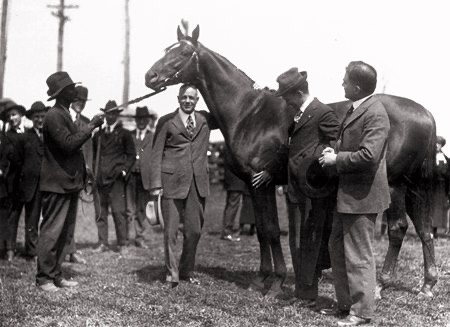
Man o' War after setting a world record in the 1920 Belmont Stakes
Miles Henry expanded his assessment in two later articles which are in the APPENDIX. The latest one was on April 11, 2026, “Man o’ War Racehorse: 20 Wins, 7 Records, and the Bloodline That Shaped American Racing.” Excerpts:
“The Blood-Horse, ESPN, Sports Illustrated and the Associated Press have all ranked him the greatest American racehorse of the 20th century — a consensus based on career dominance, physical attributes, and unmatched influence on Thoroughbred breeding…His bloodline is in virtually every modern American Thoroughbred — no other racehorse’s genetic influence comes close.”
Man o’ War was the most complete racehorse in American history. Twenty wins from 21 starts, seven speed records, the longest stride ever measured, dominance under weight conditions that would have broken other champions, and a breeding legacy that literally shaped the modern Thoroughbred breed. No other American racehorse has produced that combination across a career.
The comparison to Secretariat is real and unresolvable — and both horses are better understood by engaging with it seriously rather than declaring a winner. Man o’ War’s greatness was about the totality of dominance across a career and the depth of what he left behind. Secretariat’s greatness was about verified speed at classic distances that has never been replicated. Both are true simultaneously. They answer different questions about what a racehorse can be.
My Final Take After 30 Years in Racing When I look at a pedigree and trace backward through the generations, I find Man o’ War more often than I find any other single horse. That’s 100 years of selective breeding by people who understood horses better than most — and they kept coming back to his bloodline. That kind of influence doesn’t happen because of one fast season. It happens because something about that horse was genuinely superior at the genetic level. The records support it. The pedigrees prove it. Man o’ War is the foundation of American Thoroughbred racing, and nothing else comes close to that claim.”
See the Appendix for the complete article, arguably the most comprehensive comparison of the two most prominent thoroughbred giants.
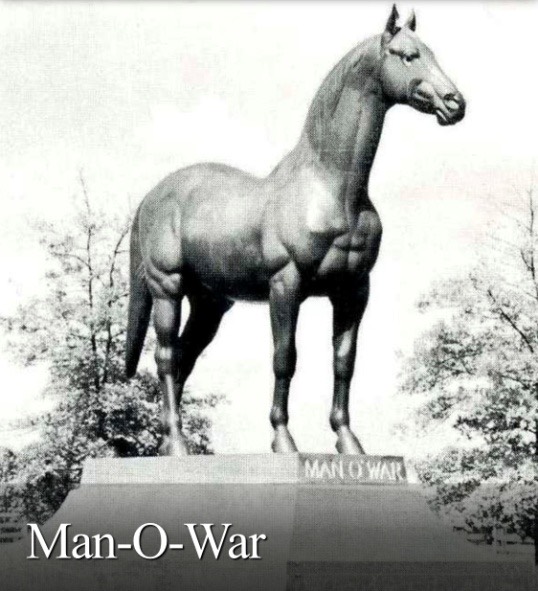
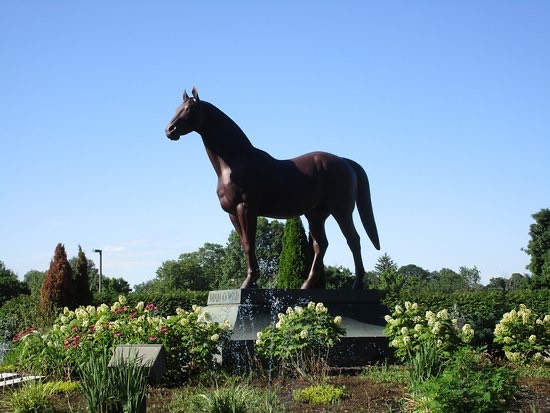
Man o' War's bronze statue at his gravesite
The Kentucky Horse Park, Lexington
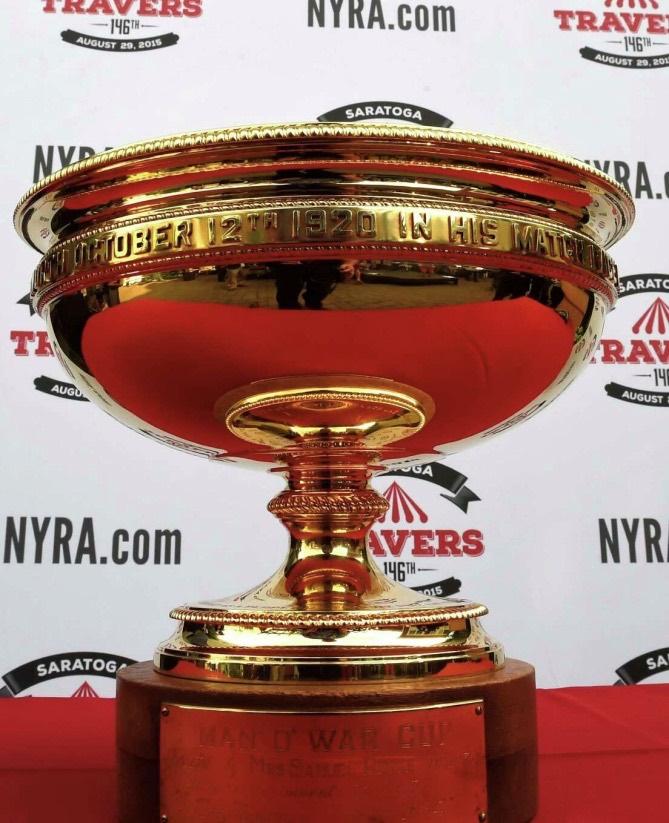
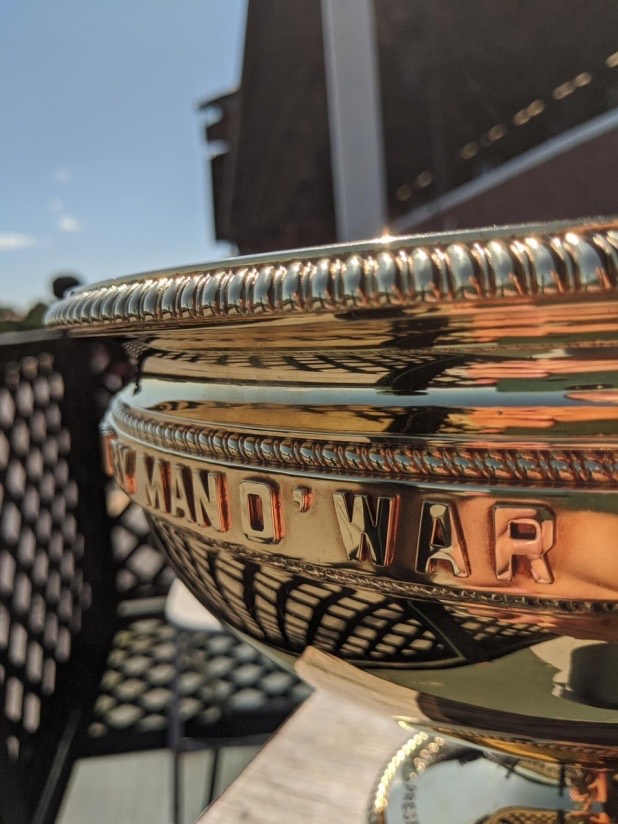
Man o' War Cup, the Travers Stakes Trophy
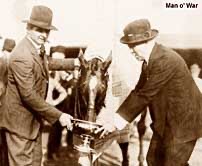
Man o' War's big gulp out of the cup after the match race victory over
Triple Crown champion Sir Barton in 1920
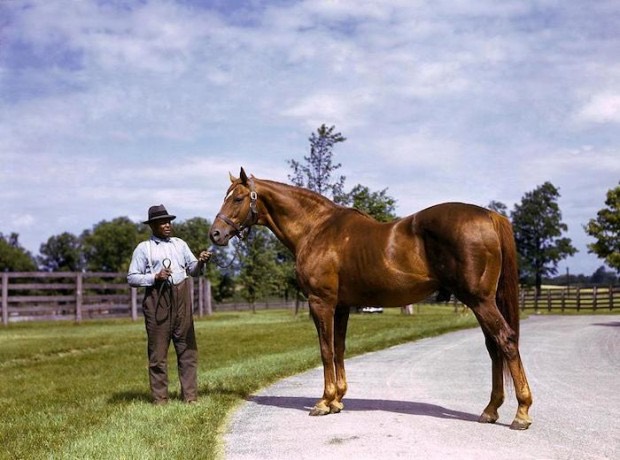
Man o' War and his long-time groom Will Harbut who coined
the famous saying: "The mostest hoss there ever was"
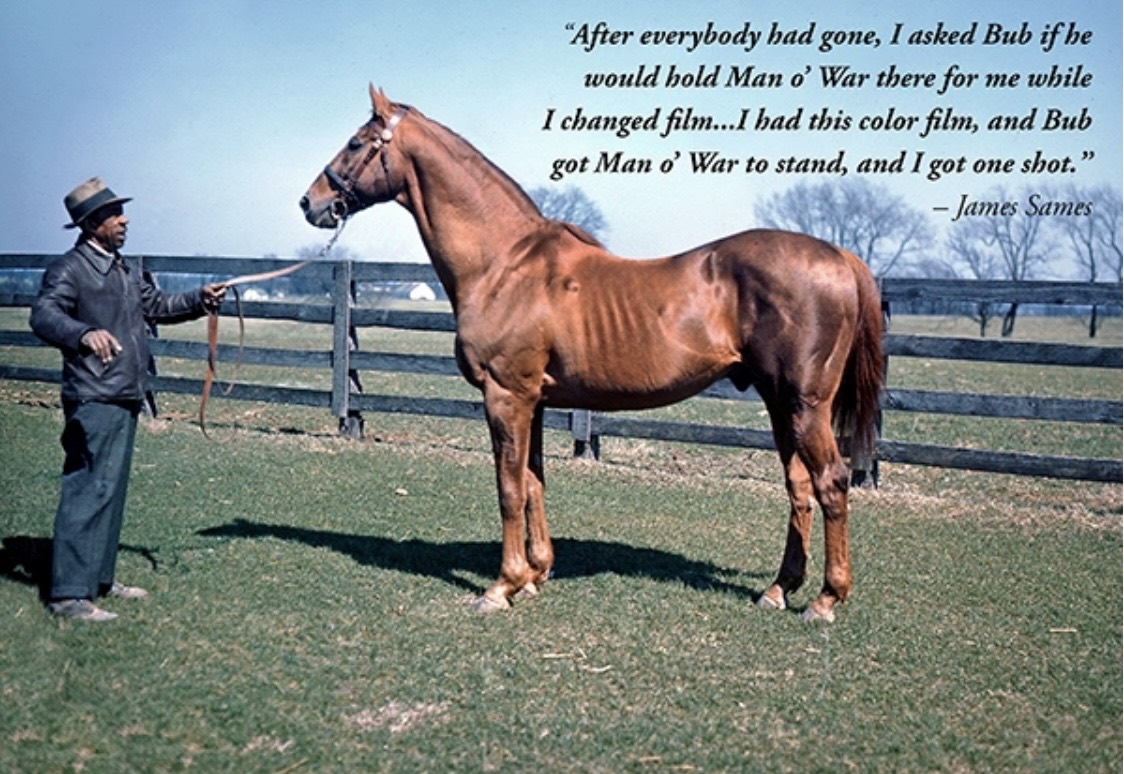
The last photo of the greatest horse three days before he died at age 30, was taken by famed Lexington horse photographer, James Sames, on October 29, 1947. Cunningham "Bub" Graves was his new groom of only 26 days after the passing of Will Harbut.
Years later, Barbara Livingston came upon the photo (one of only several known true colored photos of him) and provided this commentary:
"The aged stallion is set in a muted backdrop of grass and bare trees. His straight legs show very solid bone, although his fetlock hairs could use trimming. Ribs show through his coat of red, gold, and yellow. His lower neck is swollen, and several lumps dot his body. His tail is still thick and, although his shoulder is not quite what it once was, his hind end is still powerfully sculpted. A simple bridle is adorned with a “US” cavalry rosette. The sway of his back is accentuated by a high croup and higher head. Man o’ War’s gaze is steadfast, his nostrils distended as he soaks in the chilly autumn air. What is he looking at?
.....Yet mere words cannot sum up what made him a benchmark by which all Thoroughbreds are still measured. It was more than his brilliant racing career, his stud career in which he sired 16 percent stakes winners, his fascinating smoldering and imperious ways, and his legendary friendship with Will Harbut. Countless writers have tried to explain what made him great, but none has come close to succeeding. I wouldn’t dare try."
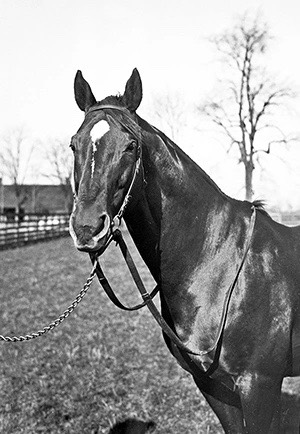
The one and only original "Big Red"
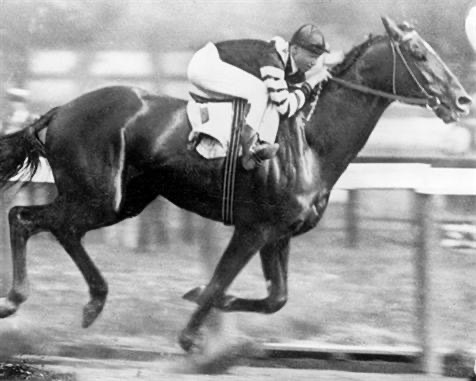
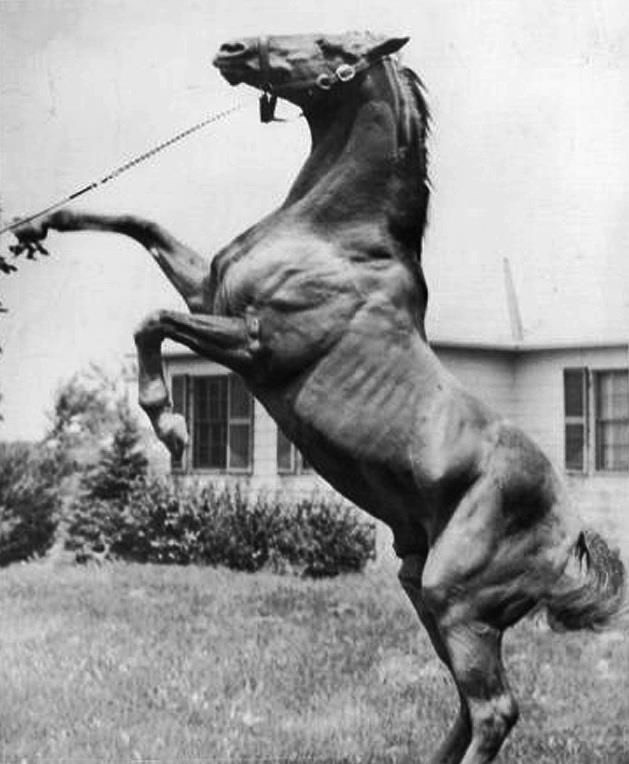
An interesting book published in 2024 takes a unique and broad perspective in assessing the top thoroughbreds of all time. THE GREATEST RACEHORSE? (MAN O' WAR and the JUDGMENT of HISTORY), by Mark Shrager, goes as far back as Boston, foaled in 1833. Boston was the sire of Lexington who headed the sire list for an unimaginable 16 years, and was Man o' War's great-great-great granddaddy. Lexington was a 6xgreat grandson of the Godolphin Arabian and a 7xgreat grandson of the Darley Arabian. Shrager analyzes all of the great thoroughbreds, with a special focus on the most famous of those foaled in the 20th and 21st centuries -- including chapters comparing Man o' War with Secretariat, Affirmed, Count Fleet, Forego, Seattle Slew, Dr Fager, Citation, John Henry, Swaps, Kelso, Spectacular Bid, Exterminator, Sunday Silence, East Goer, Flightline, and Ruffian. Shrager not only considers actual track performances and record as a sire, but also the impact each made on the sport itself as well as on American societal and economic factors in general. Incidentally, 10 of those 16 horses are direct descendants of Man o' War.
In the early 20th century, the four most popular sports were college football, boxing and the two most prominent professional sports -- major league baseball and thoroughbred racing. By 1919, a number of events, circumstances, and developments had caused a significant reduction in the number of racetracks, the number of races, the number of foals, the size of purses, and the number and income of owners, breeders, trainers, and jockeys. These included the residual impact of onerous anti-gambling laws from 1907-1913, WWI and its aftermath, the infamous 1919 Black Sox scandal which had a detrimental impact on all professional sports and the number of fans, including questionable horse racing betting and doping practices. It should be noted that Man o' War was one of only 1,680 foals born in 1917, the second smallest crop in the 20th century; the odds were against this all-time great horse emerging from such a small number of foals.
And then, almost by magic, things changed. Four athletic stars captured the public's fancy -- Babe Ruth, Jack Dempsey, Red Grange, and the only non-human, Man o' War. Between 1919 and 1930, thoroughbred racing increased dramatically in the number of races (by 150%), foals (by 233%), purse size (by 250%) and income of all industry players. This is largely attributable to the popularity of a one-of-a-kind colt who was virtually unbeatable (except for one fluke), and had a pristine reputation above reproach, without the slightest hint of doping. Yes, Shrager makes the case that Man o' War was the salvation of thoroughbred racing as a sport and as a breeding industry -- an achievement unmatched by any other thoroughbred in history. Moreover, he figured prominently in the post-war recovery, and enhanced the image of sports overall after a dark period.
Shrager does not disparage or diminish any of the other champions, but states that Man o' War may very well have been the fastest and strongest, and stresses the importance of the significant difference in the weight he carried versus that of the competition and yet still won -- another factor which no other thoroughbred can match. This made him odds-on favorite in every race and caused owners and trainers to avoid him like the plague whenever he was entered into a particular race.
A June 2026 Instagram blog on “Descendants of Man o’ War” by Winning Colors (a pseudonym/pen name) objectively captures the factors that made Man o’ War different from any other thoroughbred, past or present.
“Over 100 years later, horseracing fans are still debating how great Man o’ War really was.
Not because everyone agrees he was the greatest. Because nobody can agree on how to compare him to the champions that came after him. That is the challenge with a horse from 2019 to 1920. Racing was not the same sport we know today. The world was coming out of World War I. The racing calendar was smaller, travel was harder, national competition was not as organized, and there were no modern sports medicine, or the Breeders Cup to help compare champions across eras. Even the physical conditions were different. Track maintenance was less advanced. Horses raced in heavier, simpler shoes compared to today’s lighter race plates. Equipment, veterinary care, transportation, and training practices were far removed from the modern version of the sport. So how do we judge him fairly?
Some critics point to the short fields, and that is fair. His 1920 Belmont Stakes had only two starters. Man o’ War and Donnacona. The Lawrence Realization also came against a very small field. As his reputation grew, many owners simply chose not to run against him. But that criticism also says something. If the fields were short because rivals avoided him, then the short fields were partly a result of his dominance. Man o’ war on 20 of 21 starts. His only defeat came as a 2-year-old in the 1919 Sanford Memorial, when Upset beat him after a difficult start and race circumstances that have been debated ever since.
He won the Belmont Stakes by 20 lengths and set a world record for the 1 3/8- mile distance. In the Lawrence realization at 1 5/8 miles, he won by a margin often recorded as 100 lengths and set a Belmont Park track record that stood for 98 years, until 2018. He carried weight assignments that would be almost impossible to imagine for most modern stars, including 130 pounds multiple times at 2 and as much as 138 pounds at 3. And when racing finally gave him a true measuring stick, he answered. In the 1920 Kenilworth Park Gold Cup, Man o’ War faced Sir Barton, the first Triple Crown winner. Sir Barton was accomplished, proven, and older. Man o’ War beat him by seven lengths. That race matters because it gives his greatness context. He did not just beat overmatched horses. When asked to face an established champion, he handled him too. That does not mean we can prove he would beat Secretariat, Flightline, Dr. Fager, or any modern great. We cannot. Different eras make perfect comparisons impossible. But greatness is not only about raw time. It is about separation. How far above your own generation were you? And by the measure, Man o’ War has one of the strongest cases in racing history. He was not great because every field was deep. He was great because his presence changed the fields. His dominance discouraged challengers, and when he faced a Triple crown winner, he won decisively. Over 100 years later, that is why the debate has never gone away.
How do you judge greatness across generations: competition, dominance, achievements or legacy. If the fields were short because rivals avoided him, then the short fields were partly a result of his dominance.”
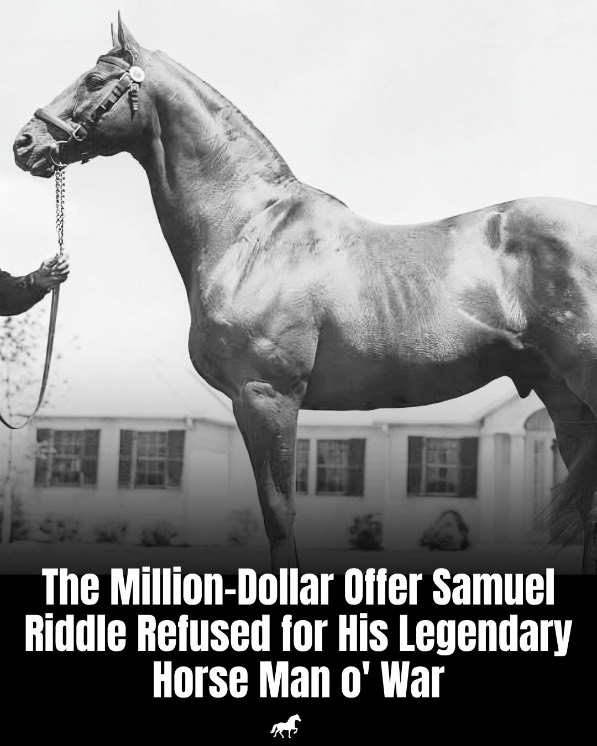
Perhaps the best description of Man o’ War’s priceless value came from his owner, Samuel Riddle. When offered a million dollars for Man o' War ($17,000,000 in 2026), he declined, replying that “plenty of men have a million dollars, but only one man could ever own Man o' War.” Then offered a blank check, he gave his legendary answer. He said “Go to France and bring back the Tomb of Napoleon…..then go to India and buy the Taj Mahal.” Only then, he said, would he even consider putting a price on Man o’ War.
CHAPTER III
Man o' War's Continuing Powerful Pedigree Presence
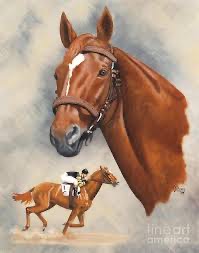
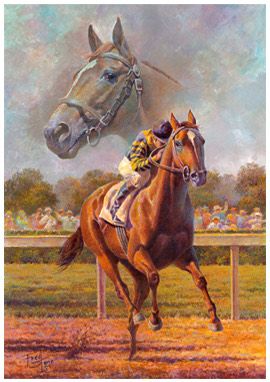
In March 2017, the thoroughbred world commemorated the 100 year anniversary of Man o' War's birth, and all racing fans were reminded of his unparalleled racing record -- 20 wins in 21 races, his only loss a second place by a fluke, and the odds-on favorite in every one, carrying far more weight than today's horses (138 pounds as a 3 year old), always eased up before the finish line, and voted top racehorse of the century in four separate polls by panels of experts. But fewer people are aware of his legacy as a stud, which has had a profound influence on pedigrees to this day. Man o' War had 22 seasons in stud, and although he did not cover a large number of mares as is the practice today, his enduring genes -- with a propensity to handle distance and weight with speed -- are still very much prevalent in both his male and female lines.
Thoroughbred breeding expert and author Frank Mitchell in his referenced article Bloodlines....Man o' War's Century of Influence, the Paulick Report (3/28/17), put it this way: "Among Man o' War's sons, Triple Crown winner War Admiral was prominent during his lifetime and particularly through his daughters, War Admiral is an important part of the fabric of pedigrees. His daughters produced such major racers and breeding stock as Buckpasser and Hoist the Flag. The other highly visible son of Man o' War who has come down in pedigrees is War Relic, especially through In Reality and his stock. Man o' War, however, is widely distributed through pedigrees and through numerous sources...This volume of presences of a horse from a century ago is a sure indication of the importance of Man o' War as contributor to our modern pedigrees; otherwise his name would have died out. There was every reason for Man o' War's influence to continue because he was a powerful factor for class and staying ability, plus a surprising amount of speed....One of the interesting things about researching my archives with regard to Man o' War's influence as we celebrate the 100th anniversary of his birth is the realization that quite a number of the great horse's daughters, as well as sons, have survived in contemporary pedigrees. This is a considerable accomplishment because most mares do not have a large number of foals, unlike stallions, and the likelihood that the mares' lines of descent will live on are naturally smaller."
As previously mentioned, Man o' War was a tail-male descendant of the storied Godolphin Arabian, and his sire and grandsire, top rated Fair Play and Hastings, had distinguished breeding records. His dam Mahubah's sire, Rock Sand, was an English Triple Crown champion.
Man o' War's sons won 6 triple crown races, and let's look at some specifics in the context of recent thoroughbred superstars. Triple Crown winner American Pharoah, triple World Cup winner Arrogate, and Triple Crown winner Justify are all descended from Man o' War through both War Admiral and War Relic. The War Relic direct connection is through his great-grandson In Reality, and In Reality's great-grandson Unbridled -- Pharoah's great grandfather and Arrogate's grandfather. (Arrogate's pedigree has In Reality on both his sire and dam side). The War Admiral connection is through two sources, his daughter Busanda through Buckpasser, and his great-granddaughter Aspidistra -- both sources also have Unbridled as a descendant through Buckpasser's daughter Magic and her stud In Reality. All told, Man o' War's pedigree presence is in 11 of Pharoah's 16 great-great-grandparents (22 appearances in all), while Arrogate's pedigree carries 23 Man o' War appearances -- this is far more than for any other great stallions in Arrogate's pedigree. And as mentioned in Chapter II, the latest thoroughbred phenom, undefeated and untested Flightline (now retired), has 29 Man o' War connections in his pedigree!
In Reality has been a powerful factor in the breeding industry -- he is in the pedigree of 8 Kentucky Derby winners as well as numerous winners of other major races including the Preakness, Belmont, Travers and Breeder's Cup Classic. In addition, champion sires Tapit and the only two-time Breeder's Cup Classic winner Tiznow are also descended from In Reality -- and in fact, the now-retired Tiznow is a direct tail-male descendant of Man o' War through War Relic. Dominant winner of the 2023 Breeder's Cup Classic, White Abarrio, has 44 pedigree ties to Man o' War. One of Man o' War's daughters, Baton Rouge, is also a prominent presence in pedigrees today, as are other female lines from Man o' War's male offspring.
The newest Triple Crown winner, Justify, is also descended from Man o' War. Justify's pedigree carries 22 connections to the original Big Red from 10 of his offspring, including sons War Admiral, War Relic, and American Flag, and 7 daughters. Of Justify's 16 great-great grandparents, 13 have lines back to Man o' War....no other thoroughbred great is even close to that number. Two of Big Red's offspring were involved in what was dubbed "The Race of the Century" in November, 1938 at Pimlico. His most famous grandson, the storied Seabiscuit, defeated his most famous son, War Admiral, by 4 lengths.
In a Paulick Report article of Nov 16, 2010, Frank Mitchell summarized the great horse's amazing stud record: "LANE'S END brings you THE WEEKENDER PEDIGREE: MAN O' WAR AND AMERICAN FLAG":
"Memorial Day is an appropriate time to think of the heritage of sport and courage that lies in the pedigrees of our horses. In the claimer, as well as the classic horse, lie traces of the greatest racers of past years.
Lack of immediate exposure of past champions as a sire or broodmare sire moves a horse out of the limelight of general appreciation. Even the most famous of early 20th century racers, Man o’ War, is frequently thought extinct or “lost” from the gene pool of the modern horse. Nothing could be further from the truth. Man o’ War, along with several of his important sons and daughters, is present in virtually all American pedigrees today.
In the male line, that most tenuous line of contact, Man o’ War is largely represented only through his son War Relic with his descendants In Reality, Relaunch, Skywalker, Bertrando, Officer, and others. But a broader view of pedigrees opens up vast lines of connection to Man o’ War and his many high-class offspring. To an uncommon degree, Man o’ War was able to reproduce his own outstanding ability in succeeding generations of racehorses for the benefit of racing fans. The great racer sired 64 stakes winners, which was 17 percent of his foals.
A leading broodmare sire himself, Man o’ War had many important daughters, as well as good sons. His best son on the racetrack and at stud was Triple Crown winner War Admiral. Although the loser to Seabiscuit in their famous match, War Admiral was a top-class stallion, but Seabiscuit (a grandson of Man o’ War through his son Hard Tack) had little success. Even so, War Admiral was a better sire of fillies, overall, than of colts. He sired Horse of the Year Busher, as well as Suburban Handicap and Alabama winner Busanda. The latter continued the influence of her sire at the top level by producing Horse of the Year Buckpasser, as well as Futurity Stakes winner Bupers.
Other top-class sons of Man o’ War included the Belmont Stakes winners Crusader and American Flag. With 18 victories, Crusader had the better race record, as that big, rangy son of Man o’ War won not only the Belmont but also the Suburban Handicap twice, the Jockey Club Gold Cup, and the Dwyer. American Flag was likewise the leading 3-year-old colt of his year (1925), but his major victories that season included only the Belmont, Dwyer, and Withers. Still, their performances and pedigrees were easily enough to get them space at stud, even in the much less commercial atmosphere of the sport in the 1920s. Both were bred, raced, and managed by Man o’ War’s owner Samuel Riddle. He gave both a reasonable chance at stud. Although Crusader was just fair as a stallion, his compatriot American Flag was much better, siring 9 percent stakes winners from his foals.
American Flag’s best daughter was the high-class filly Nellie Flag, winner of the Selima, Matron, and Kentucky Jockey Club Stakes. His best son was Gusto, winner of the American Derby and the Jockey Club Gold Cup who died at 6. As a broodmare for Calumet Farm, Nellie Flag was even better at stud than she proved as a racehorse. The mare produced three stakes winners: champion Mar-Kell (Spinaway and Beldame), Nellie L. (Kentucky Oaks, Acorn Stakes), and Sunshine Nell (Barbara Fritchie and Top Flight handicaps). This became one of Calumet’s most famous and successful families and is also the family of Kentucky Derby and Belmont Stakes winner Bold Forbes, whose second dam is Nellie L.
Even some of American Flag’s daughters who did not shine on the racetrack became good broodmares, and the one who has had the most effect in making her sire an omnipresent name in American pedigrees is the unraced Lady Glory, who was foaled in 1934. As a broodmare, Lady Glory produced nine winners from 10 foals to race, including the stakes winners Mr. Ace and Raise You. The latter won the Colleen and Polly Drummond stakes. As a broodmare, Raise You produced two stakes winners and four stakes-placed horses.
The one who mattered most at the time and who matters so much to breeding today is Raise a Native. The big, red chestnut son of Native Dancer was unbeaten in four starts and made history as a sire of racehorses and breeding stock. Through Raise a Native and many other lines, the American Flags will wave for many generations to come."
Often overlooked when reviewing the accomplishments of Man o' War's offspring are the records of his steeplechase "jumpers", two of whom drew international acclaim -- Battleship and Blockade. Both were born in 1927 and were small of stature, but carried their sire's heart and courage.
At six, Battleship won the prestigious American Grand National at Belmont, despite carrying 147 lbs. In 1936, he was shipped to England to compete in the 1937 Grand National at Aintree, the UK's most rigorous and distinguished steeplechase. The Grand National, dating from 1839, is run at a distance of 4 miles, 4 furlongs, and has 30 jumps that the horses must clear twice. Many entries never finish because of fatigue or injury to the horse or jockey.
There was some concern whether the small horse (15.2 hands) would be able to effectively compete against his UK counterparts who were 16-17 hands. When British Grand National officials assigned Battleship a weight of 154 lbs., his trainer officially withdrew him, and the race was won by Royal Mail. After a year of training and racing in England, Battleship was entered in the 1938 Aintree, where he carried 160 lbs. and had long odds of 40-1. While it was acknowledged that he was a son of the legendary Man o' War, the other horses made him look like a pony as they paraded past the grandstand. Although there were other formidable competitors, the favorite was the winner of the previous year's race, Royal Mail.
Battleship was always sent out fast, and halfway through the race he was among the leaders. He showed his sire's determination and fortitude as though he knew he was racing into history and won in a close finish. Battleship was the first American-bred and owned thoroughbred, and the smallest horse to ever win the Grand National. To this day he is the only racehorse to win both the American Grand National and the British Grand National.
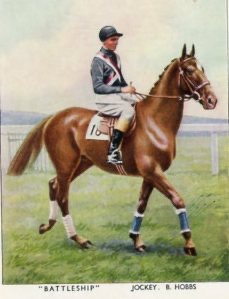
Battleship was officially recognized as a British hero when he got his own tobacco card. He died in 1958 at 31, and was inducted into the American Hall of Fame in 1969.
Blockade, who was as small as his more famous half-brother Battleship, competed in America’s most prestigious National Hunt races from 1938-1940 and was an absolute superstar. In 1938, when his beloved sire Man o' War celebrated his twenty-first birthday, Blockade won the Maryland Hunt Cup run over a distance of 4 miles with 22 jumps in record-breaking time. Famous author and illustrator C. W. Anderson’s gave this account of Blockade’s win:
“…He went off in front and stayed there. The pace was terrific for such difficult fences, but it suited him. Blockade jumped big, much bigger than most horses. Those who took off head and head with him usually went down. He was cut on the pattern of his great sire: he did things in a grand way."
Those were heady times for Man o' War's progeny. War Admiral won the Triple Crown in 1937, and then in 1938 Battleship won the Grand National at Aintree. and Blockade won the Maryland Hunt Cup. But the biggest event of 1938 was the Seabiscuit-War Admiral Match Race -- a son and grandson of Big Red going head -to-head in a race for the ages.
Blockade continued his dominating performances in 1939 and 1940, winning the Maryland Hunt Cup twice more. To win it once was outstanding, but to win it three times was unprecedented. Fittingly, the next horse to win the Cup, Mountain Dew, was out of a daughter of War Admiral.
The Maryland Hunt Cup is still run to this day. In 1939, Blockade edged out superstar Coq Bruyere in what was regarded as the most exciting horse race of the season. Blockade covered the 4 miles in a record 8:44 — a time that stood for 22 years. In 1939, Blockade also won the Maryland Grand National, a race which is still run today under its new name, “The Breeders Cup Grand National Steeplechase.” By then, Blockade had become a legend, and his victories made headlines across the country.
Blockade was entered in the prestigious Virginia Gold Cup in 1942. Tragically, he went down at the seventeenth fence. As described by William Myzk in his book, “The History and Origins of the Virginia Gold Cup” :
“The crowd was hushed, waiting for word that their hero had only been knocked out, but no word came. The great Blockade had jumped his last fence and run his last race. A saddened audience went slowly home, knowing that they had witnessed the passing of one of the gamest sons of the great Man O’ War.”
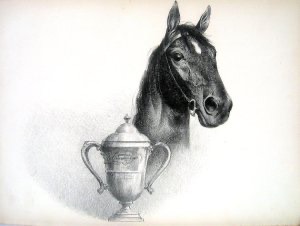
Blockade, triple winner of the Maryland Hunt Cup
Man o' War's owner, Samuel Riddle, only bred him to about 25 of his own mares each year and to several mares owned by his close friends. This is a far cry from the hundreds of mares covered annually by today's top stallions, so it's remarkable that his legacy remains as powerful as it is to this day.....a testimonial to the staying power of his genes! In fact, many modern breeders still devise matches to concentrate the influence of Man o' War through deep inbreeding.
Based on contemporary descriptive accounts in the mid 1700's, it appears that the fabled Godolphin Arabian, Man o' War's tail-male ancestor, had certain powerful conformation qualities that the two other foundation sires did not have. The well- regarded author and veterinary surgeon William Osmer, who saw him, wrote:
”There never was a horse…so well entitled to get racers as the Godolphin Arabian. Whoever has seen him must remember that his shoulders were deeper and lay farther into his back than any horse yet seen; behind his shoulders there was but a small space; before the muscles of his loin rose excessively high, broad, and expanded, which were inserted into his quarters with greater strength and power than any horse ever yet seen of his dimensions." It should be noted that in addition to his direct tail-male connection, Man o' War's ancestry had numerous crossings to the Godolphin line. Perhaps these genes contributed to Man o' War's physical might, racing prowess, and extraordinary stud record.
Dorothy Our, in her great 2006 book Man o' War - Legend Like Lightning, gave an apt description in commenting on his appearance as a sprinter and long distance horse: "He looked like both. His extra-wide bodybuilders chest promised sheer strength, while his deep and well-rounded rib cage promised exceptional lung capacity. His straight hind legs said rapid propulsion, while the long cylinder of his torso stretched over a lot of ground -- all the better to cover any distance with fewer strides."
Barbara Livingston in her article Chasing Man o' War's Ghost in DRF trending (3/24/17) captured the continuing all-pervasive influence of the great horse in this quote: "Man o’ War was truly the stuff of dreams -- so grand that even 100 years after his birth, as other greats like Domino, Whirlaway, and Citation fade into the background, he remains the benchmark for greatness.....In 100 years, will Ruffian and Secretariat still be spoken of with the reverence they are now? I don’t know, but I’m certain Man o’ War will."
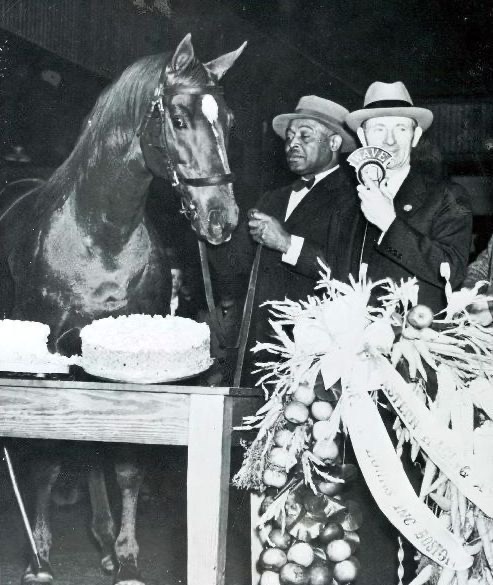
MAN O’ WAR celebrates his 21st birthday with a cake. With him is his beloved Will Harbut and radio sportscaster, the legendary Clem McCarthy, who announced the famous War Admiral-Seabiscuit match race
MAN O' WAR'S PARENTAGE
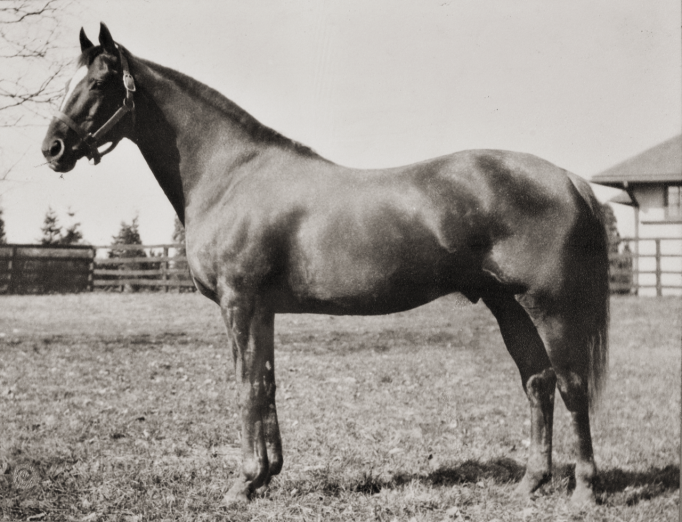
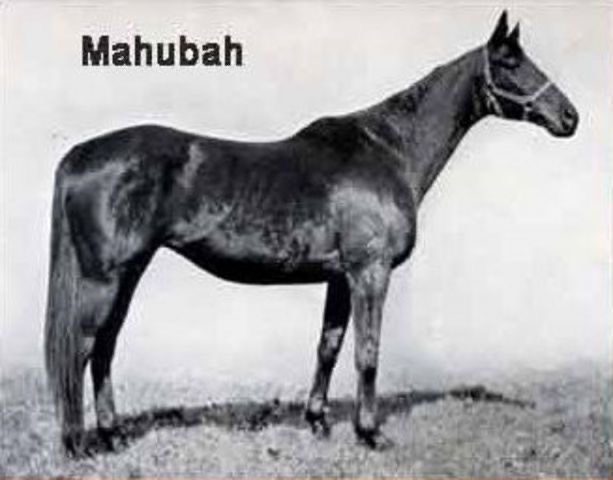
Fair Play, Man o' War's sire Mahubah, Man o' War's dam
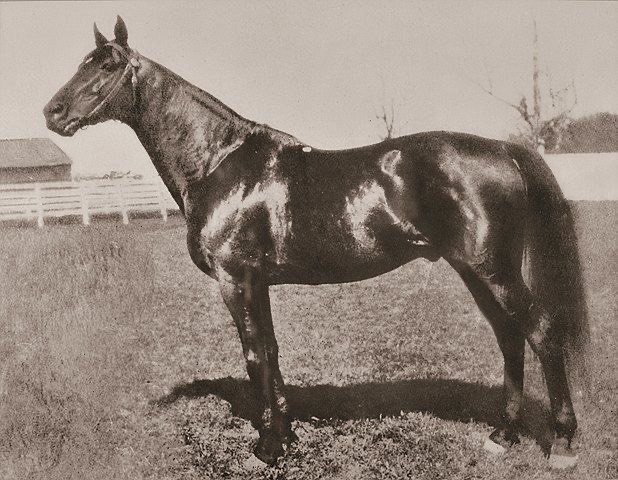
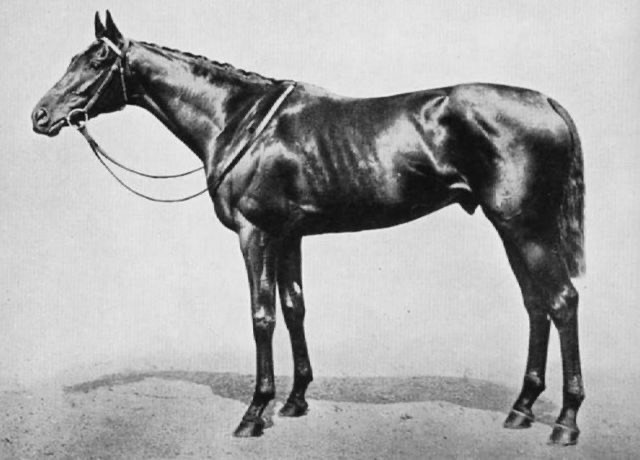
Hastings, Fair Play's sire Rock Sand, Mahubah's sire
THE YOUNG MAN O' WAR
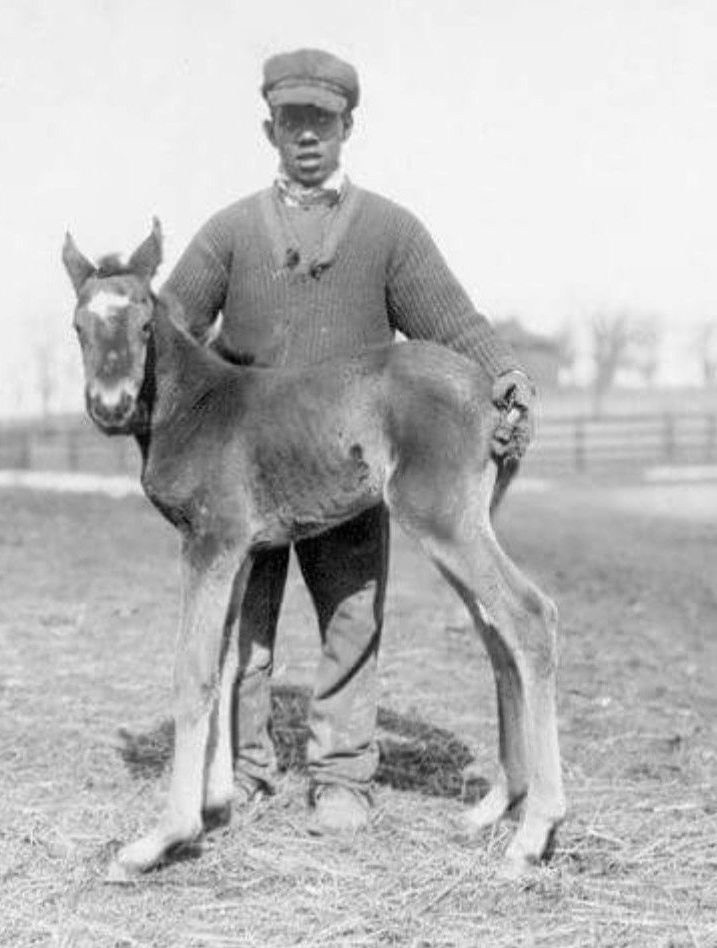
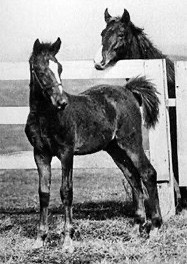
Man o' War as weanling and with his dam Mahubah, daughter of
English Triple Crown Champion, Rock Sand
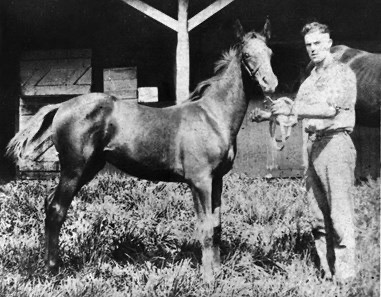
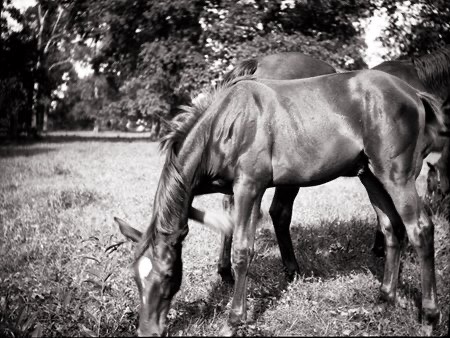
The young Man o' War...the promise before the all-time proven superiority
The closing paragraphs of Dorothy Ours' book are worth repeating verbatim:
"And Man o' War? People imagined perfection for him: a Speed Miracle that never got tired and always could give something more. In one telling tribute, on April 12, !947, the First Cavalry Division of American troops occupying Japan made Man o' War an honorary colonel. When he died, at the impressive age of thirty, the division's three thousand soldiers saluted him in Tokyo.
Weakened by several heart attacks, Red's body gave out at Faraway Farm on November on November 1, 1947. On November 4, a radio broadcast of his funeral ceremony, including nine eulogies and a bugler playing 'Taps,' aired throughout the United States. His embalmed remains, interred beneath the marble pedestal of his heroic bronze statue, were moved in 1947 to a spotlighted site near the front of the entrance of Lexington's popular Kentucky Horse Park. Visitors can view his monument there free of charge. Imagination can carry them back in time, where a red horse is bounding toward the finish line, setting the bar for legends to come."
The nature and scope of these tributes have never been matched for any other thoroughbred racehorse before or since. Truly one of a kind for all time.
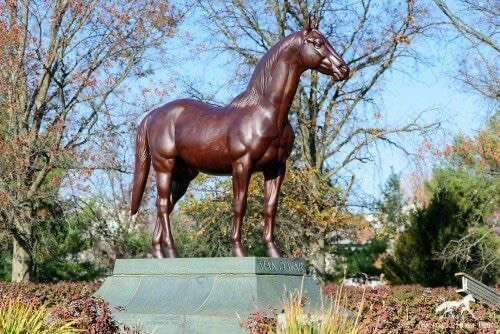
Refurbished statue for Man 0'War's 100th birthday in 2017
Big Red in all his regal glory.....for the ages
A fitting way to close this chapter is to cite the contents of a brilliant website on Man o' War which was put online in 2017. The website Man o' War Racing Icon (https://manowar.info/) is the most scholarly, comprehensive, and definitive compilation of the great horse's lasting impact on thoroughbred racing. The culmination is a chapter on Top Horses of the Century, which includes the names of all members on three different panels of experts which voted on this -- and all named Man o' War the best horse of the 20th Century. Even more importantly, the compilation consists of four other chapters relating to Man o' War's powerful influence -- Historical Champions, Eclipse Champions, Classic Winners, and Hall of Fame. In each of these chapters, the descendants of Man o' War are highlighted in orange, and the number is absolutely staggering.
Following is the chapter on Top Horses of the Century from this website.
"Top Racehorses of the 20th Century
Several organizations offered opinions on the top horses of the 20th century as the year 2000 loomed.
In 1992, Sports Illustrated magazine created a panel of seven experts: ABC Sports broadcaster Jim McKay; Arlington International Racecourse steward Tommy Trotter; retired California racing official Frank E. Kilroe; executive columnist of the Daily Racing Form Joe Hirsch; Hall of Fame trainer Woody Stephens; secretary-treasurer of the National Turf Writers Association Jim Bolus; and columnist and author William F. Reed. They chose Man o' War and Secretariat, in that order, as the top two of the century.
In 1999, the Associated Press asked a panel of six voters a similar question; four chose Man o' War as best, one named Secretariat, and the sixth picked Tom Fool. Below left are their choices for the top 10 competitors. Apart from Big Red himself at the top of the list, all horses marked in orange are descendants of Man o' War. If you'd like to check on any horse's pedigree, click here: www.PedigreeQuery.com.
In 1999, The Blood-Horse magazine assembled a seven-person panel of eminent horse racing people: Daily Racing Form columnist and author Jay Hovdey, California senior steward Pete Pedersen, Gulfstream Park steward Tommy Trotter, Keeneland racing secretary Howard Battle, Louisville Courier-Journal racing writer Jennie Rees, Maryland Jockey Club vice president Lenny Hale, and Sports Illustrated senior writer and author William Nack. Each of the experts compiled a list of horses they considered to be the top 100 Thoroughbred racehorses of the 20th century. The lists were then compiled into a master list, the final order decided by averaging the placement of specific horses on the individual lists.
Below right are their choices. Again, apart from Big Red himself, all horses marked in orange are descendants of Man o' War. Check on any horse's pedigree at www.PedigreeQuery.com.
Click on the buttons along the top to reach the lists of Consensus American Historical Champions, Official American ('Eclipse') Champions, American classic winners, and the list of the Thoroughbred Racing Hall of Fame inductees with Man o' War blood.
Click on the buttons along the top to reach the lists of Consensus American Historical Champions, Official American ('Eclipse') Champions, American classic winners, and the list of the Thoroughbred Racing Hall of Fame inductees with Man o' War blood.
Rank
Associated Press Top 10
Rank | Horse |
|---|---|
1 | Man o' War |
2 | Secretariat |
3 | Citation (tie) |
3 | Native Dancer (tie) |
5 | Kelso |
6 | Tom Fool |
7 | Dr. Fager |
8 | Count Fleet |
9 | Spectacular Bid |
10 | Forego (tie) |
10 | Seattle Slew (tie) |
Sports Illustrated Top 2
Rank | Horse |
|---|---|
1 | Man o' War |
2 | Secretariat |
The Blood Horse Top 100
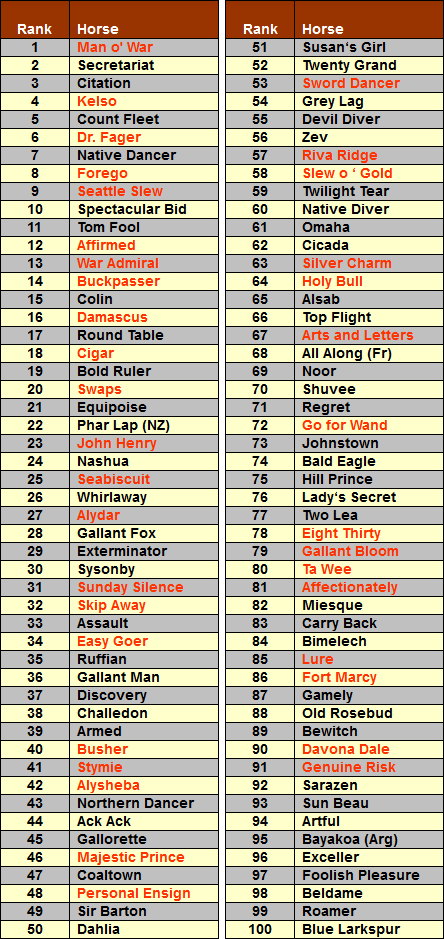
This is a tail-male descendant of Man o' War - a colt born in April 2015, sired by Master James of the War Relic/In Reality line, and out of the dam Intravenus. The cute little guy who is four days old in this photo is the 6x great grandson of Big Red.
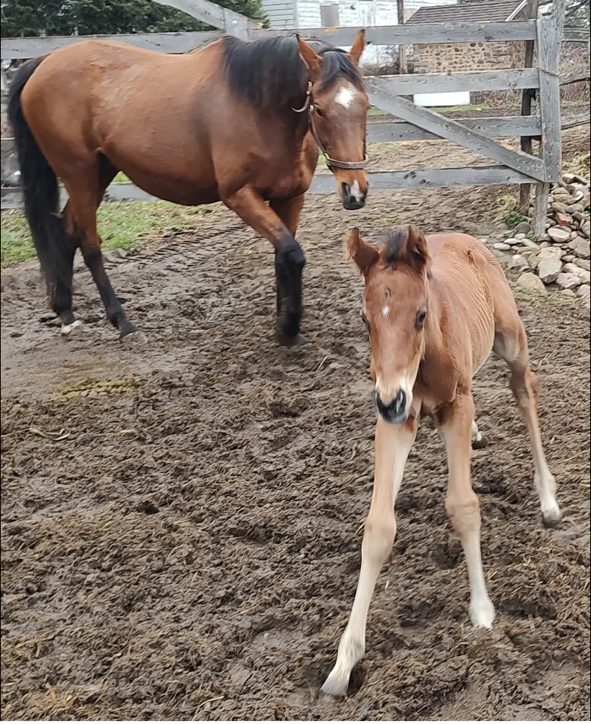
CHAPTER IV
The Legendary & Unique Dr. Fager
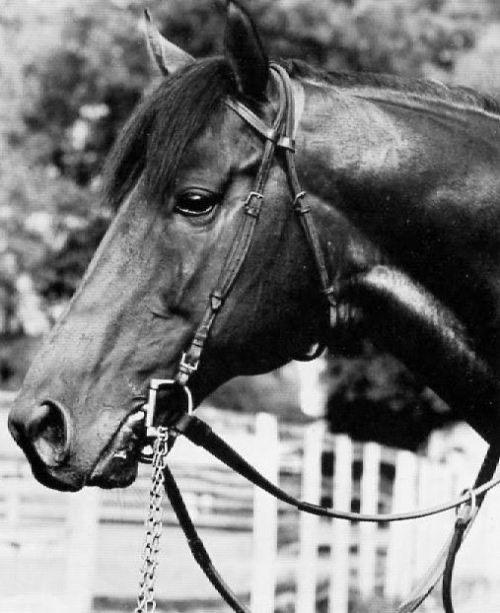
![C:\Users\user\Desktop\Dr. Fager\FagerUN%20Hcp[1].jpg](assets/image54.jpeg)
Thoroughbred writer Terry Conway put it best: "He was a 'freak' before the label was coined. A colt with uncommon desire and dash, Dr. Fager put away swift horses with relative ease. Headstrong and maniacally competitive, any horse that dared to pass him risked being lunged at and savaged. When the leggy bay wanted the lead there was no one to stop him." “He could punch a hole in the wind,” marveled his regular rider, Braulio Baeza, who learned not to try to control him when he wanted to run, and never had to urge him on at any time in a race. “I never in any of his races knew how fast he was going,” he said. “He moved so smoothly and his action was so fluid I felt like I was in a Lear Jet. All I knew was that he was going faster than the rest of them. I’d try to slow him down, but he’d still pull away from them.”
Dr. Fager's pedigree was spectacular on both his sire's and dam's side. He was the great-great-great grandson of Man o' War, and his dam's lineage includes Phalaris, who is the foundation stallion for many of today’s champion bloodlines.
To many experts, Dr. Fager was the fastest horse who ever ran. His hall of fame trainer, John Nerud, who had been around horses since he was five years old, confirmed this perspective when he said: "Dr. Fager was the fastest horse I ever saw. There was never a horse in the world who could run with him and win.” His mind-boggling 1:32 1/5 dirt mile carrying 134 pounds in the Washington Park Handicap at Arlington Park in Chicago against a strong field in August 1968 smashed the world record, even though he was eased up at the end by Baeza, who had a ten-length lead and didn't realize a world record was at stake. In any case, that mark still stands....58 years later (as of 2026)! His 2nd quarter mile time of 20 3/5 seconds was the fastest quarter mile ever run in any non-sprint race at any distance....to this day!
In fact, with each passing year's Breeder's Cup dirt mile - which draws the world's best dirt milers -- Dr. Fager's world record looks more and more astounding. The 2018 winner, City of Light, carrying top weight of 126 pounds at Churchill Downs, finished in a very fast time of 1:33.83 -- in fact, the second fastest time in the history of the race which has been run since 2007. Comparing this to Dr. Fager's time of 1:32 1/5 while carrying 134 pounds, one can appreciate why this record has stood for more than half a century. In fact, it should be noted that his 134 pounds was the heaviest weight ever carried in the 94-year history of the Washington Park Handicap!
Horseracing guru and one of my favorite thoroughbred racing writers Steve Haskin says this: "Over the decades, those of us around to experience and truly appreciate this historic event keep asking the same question. If only he had been given the opportunity, how fast could Dr. Fager have run that day? The legendary jockey Ted Atkinson (said) after the race, 'Hell, he could have done it in (one) thirty and change. He was six lengths within himself.' What is important is Atkinson’s comment that had he been asked to run even slightly, Dr. Fager could have run the mile in a mind-boggling 1:30 and change. Even if you don’t agree, it is difficult to argue that he would have run 1:31 or no worse than 1:31 and change. One thing is fairly certain. Although it still has not been surpassed after 48 (now 58) years, Dr. Fager’s world record would be almost as unreachable as Secretariat’s Belmont Stakes record." In my view, perhaps even moreso!
He won 18 of his 22 races, finished second twice, and third once. The only time he was out of the money was as a result of a highly controversial disqualification by a prejudiced steward in a race in which he finished first by 6 1/2 lengths. Two of his three true losses were due to opposing owners purposely putting a "rabbit" in the field to take advantage of the Dr. Fager's penchant for not ever letting any horse get in front of him (his only flaw)....making him vulnerable to closers at the end who didn't get caught up in the suicidal speed duel and waited for the "rabbit" to fold. His only other loss was a close one, as an early 2-year-old juvenile still learning the ropes, and under a bad ride by a jockey who couldn't handle him.
Dr. Fager always carried staggering handicap weights, the most of any thoroughbred to this day since the incomparable and consensus all-time top-rated Man o' War. He had a huge flowing mane, a big forelock, and a massive sweeping tail -- all of which gave the impression of a wild war horse when he was on the racetrack.....making him an even more fearsome opponent to other horses and jockeys.
Various health issues kept him out of the Triple Crown races at age three, but later that year he still won seven stakes races, setting two track records. Dr. Fager's four- year-old season, 1968, was one for the ages. Following his world record mile, his final race was an even more incredible tour de force: the Vosburgh Handicap at Aqueduct, which in the pre-Breeder's Cup era was the most important sprint race (7 furlongs or 7/8 mile). He was assigned an unheard of weight of 139 pounds (the Racing Secretary originally wanted to assign a weight of 145), giving an astounding 12-34 pounds to six quality sprint rivals. The main competitor was a champion sprinter who had already beaten hall of famer Buckpasser and other stakes champions that year. To add to the challenge, the track had just been winterized with a deep cushion, which made the running surface two seconds slower than normal!!
Under a pure hand ride with no urging, Dr. Fager crossed the wire 6 lengths in front, beating the track record by a full second and missing the world record by 1/5 of a second, which would have been smashed with any urging by the jockey, and even more so with a normal hard track surface. His jockey said later that knew the track was slower than usual and felt that "Dr. Fager was going so easily there was no way he was going to break any records, especially with 139 pounds on his back..... If I knew how fast he was going I would have chirped to him and he would have gone faster." His track record time of 1:20 1/5 lasted 31 years before it was broken by sprint champion Artax, who ran 1/5 second faster carrying 25 pounds less than Dr. Fager!!
Here are Steve Haskin's words: "That ended an amazing career and a 4-year-old campaign unlike anything seen before or since, resulting in an unprecedented four championships (Horse of the Year, Handicap Horse, Sprinter, and Turf Horse), a feat that has never been duplicated." (...and almost certainly never will.) "As the horse emerged from the barn and strode majestically into the chilling November air, a gust of wind blew his long mane on end, giving it a plume-like effect, as if atop the head of a Spartan warrior. Dr. Fager arched his neck and flared his nostrils just as he had done so many times in battle and as he had done before....he always seemed to know the importance of the moment."
"It took a rabbit, the stewards, and an admitted bad ride by hall of fame jockey Bill Shoemaker at age 2 to beat him. Only three horses ever finished ahead of Dr. Fager. Two of them are in the Hall of Fame." (Horses of the Year Buckpasser and Damascus, and the other was the juvenile champion Successor who took advantage of the bad ride by Shoemaker. Shoemaker later admitted that he was actually scared of Dr. Fager, and told trainer John Nerud: "John, this horse is just too much for me.") John Nerud said of his most famous thoroughbred: "Any horse that ran head-to-head with him had to get beat. No horse could look him in the eye and survive."
Dr. Fager was named after the neurosurgeon who saved John Nerud's life with emergency surgery to remove a blood clot on the brain in 1965. The medical Dr. Fager could never have imagined how his name would be immortalized. The equine Dr. Fager had an unusual personality. Although he was a terror on the track, he was kind and gentle in the paddock. He was also very sensitive....he didn't like to be scolded, and absolutely detested the whip, which all of his jockeys quickly learned, sometimes the hard way, and realized that hand rides worked best with him. As Steve Haskin put it: " (The racetrack) would become Dr. Fager's domain, and once the gates opened, there was no human on earth who could tell him what to do."
Some other quotes from Steve Haskin help paint the full picture of this amazing and wondrous animal:
"That was Dr. Fager. A force of nature who took the fire that was bred into the Thoroughbred 250 years earlier and ignited it at racetracks all over the country, running with reckless abandon. It is safe to say we will never see his like again."
"But statistics, mind-boggling as they were, are only a part of the Dr. Fager legacy. With his long mane blowing wildly in the breeze and fire burning in his eyes, he was a force of unharnessed energy. It was as if he had leaped off the pages of a children's novel.
"Even the fastest of the fast crumbled when Dr. Fager looked him in the eye."
Throughout his life, Dr. Fager had stomach problems and was plagued by frequent bouts of severe colic, which John Nerud had learned to treat to keep him doing what he liked to do best -- run like the wind. In the end, it was his demise; in 1976 at the young age of 12, he died of a ruptured stomach. Even with such a shortened stud career, he turned out to be a successful sire, especially with his fillies, many of whom became champion broodmares.
I asked Steve Haskin if any horse he had ever seen could beat Dr. Fager in a match race, and that includes the three triple crown winners of the 1970's (Secretariat, Seattle Slew, and Affirmed) as well as American Pharoah, Arrogate, and Justify up to the present. His reply: "As for Dr. Fager, I don't believe any horse could beat him in a match race whether it was 6 furlongs (3/4 mile) or 1 1/4 miles." In a match race, he would be his own unbeatable "rabbit." Now of course, Steve never saw Man o' War -- Dr. Fager's great-great-great grandsire. So, in my mind's eye, a match race between those two indomitable wills would be an event for the ages!
Thoroughbred rankings have Dr. Fager pegged between fourth and sixth on the all -time list -- behind only Man o' War, Secretariat, and Citation....and sometimes Kelso and Count Fleet as on the BLOODHORSE list of Top 100 Racehorses of the 20th Century. Rare company indeed for the legendary Doctor! For a more complete account of his life and times, see Steve Haskin's book in the Thoroughbred Legend Series: "Dr. Fager - Racing's Top Record Setter." See the Appendix for a thoroughbred industry insider's appreciation of Dr. Fager.
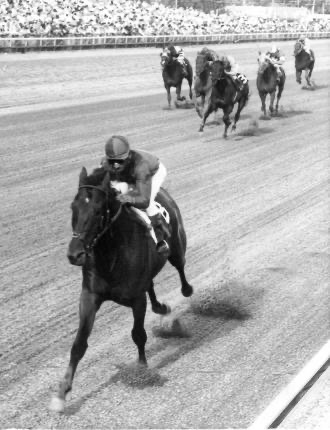
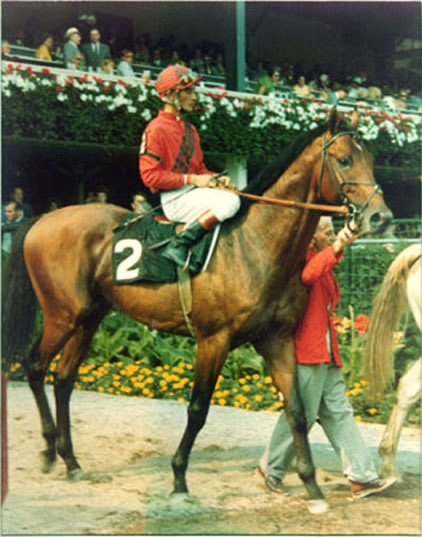
APPENDIX
THE HORSE-HUMAN RELATIONSHIP
Articles in a number of recent publications, including NewScientist and Smithsonian Magazine, highlight the results of a scientific study published on June 6, 2024 in the journal Nature, where archaeologists used DNA analysis to trace horse domestication timelines. The study found that modern horse bloodlines have origins some 4,200 years ago. Reproductive control of the modern domestic lineage emerged about 2,200 BC in Eurasia, leading to widespread horse-based mobility. This refutes the commonly-held notion that large horse herds accompanied the massive migration of steppe peoples across Europe about 3,000 BC and earlier.
Wild horses were first domesticated 5,500 years ago by early hunter-gatherers in what is now Kazakhstan, probably used for their milk and meat. But the culture died out without sharing their practice, and the horses returned to the wild throughout Central Asia.
Then some 1,300 years later, humans domesticated horses once again - a different line of horses in the Pontic-Caspian steppes of southern Russia. According to the research, Bronze Age people employed breeding techniques to develop specific traits that made superior riding and chariot horses. That enabled the rapid spread of horse-powered travel throughout Eurasia, and through this breeding, a new equine bloodline emerged.
These ancient breeders dramatically shortened the natural generation times of horses. This intensive in-breeding led to an expansion of those bloodlines across Eurasia within a few centuries. It was this line that ultimately spread across the globe, leading to every domestic horse in the world today.
In Horse Power, New York Times Magazine (September 8, 2024), Robert Sullivan reviews a 2024 book by David Chaffetz - RAIDERS, RULERS, AND TRADERS; The Horse and the Rise of Empire. Excerpts:
"Chariots showed up before saddles.......As chariots appeared in battle, horses took on a new value. Herdsmen bred the warhorse, and found it an ideal soldier in arms. 'No other quadruped will jump over obstacles, pass through flames and explosions, or carry on when wounded', Chaffetz writes. 'Humans have weaponized the fight-or flight instincts of the horse for mass cavalry charges.'
Eventually mounted warriors from the western steppe beat the charioteers, thus changing the balance [of power] between the people living in stationary Mediterranean cities and the more migratory herders of the outlying steppe. 'Even relatively small steppe nations could defeat powerful settled states', Chaffetz writes.
Great civilizations soon necessitated great numbers of horses. In the sixth century BC, Persia, Cyrus the Great created stud farms.....Genghis Kahn marshaled 10 million horses, maybe half the world's total. With them, his descendants controlled 16 % of the earth's landmass. Having survived the steppe himself, Khan saw the way that pastoralism could be militarized. Horses brought to graze on the land for meat, milk, and clothing, could also, as they multiplied, be summoned up for battle, providing the Mongol Empire with a kind of moving, self-perpetuating war factory. 'Army units traveled with the personal herds of their troopers and their families', Chaffetz writes."
And so the horse assumed a powerful new dimension in its relationship with mankind, one that led to a multitude of other unique shared roles extant to the present day.
Excerpts from: The Horse/Human Connection, by Franklin Levinson
”Majestic, noble, proud, magical, mystical, powerful, naturally beautiful, living-breathing art, the embodiment of grace athleticism and strength. These are just a few of the ways humans describe horses. We also attribute to the horse some of the qualities we humans strive for in ourselves. Qualities such as loyalty, integrity and honesty are part of the horse's natural being. A horse always gives us an honest response to what is presented to it. It does not have an ego to cloud its perception.
Horses and humans have been joined since the first newborn foal was taken from its deceased mother mare and raised by its captors. Before that and since many horses have been food for humans and been their prey. But as soon as we had the knowledge and ability to raise a horse from infancy we had to make a very important choice. The decision is whether to lead this young creature into the rest of its life, as a domesticated animal, through force (i.e. fear-based control) or to lead it through trust, respect, knowledge and mutual agreement (i.e. love). One way produces a slave, a being whose actions are motivated by fear of punishment, a captive. The other way produces a willing partner, a loyal and trusted friend. It builds a relationship with respect and trust at its core.
The question becomes, how do we lead this wild, magnificent creature who is more powerful and bigger than we are, without using the force that produces a slave. The first part of the answer comes through learning about the horse and it's language. This is done by observation of the animal in its natural state, in the wild. How it communicates with other herd members. The dynamics of its social structure and how older horses teach and discipline the younger ones (who is the boss and why).
Some of the earliest memories young horses have is of how their mothers and other older herd members communicated with them. This was done through body language, touch and sound, along with other sensory stimulation. We must learn this language in order to communicate with the horse in such a way as not to produce fear but rather to promote feelings of safety and security in the horse. When the horse has all the assurance it needs to know it is safe, it will want to "join" with us in kind of a communion of spirits. After all, we are not separate from nature. Like the horse, we need to feel safe within ourselves in order for our lives to flourish. The horse is always ready to be our willing and loyal partner but only to the degree we are willing to extend peace, respect and love to this most magnificent creature to flourish. The horse is always ready to be our willing and loyal partner but only to the degree we are willing to extend peace, respect and love to this most magnificent creature."
Mutual Trust and Interdependence
Excerpts from: Article on Dr. Caroline Willikes, by Katherine Sharples,
Mount Royal University, January 9, 2023

Dr. Carolyn Willekes, PhD, assistant professor of general education at Mount Royal University, Calgary, Alberta, Canada, has been a horsewoman for more than 30 years, and is a seasoned re-enactor of equestrian events simulating Roman and medieval mounted warfare.
"Willekes researches historic horse-human interactions and....how past humans worked with and trained [horses] to participate in both war and entertainment. She says that the element of this relationship that always stands out is the partnership that exists between horse and rider: 'It’s easy to overlook the existence of an emotional bond, particularly when looking at the history of the war horse, as it can be difficult to wrap our heads around the fact that someone would ride a horse they cared about into war, but this was central to the very existence of cavalry,' Willekes says.
Understanding the horse-human interaction is important to modern society, Willekes explains. The horse is an introduced species to many parts of the world, and in many cases that introduction occurred as a result of colonialism and conquest. Yet, over and over again the horse is accepted into the community and becomes a part of its cultural identity. The horse-human connection has allowed the animal to remain integral long after events like the industrial revolution and the mechanization of agriculture, transportation and warfare, which speaks to the ways in which humans connect with the horse on a personal level."
Excerpt from: Sports Illustrated Article, November 19, 2021
Sports Illustrated featured a young equestrian, Zoie Brogdon, 16, who captured the connection perfectly: "Me and my horse Ninja are best friends. He is my partner in crime. We do everything together. I absolutely love him. To get that emotional with any animal that you bonded with is such a special connection. For me and my horse, we've grown together and we know each other so well. It's not like a dog or a cat; they're not just your pets. This connection goes a bit deeper. You trust your horse with your life, and they're trusting you with theirs. It's a team effort—you have to have a certain communication."
Documentary Movie: My Heroes Were Cowboys
This wonderful 2021 short documentary movie perfectly captures the close mystical bond between human and horse. Captivated by Westerns he saw on the silver screen, young Aussie Robin Wiltshire came to the American West to pursue his dream and passion as a cowboy training horses. Becoming a true "horse whisperer", Robin and his horses demonstrate the mutual love, compassion and respect they have for each other - and the trust, patience, and gentle methods required to teach an animal new skills.
Wiltshire's first break came when his horses appeared in the famous Marlboro Man cigarette ads in the 1990s. He went on to train the famous Budweiser Clydesdales in many commercials (including the Super Bowl), and trained horses for hit films Rocky IV and Django Unchained. He now owns Turtle Ranch in Wyoming, which is a horse training facility. This documentary, shown on NETFLIX, is a must for anyone wanting to see graphic proof of the powerful human-horse relationship.
Rob Wiltshire training one of his horses
NOTABLE TRIBUTES TO MAN O' WAR
It's astonishing to note how many articles in various publications still refer to Man o' War as the greatest racehorse of all time - and this is 100+ years after his last race and 50+ years after his namesake "Big Red", Secretariat, set records in all three triple crown races. Following are some of these:
Man o’ War: The Measuring Stick for Greatness
Legends
December 26th, 2016 by Terry Conway
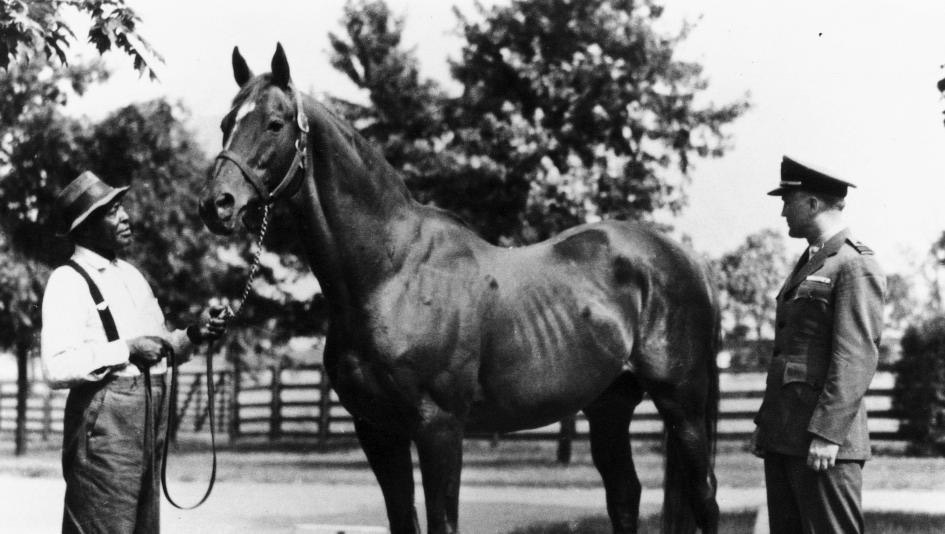
5Man o' War is regarded as one of the greatest Thoroughbreds of all time. (Blood-Horse photo)
Perched high on the bluffs above the Susquehanna River and at the headwaters of the Chesapeake Bay sat one of America’s most revered racetracks, Havre de Grace. Racing history was minted here.
During early morning works the mist rose like steam from the water, the sun pale and golden. In the Spring of 1919 a feisty Man o’ War turned up in preparation for his 2-year-old campaign. “Big Red” had the whole backstretch buzzing. Ruggedly handsome, he struck his regal, high-headed stance. His coat was rubbed and brushed, and gleamed like polished copper. Grooms, exercise boys, and trainers hugged the rail when he stepped onto the loamy track. With his long, effortless stride Man o’ War ran other horses off their feet from the beginning.
Man o' War Foaled: March 29, 1917 Died: November 1, 1947 Birthplace: August Belmont III’s Nursery Stud, Lexington, Ky. Sire: Fair Play Dam: Mahubah Owner: Sam Riddle, Glen Riddle Farm, Berlin, Md. |
|---|
In all the history of American horse racing no Thoroughbred has ever quite matched either the brilliance or popularity of Man o’ War. He is the measuring stick for greatness in horse racing. Though he competed for just two years, Man o’ War was a national hero, joining Babe Ruth, Jack Dempsey and Red Grange as the first shining stars of the "Roaring Twenties".
"He was as near to a living flame as horses ever get, and horses get closer to this than anything else," wrote legendary racing writer Joe Palmer. “It was that way even when he was standing motionless in his stall, with his ears pricked forward, and his eyes focused on something above the horizon which mere people never see, energy still poured from him.”
Man o’ War was bred by one of the premier sportsmen of the American turf, August Belmont III. He was a son of Fair Play out of Mahubah, both of whom Belmont bred and raced. The chestnut colt inherited a fiery disposition from Fair Play, the archrival of the fabulous Colin. Fair Play’s sire, Hastings, was a hellion as well.
In spring 1918, Belmont, now in his sixties, departed his Nursery Stud to answer the call of his country and served as a major in Spain in the U. S. efforts in World War I. With that fateful decision Belmont also announced the sale of his entire yearling crop at the upcoming Saratoga sale.
Pennsylvania’s Sam Riddle with his trademark straw boater hat and sporting a bottlebrush mustache was at that August sale. He became, arguably, the luckiest man who ever bid on an American Thoroughbred when the gavel fell on Fair Play's powerfully built colt at $5,000. That day six yearlings went for more than that sum. Later that afternoon, Man o’ War and 10 other horses walked up a ramp into waiting box cars destined for Riddle’s Glen Riddle Farm in Media, Pa. Later, Riddle moved him to his other Glen Riddle Farm located near Berlin, Md.
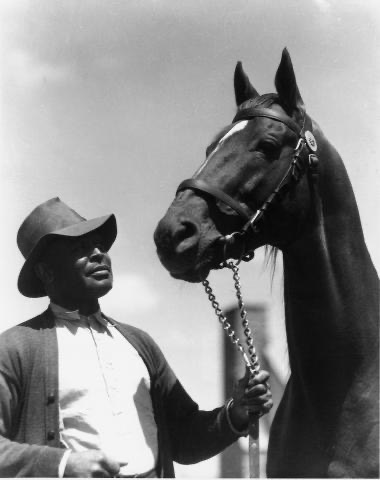
Man o' War with his groom, Will Harbut. (Blood-Horse photo)
Trainer Louis Feustel began the chore of breaking him. Man o’ War fought every step and repeatedly dumped his rider.
“He was a tough horse to saddle,” said Feustel. “You couldn’t tighten the girth all the way or he would jump right up and out of the stall.
“He was always in a hurry. If I wanted him to walk, he wanted to jog. If I wanted him to jog, he wanted to gallop. No matter what I wanted, he wanted to go faster.”
Man o’ War made his first start at five furlongs on June 6, 1919. With Johnny Loftus in the irons, the chestnut colt ran away from his six rivals winning by six lengths, “cantering,” as the Daily Racing Form chart called it.
Big Red’s spirit could be bridled yet never tamed. He swept past his overmatched opposition, regularly shattering speed records. It was not just his warp speed. It was the aura. It was the oversized crowds pushing to the rail to get a glimpse of him. Ears pricked, muscles rippling beneath his copper coat, he radiated majesty, energy and power.
As his wins climbed, so did the weight as racing secretaries piled it on. By his fourth race, the giant-striding Man o’ War was lugging 130 pounds, a hefty weight for a developing 2-year-old. His lone blemish came in the Sanford Memorial. In that era, jockeys circled around and then gathered their horses in a line behind a piece of webbing known as the barrier and were off running when it was raised. Man o’ War was circling with his back to the starting line when it went up. Ten lengths behind, he made up the lost ground but finished a half-length short of Henry Payne Whitney’s Upset. He toted 15 pounds more than the winner.
The winner of nine of his ten starts in 1919, he was selected Horse of the Year. By age 3, he was a strapping 16.2 hands and weighed about 1,125 pounds with a 72-inch girth. His stride measured an incredible 28 feet.
Man o' War and Will Harbut. (Blood-Horse photo)
Man o’ War set an American record in the 1920 Belmont Stakes, a race he won by 20 lengths without being extended. He scored victories the Preakness, the Withers, the Dwyer Stakes, Stuyvesant Handicap and romped in the Travers, setting a track record that was not broken until 42 years later. Then he blew away his rivals in the Lawrence Realization, Jockey Club, and Potomac Handicap.
“Man o’ War did not beat, he merely annihilated,” wrote Joe Palmer.
The crowning achievement of Man o’ War’s career came in a match race against the top-rated older horse Sir Barton that would decide Horse of the Year.
Racing at Kenilworth Park in Ontario, Man o’ War kicked dust in Sir Barton’s face, whipping him by seven lengths. Despite the jockey’s broken stirrup, he took more than six seconds off the track record. He went to the post 21 times and won 20 races.
Nine decades later no champion Thoroughbred has dominated his respective era like Man o’ War. In the end, it was the excessive weight racing secretaries assigned to the handsome champion that sent him to stud. At the time of his retirement, Big Red was the greatest money-winning Thoroughbred, earning $249,465.
Epilogue
During 23 years as a stallion, Man o’ War produced 64 stakes winners, including Hall of Famers Crusader, Battleship and War Admiral (Riddle’s 1937 Triple Crown winner). The fillies he sired became outstanding broodmares who produced 124 stakes winners.
Will Harbut was Man o’ War’s stud groom for more than 15 years. He handled all the day-to-day duties, ushered him into the breeding shed and led him out of a small barn into his paddock to meet the steady stream of admirers (estimated at more than a million).
A visit with Man o’ War always began like this: “Folks, this is Man o’ War, the greatest horse that ever lived," said Harbut, in his rich, melodic voice. “He’s the most and he’s going to go on being the most as long as you and I can tell about it.”
When Man o’ War died at 30 on Nov. 1, 1947, his burial was a moment of national mourning. More than 2,000 people attended his funeral, which was broadcast over radio. Faraway Farm was his original burial site. Nearly 30 years later Man o’ War and his heroic-size statue (20 hands tall, 3,000 pounds of bronze) were transferred to the Kentucky Horse Park. Here at the end of the entrance drive, his grave and statue serve as a beacon and sentry to horse fans from all over the world.
Fun Facts
Mrs. Belmont conferred the evocative name of Man o’ War to honor Major Belmont’s military service.
Trainer Feustel’s brother who worked around the barn was called “Red” for his auburn hair. As Man o’ War grew to more than 16 hands, he picked up the name “Big Red.”
His appetite was huge. He ate 12 quarts of oats every day, or about three quarts more than the average racehorse.
Stable employees claimed that Man o' War had nightmares for weeks after his only defeat by Upset, and he never lost again.
He held American records for the fastest mile, 1 1/8 miles, 1 3/8 miles, 1½ miles and 1 5/8 miles. He didn’t just take a tick off time records, he obliterated them.
He lugged 130 pounds six times as a 2-year-old and was saddled with as much as 138 pounds at age three.
He was odds-on in all 21 races. Three times bookmakers quoted him at 1-100. In the Lawrence Realization Stakes he won by an incredible 100 lengths at Belmont Park in 1920.
When he was retired from the track, Riddle turned down $1 million offer to sell his champion. Said Riddle, "lots of men have a million dollars, but only one can own Man o' War.”
It would more than 35 years before any Thoroughbred would be sold for that amount.
Remembering the Greatest of the Greats - Man o' War; Press Pros Magazine; by Sonny Fulks, November 8, 2017
" Not many will know or remember, but 70 years ago this week the most respected animal in thoroughbred racing was laid to rest, and was done so in a manner as to be immortalized forever. File this under the heading of little-known facts, perhaps, but 70 years ago this weekend the most invincible American athlete, as he was called at the time, was laid to rest, the first in his field to be entombed in such a unique and fitting manner. He died at the ripe of age…of 30!
I’m referring to the great thoroughbred race horse, Man O’ War, who in his brief career as a two and three-year-old won 20 times out of the twenty-one times he went to the post.
Man o ’War was an American icon. Nicknamed 'Big Red', his dominance of thoroughbred racing at that time became so complete that other owners and trainers simply gave up running against him. They simply refused to enter races when Big Red was on the program, citing his invincibility; and for decades he became known as the unquestioned standard in horse racing – the one by which all others were compared.
After winning 20 of his first 21 starts, competing owners refused to race against Man O’ War. He was retired to stud as a four-year-old......His retirement was nearly mandated at the end of his three-year-old season as he was deemed invincible, and damaging to the competitive future of the sport.....In the seventy years since Man o’ War, many of his offspring have risen to prominence in the racing world, including War Admiral, the Triple Crown winner in 1937. For those with a sense of equestrian history, no horse since has carried the legend, and respect, of that afforded Big Red. The last American athlete, man or animal, to have been deemed…'invincible'".
The following two articles by Miles Henry written a year apart are perhaps the most comprehensive and objective accounts comparing Man o’ War and Secretariat. There is some overlap.
The debate between Man o’ War and Secretariat as the greatest is legitimate and unresolvable — they raced 53 years apart. What isn’t debatable is that Man o’ War dominated his era in a way no other horse in American racing history has matched.
Man o’ War — Career Stats at a Glance
Career Starts | 21 |
|---|---|
Wins | 20 |
Losses | 1 |
Years Active | 1919–1920 |
Speed Records Set | 7 |
Longest Stride | 28 feet |
Top Weight Carried | 138 lbs |
Stud Stakes Winners | 62 |
Horse of the Year | 1920 |
Every time I study a Thoroughbred pedigree — and after 30 years owning and racing horses at Fair Grounds, Delta Downs, and Evangeline Downs, I’ve looked through thousands of them — the Man o’ War racehorse shows up in the background. Not occasionally. Almost always. And in this game, that tells you more about a horse than anything in the record books. Man o’ War proved that better than any horse we’ve ever had.
He was called “Big Red” by the farmhands who raised him — the same nickname Secretariat would earn 50 years later, which tells you something about how rare that tier of horse actually is. Man o’ War came first, and in this game, that matters. He set the bar that every great horse since has been measured against. Here’s the full picture of what he did, why it still counts, and what an honest comparison to Secretariat actually looks like.
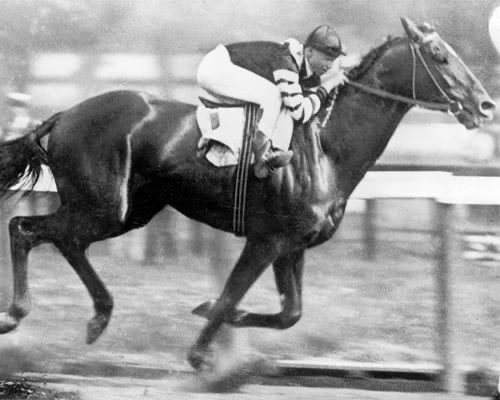
Man o’ War winning the 1920 Belmont Stakes by 20 lengths — one of the most dominant performances in American racing history.
Table of Contents
Early Life and Pedigree
Two Dominant Racing Seasons
The One Loss: Upset at Saratoga
Physical Traits: What Made Big Red Exceptional
Seven Speed Records
Why Man o’ War Never Ran the Kentucky Derby
Man o’ War vs. Secretariat: The Honest Comparison
Stud Career and Breeding Legacy
Death and Enduring Legacy
FAQs About Man o’ War
Was Man o’ War the Greatest Racehorse Ever?
The Verdict: Man o’ War’s Place in Racing History
Early Life and Pedigree
Man o’ War was foaled on March 29, 1917, at August Belmont Jr.’s Nursery Stud near Lexington, Kentucky. His sire was Fair Play — the leading sire in North America in 1920, 1924, and 1927 — and his dam was Mahubah, a Cluster Mare who produced multiple offspring capable of winning five or more of the top eight races. The combination of Fair Play’s speed and Mahubah’s race-winning bloodline produced something the breeding world hadn’t seen in a generation.
Belmont’s decision to sell his yearlings in 1918 — the year Man o’ War came up for auction at Saratoga — was driven by his involvement in World War I. While Belmont was serving in France, his wife named the foal Man o’ War in honor of his military service. At the Saratoga yearling sale, Samuel Riddle purchased the chestnut colt for $5,000. Riddle later declined offers reportedly exceeding $300,000 for the horse — a decision that, given what happened next, proved to be one of the most astute refusals in the history of horse ownership.
At Riddle’s farm, the colt grew into a tall, imposing chestnut with straight legs and a presence that made farmhands stop and look. They started calling him “Big Red” — the same nickname Secretariat would earn half a century later, which gives you a sense of how rare that physical impression actually is among Thoroughbreds. His trainer, Louis Feustel, recognized early that he was working with something extraordinary.
From a horseman’s perspective on pedigree: Every time I evaluate a claiming horse at Louisiana tracks, I’m looking at the pedigree going back three or four generations. Man o’ War’s name appears through Fair Play’s line in an enormous percentage of modern American Thoroughbreds. When you’ve spent 30 years studying these bloodlines, that kind of generational influence stops being a statistic and starts being something you actually feel when you look at a horse’s papers. His genes didn’t just survive — they became the foundation.
Two Dominant Racing Seasons
1919: The Two-Year-Old Season
Man o’ War’s two-year-old campaign in 1919 produced 9 wins from 10 starts — the one blemish being his famous loss to Upset at Saratoga, covered in the next section. His victories included the Hopeful Stakes and the Belmont Futurity, then the most prestigious races for two-year-olds in American racing. He won most of them with something in reserve, which is what made racing observers nervous in the best possible way. You could see he wasn’t being extended.
1920: The Three-Year-Old Season — Unbeaten
In 1920, Man o’ War was undefeated in 11 starts, and the performances moved from dominant to historic. He won the Preakness Stakes, the Belmont Stakes, the Withers Stakes, the Stuyvesant Handicap, the Dwyer Stakes, the Miller Stakes, the Travers Stakes, the Lawrence Realization, the Jockey Club Gold Cup, and the Potomac Handicap. He was named Horse of the Year and was voted the best American racehorse of the 20th century by The Blood-Horse, Sports Illustrated, ESPN, and the Associated Press — a consensus across a century of racing that no other horse has matched.
What stands out in retrospect is not just the wins but the conditions under which he won. In many of his races, handicappers loaded him with extra weight to give the field a chance — routinely carrying 130 pounds or more, with some races requiring up to 138 pounds. He won them anyway, often by multiple lengths. Weight assignments in racing are designed to equalize competition. They couldn’t equalize Man o’ War.
What the Weight Tells a Working Horseman In my years at Louisiana tracks, I’ve watched good horses get crippled by a few extra pounds under handicap conditions. Weight is not a trivial thing — it changes a horse’s balance, increases fatigue, and limits acceleration. When Man o’ War was assigned 130, 135, 138 pounds and won by margins that would embarrass horses carrying normal weight, that’s not just impressive. That’s a category of athletic ability that I genuinely don’t have a frame of reference for from anything I’ve watched at Fair Grounds or anywhere else.
The One Loss: Upset at Saratoga
On August 13, 1919, at Saratoga Race Course, Man o’ War lost by a neck to a colt named Upset. The circumstances deserve examination because the loss is often cited as evidence of vulnerability — which it wasn’t, not really.
The start was a mess. Barrier starts were used at the time rather than starting gates, and Man o’ War was facing the wrong direction when the flag dropped. He was left at the post while the field broke cleanly. He closed the gap through the race but couldn’t overcome the deficit in time. Jockey Johnny Loftus — who was later denied a license renewal, though the reasons were disputed — was widely criticized for his handling of the horse both at the start and during the race.
The horse that beat him, Upset, never beat another horse of significance in his career. He was a good horse. He was not in Man o’ War’s class. The loss was a function of circumstances, not capability — which the 1920 season, with 11 consecutive wins under heavy weights, demonstrated conclusively.
A note on the “upset” etymology: Racing lore holds that the word “upset” in its sporting sense derives from Man o’ War’s loss to the colt named Upset. The etymology predates 1919 — earlier uses in sporting contexts have been documented — and the connection is a myth. But the race is real, and the loss is one of the most studied single defeats in American racing history, which tells you more about Man o’ War’s dominance than about Upset’s talent.
Physical Traits: What Made Big Red Exceptional
Man o’ War’s physical attributes were extraordinary even by the standards of elite Thoroughbreds. Standing over 16 hands and weighing over 1,100 pounds at his peak, he was large for a racehorse of his era. But size alone doesn’t produce what he produced. The specific combination of traits that made him exceptional was more particular than that.
His stride length was measured at 28 feet — the longest ever recorded for a Thoroughbred racehorse. For comparison, Secretariat’s stride was approximately 25 feet, itself considered exceptional. A 28-foot stride means that at full extension, Man o’ War was covering more than nine yards of ground with each complete cycle of his legs. Combined with the stride frequency he was capable of maintaining, this produced ground-covering efficiency that no instrument at the time could fully quantify but that everyone who watched him recognized immediately.
His musculature was described by contemporaries as “perfectly proportioned for power” — a deep chest, powerful hindquarters, and a balance through the back that allowed him to transfer energy from his hindquarters into forward motion with minimal waste. Louis Feustel, his trainer, reportedly said that training Man o’ War was less about developing his ability than about managing it — keeping him focused and preventing him from doing more in training than was good for him.
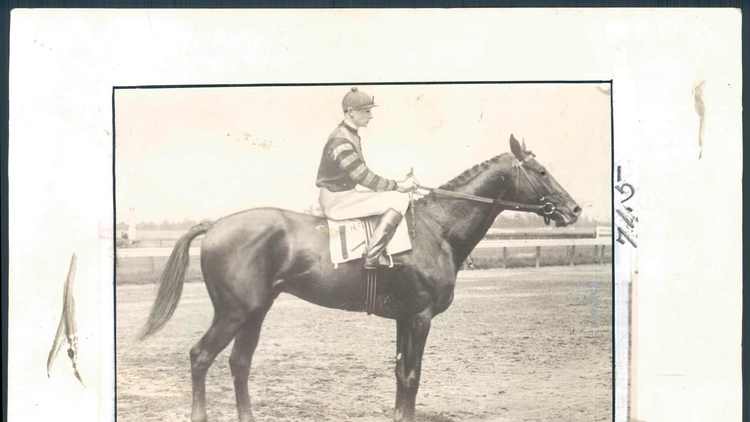
Man o’ War’s physical presence was described by contemporaries as unlike anything they had seen — a perfectly proportioned power engine in chestnut.
Seven Speed Records
Man o’ War set world or American speed records in seven races across his two-season career. This is the number most often cited, and it holds up to scrutiny — he wasn’t breaking records in obscure conditions on unusual tracks. He was breaking them in major races against the best fields available, often carrying above-average weight assignments.
Race | Year | Distance | Time | Weight Carried |
|---|---|---|---|---|
Belmont Stakes | 1920 | 1½ miles | 2:14.2 | 126 lbs |
Lawrence Realization | 1920 | 1 mile 5 furlongs | 2:40.4 | 126 lbs |
Travers Stakes | 1920 | 1¼ miles | 2:01.4 | 129 lbs |
Dwyer Stakes | 1920 | 1⅛ miles | 1:49.2 | 130 lbs |
Withers Stakes | 1920 | 1 mile | 1:35.4 | 118 lbs |
Stuyvesant Handicap | 1920 | 6 furlongs | 1:11.2 | 135 lbs |
Potomac Handicap | 1920 | 1⅛ miles | 1:44.4 | 138 lbs |
Times are recorded in the format used at the time (seconds and fifths). Weight carried is shown to illustrate the handicap conditions under which the records were set.
The breadth of this record-setting is more significant than any individual time. He set records from 6 furlongs all the way to a mile and a half — demonstrating that his speed wasn’t distance-specific. He was equally fast over sprint distances and classic distances, and he was doing it under weight assignments that were designed to slow him down. They didn’t.
One important qualifier that honest horsemen acknowledge: timing technology in 1920 was less precise than modern systems. Hand-timing with stop watches was the standard, introducing measurement variability that makes exact era comparison difficult. This doesn’t diminish what Man o’ War achieved — it just means his times can’t be placed alongside a modern Beyer Speed Figure and treated as equivalent data. The records stood for years or decades in several cases, in conditions where other horses were actively trying to break them. That durability is the most meaningful measure.
Why Man o’ War Never Ran the Kentucky Derby
The Kentucky Derby is the most famous American race, and Man o’ War never ran it. This is one of the first questions anyone asks about his career, and the answer is worth understanding in context.
Owner Samuel Riddle had two stated objections. First, he believed ten furlongs — a mile and a quarter — was too demanding a distance for a three-year-old in early May. This was a genuinely held view among some horsemen of the era and not as eccentric as it sounds today. Second, and more practically, Riddle simply did not like racing in Kentucky. He was a Pennsylvania man and preferred the racing circuits of the Northeast.
The historical irony is considerable. The Kentucky Derby in 1920 was won by Paul Jones, a horse Man o’ War had beaten easily in prior meetings. Later in the same season, Man o’ War easily defeated horses that Paul Jones couldn’t have touched. The consensus among racing historians is that Man o’ War would have won the 1920 Derby without being fully extended. But he never ran it, and the record shows a blank where the roses should be.
The Derby gap in perspective: Not running the Kentucky Derby was a meaningful omission for the historical record, but it wasn’t a gap in his competitive resume. The races Man o’ War did run — the Preakness, the Belmont, the Travers, the Jockey Club Gold Cup — against older horses in some cases and under heavy weight in nearly all of them, represented a more challenging competitive schedule than a Derby win would have added. The Derby absence is a question mark, not a flaw.
Man o’ War vs. Secretariat: The Honest Comparison
This is the comparison that never gets resolved and never will — which is exactly what makes it worth examining carefully. In the Secretariat article on this site, I make the case that Secretariat was the fastest horse to ever race at classic distances. The Belmont record of 2:24 flat, standing for over 50 years, is the foundation of that argument. Nothing in this article changes that position. But the comparison between the two horses is more nuanced than a single race time.
Category | Man o’ War | Secretariat |
|---|---|---|
Career record | 20–1 (21 starts) | 16–3–1 (21 starts) |
Speed records set | 7 world/American records | 3 Triple Crown records (all still stand) |
Stride length | 28 feet (longest ever recorded) | ~25 feet (exceptional) |
Weight carried | Up to 138 lbs under handicap | Standard weights — no heavy handicaps |
Kentucky Derby | Did not run (owner’s choice) | Won in 1:59 2/5 (record still stands) |
Belmont Stakes | Won by 20 lengths | Won by 31 lengths — 2:24 flat (record) |
Stud success | 62 stakes winners — War Admiral (TC) | Modest as sire — daughters dominant |
Pedigree influence | Found in virtually every modern TB | Strong through female line |
Era comparison | Pre-standardized timing (1919–1920) | Modern timing, records verifiable (1973) |
Timing precision | Hand-timed — era limitation | Electronic timing — directly comparable |
Neither horse is clearly superior across all categories. The comparison depends entirely on which metrics you weight most heavily.
The case for Man o’ War as the greatest, taken on its own terms: he ran more races under harder conditions — heavier weights, uncertain track preparation, and barrier starts rather than starting gates — and won 20 of 21. His competitive record is cleaner than Secretariat’s. His stride length was longer. His stud influence was more pervasive. And he did all of this before the sport had the infrastructure to properly measure what he was doing.
The case for Secretariat, taken on its own terms: his times are verifiable, directly comparable to every horse that ran after him, and they’ve held up for over 50 years of serious competition. His Belmont record by 31 lengths in 2:24 flat is the single greatest timed performance in racing history. American Pharoah, the best Triple Crown winner of the modern era, ran that distance in 2:26.65 — on the same track. That gap is not a rounding error.
The Honest Verdict After 30 Years in Racing I’ve read every serious argument on both sides. My position: Man o’ War was the most complete racehorse in American history. Secretariat was the fastest over classic distances by any verifiable measure. Those aren’t contradictory conclusions — they’re answers to different questions. If you’re asking which horse was greater as a total athlete and competitor across a career, Man o’ War’s 20-1 record under heavy weights against the best fields available makes an argument that can’t be dismissed. If you’re asking which horse ran the fastest at a mile and a half under race conditions, Secretariat wins and it isn’t close. The debate isn’t resolvable and it shouldn’t be — that’s what makes both horses worth studying.
Stud Career and Breeding Legacy
Man o’ War retired from racing after the 1920 season and stood at stud at Samuel Riddle’s Faraway Farm near Lexington, Kentucky. Despite being limited to approximately 25 mares per year — the Jockey Club’s rules required live cover rather than artificial insemination, which remains the rule in Thoroughbred breeding today — he produced 62 stakes winners across his stud career. That number, achieved under strict breeding limitations, is remarkable.
His most famous son was War Admiral, who won the 1937 Triple Crown and is best remembered as the horse Seabiscuit defeated in their famous 1938 match race. Man o’ War was the leading sire in North America in 1926 and the runner-up in 1928, 1929, and 1937. The depth of his stud influence is measured not just in stakes winners but in the degree to which his bloodline permeated the breed — virtually every modern American Thoroughbred traces back to Man o’ War through multiple pathways.
His daughter-in-law connection to Seabiscuit deserves specific mention: Seabiscuit’s sire was Hard Tack, who was Man o’ War’s son, making Seabiscuit Man o’ War’s grandson. The 1938 match race between War Admiral and Seabiscuit was, in a meaningful sense, a competition between two branches of the same bloodline — Man o’ War’s legacy running against itself. If you want to understand why Man o’ War’s influence on the breed is considered unmatched, that race is a useful illustration. His blood was on both sides of the most celebrated match race in American history. For the full story of how Man o’ War’s bloodline played out through Seabiscuit’s career, see Seabiscuit: the unlikely champion who captivated Depression-era America.
Death and Enduring Legacy
Man o’ War died on November 1, 1947, at the age of 30 — an exceptional lifespan for a horse. His death was treated as a public event of genuine significance. He was embalmed and buried in an oak casket at Faraway Farm, believed to be the first horse in America accorded a full funeral service. Nine eulogies were delivered. The service was broadcast on radio across the country and lasted approximately 30 minutes. An estimated 2,000 people attended in person.
The National Museum of Racing and Hall of Fame honored his achievements with a special exhibition, “Man o’ War at 100,” marking the centennial of his birth. Multiple sports publications’ all-time rankings consistently place him at or near the top of any list of the greatest American racehorses — The Blood-Horse, ESPN, Sports Illustrated, and the Associated Press all named him the best American racehorse of the 20th century. In a century that included Secretariat, Citation, Seattle Slew, and Affirmed, that consensus means something.
His racing legacy is found in the speed records of every subsequent era, in the pedigrees of horses winning today, and in the standard against which every successive generation of great racehorses is inevitably compared. When people ask whether a modern horse is as good as the greats, the conversation always comes back to Man o’ War eventually.
Watch archival footage of Man o’ War in action — rare film of the horse whose performances defined what American racing could look like:
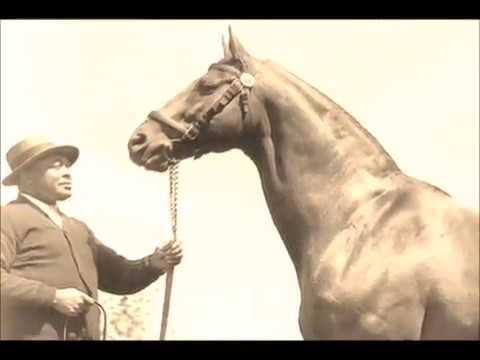
Archival footage and historical record of Man o’ War’s career.
FAQs About Man o’ War
Was Man o’ War the greatest racehorse of all time?
Man o’ War is widely considered the greatest American racehorse of the 20th century by The Blood-Horse, Sports Illustrated, ESPN, and the Associated Press. His 20-1 career record, 7 speed records, dominant weight-carrying performances, and unparalleled breeding influence collectively make the strongest case. Whether he was greater than Secretariat depends on how you define greatness — career dominance and influence favor Man o’ War; verifiable sustained speed at classic distances favors Secretariat.
How many races did Man o’ War win?
Man o’ War won 20 of 21 career races across two seasons — 9 from 10 as a two-year-old in 1919, and 11 from 11 as a three-year-old in 1920. His only loss came to a colt named Upset at Saratoga in 1919, in a race where Man o’ War was left at the post due to a poor barrier start. He was never beaten by a horse that ran better on the day; the circumstances of that single loss have been debated ever since.
What horse beat Man o’ War?
The only horse to ever beat Man o’ War was a colt named Upset, in the 1919 Sanford Memorial Stakes at Saratoga. Ironically, some racing historians attribute the origin of the term ‘upset’ in sports to this race — though etymologists note the word predates 1919. Upset never beat another horse of comparable quality in his career. The circumstances of Man o’ War’s loss — a bad start from a barrier with his jockey facing the wrong direction — are considered the primary reason for the defeat.
Why didn’t Man o’ War run the Kentucky Derby?
Owner Samuel Riddle chose not to enter Man o’ War in the 1920 Kentucky Derby for two reasons: he believed ten furlongs was too demanding for a three-year-old in early May, and he preferred the racing circuits of the Northeast to Kentucky. The Derby was also less prestigious in 1920 than it is today. Paul Jones, who won the 1920 Derby, had previously been beaten by Man o’ War and would have been no match for him.
What racehorse has the longest stride?
Man o’ War holds the record for the longest measured stride in Thoroughbred racing at 28 feet. Secretariat’s stride was approximately 25 feet, itself considered exceptional. Stride length combined with stride frequency determines speed efficiency — Man o’ War’s 28-foot stride meant he was covering more than nine yards of ground per complete stride cycle, which contributed directly to his ability to win by wide margins even under heavy weight.
Is Man o’ War related to Secretariat?
They are not directly related. Man o’ War’s sire was Fair Play. Secretariat’s sire was Bold Ruler, whose great-grandsire was Fair Play — making Fair Play a common ancestor rather than a direct connection. They are very distantly related through Fair Play’s line, which is present throughout modern Thoroughbred pedigrees. Secretariat is not a descendant of Man o’ War.
Is Man o’ War related to Seabiscuit?
Yes — Seabiscuit was Man o’ War’s grandson. Seabiscuit’s sire was Hard Tack, who was one of Man o’ War’s sons. This made the 1938 match race between War Admiral (Man o’ War’s son) and Seabiscuit (Man o’ War’s grandson) a competition within the same bloodline — two branches of Man o’ War’s legacy racing against each other. War Admiral lost.
Who was Man o’ War’s trainer?
Man o’ War was trained by Louis Feustel throughout his racing career. Feustel reportedly described training Man o’ War as more about managing his energy than developing it — keeping the horse focused and preventing him from doing more in training than was good for him. Feustel recognized early that he was working with an animal whose ability exceeded anything the sport’s conventional training methods were designed for.
Would Man o’ War have beaten Secretariat?
No one can answer this with confidence, and anyone who tells you they can is speculating. They raced 53 years apart on different tracks with different timing technology, different competition fields, and different race conditions. Man o’ War’s 20-1 record under heavy weights is the strongest career dominance argument in American racing history. Secretariat’s Belmont time of 2:24 flat has never been approached. The honest answer is that the comparison is one of racing’s great unresolvable debates — which is precisely why it remains interesting.
Was Man o’ War the Greatest Racehorse Ever?
The question has been debated for over a century and it isn’t going away. Multiple sports publications — The Blood-Horse, ESPN, Sports Illustrated, and the Associated Press — all named Man o’ War the best American racehorse of the 20th century. That’s a century of racing that includes Secretariat, Citation, Seattle Slew, Affirmed, and American Pharoah. The consensus isn’t unanimous, but no other horse has earned it as consistently.
The argument against him is Secretariat’s Belmont record — 2:24 flat, still standing after 50 years — and the fact that Man o’ War’s times were hand-timed on tracks that weren’t prepared to modern standards. Those are legitimate points. The argument for him is everything else: 20-1 under conditions designed to slow him down, 7 speed records across multiple distances, 28 feet of stride, and a breeding legacy that literally built the modern American Thoroughbred. Even elite modern horses like American Pharoah and Justify, who won the Triple Crown without heavy handicap weights, never faced the kind of weight assignments Man o’ War routinely carried and won under.
My answer, after 30 years in racing: the “greatest ever” question depends entirely on your definition. For career dominance, competitive conditions, and lasting genetic influence — Man o’ War. For the single most verifiable timed performance over a classic distance — Secretariat’s full breakdown of speed and records makes the case. Both answers are defensible. Neither is wrong.
The Verdict: Man o’ War’s Place in Racing History
Man o’ War was the most complete racehorse in American history. Twenty wins from 21 starts, seven speed records, the longest stride ever measured, dominance under weight conditions that would have broken other champions, and a breeding legacy that literally shaped the modern Thoroughbred breed. No other American racehorse has produced that combination across a career.
The comparison to Secretariat is real and unresolvable — and both horses are better understood by engaging with it seriously rather than declaring a winner. Man o’ War’s greatness was about the totality of dominance across a career and the depth of what he left behind. Secretariat’s greatness was about verified speed at classic distances that has never been replicated. Both are true simultaneously. They answer different questions about what a racehorse can be.
My Final Take After 30 Years in Racing When I look at a pedigree and trace backward through the generations, I find Man o’ War more often than I find any other single horse. That’s 100 years of selective breeding by people who understood horses better than most — and they kept coming back to his bloodline. That kind of influence doesn’t happen because of one fast season. It happens because something about that horse was genuinely superior at the genetic level. The records support it. The pedigrees prove it. Man o’ War is the foundation of American Thoroughbred racing, and nothing else comes close to that claim.
Key Takeaways
20 wins from 21 starts — the one loss came from a bad barrier start, not a faster horse
7 world/American speed records across multiple distances in two seasons
28-foot stride — the longest ever measured in a Thoroughbred; Secretariat’s was approximately 25 feet
Carried up to 138 pounds under handicap and won anyway — weight assignments couldn’t equalize him
Never ran the Kentucky Derby — owner’s choice, not a competitive limitation; he beat the Derby winner easily that season
62 stakes winners as a sire — including Triple Crown winner War Admiral
Found in virtually every modern American Thoroughbred pedigree — no other racehorse’s genetic influence is as pervasive
Also Read: Was Secretariat the Fastest Horse to Ever Race? The Evidence
Also Read: The World’s Fastest Racehorses in History
Miles Henry
About Miles Henry
Racehorse Owner & Author | 30+ Years in Thoroughbred Racing
Miles Henry (legal name: William Bradley) is a professional horseman based in Folsom, Louisiana. He holds Louisiana Racing License #67012 and has spent over three decades managing Thoroughbreds at premier tracks including Fair Grounds, Delta Downs, and Evangeline Downs.
Expertise & Hands-On Experience: Beyond the track, Miles has decades of experience in specialized equine care, covering everything from hoof health and nutrition to training protocols for Quarter Horses, Friesians, and Paints. Every guide on Horse Racing Sense is rooted in this “boots-on-the-ground” perspective.
Man O’ War: Was He the Greatest or Fastest Horse to Race?
Home • Horse Racing
Last updated: July 2, 2025
By: Miles Henry Fact Checked
There have been many great horses that have raced over the years. Some were faster than others, but there was one horse who is often considered to be the greatest of them all – Man o’ War.
In addition to being one of the most successful horses ever, Man o’ War is also considered to be one of the fastest. Over the course of his career, this equine powerhouse would go on to win 20 of the 21 races and set seven speed records over various distances.
Man o’ War was incredibly fast and had incredible endurance, making him the perfect candidate for racing. He was a force to be reckoned with on the track, and his influence on racing is still present; Man o’ War is found in almost all modern American racehorses’ pedigrees.
In this article, we will look at Man o’ War and find out why he is often considered the greatest horse to ever race.
Man o’ War
Man o’ War was born in 1917 near Lexington, Kentucky. He was sired by the stallion Fair Play, who was the leading sire in North America in 1920, 1924, and 1927. His dam Mahubah was listed as a Cluster Mare for producing multiple offspring to win five or more of the top eight horse races.
Interestingly enough, when Man o’ War was put up for auction as a yearling at Saratoga Springs Race Course, Sam Riddles’ bid of $5,000 was successful. Two years later, Mr. Riddle was offered $400,000 for his horse which he turned down.
At Mr. Riddle’s farm, the young colt grew to be a tall, imposing chestnut stallion. He was so big that the farmhands nicknamed him “Big Red.” Most notably, he was a spirited horse with straight legs and a bit of swayback.
Man o’ War was named in honor of its breeder, August Belmont Jr., who joined the US Army during World War I. While he was away in France, his wife named the foal Man o’ War. From the beginning of his racing career, Man o’ War was a betting favorite. In just his second race, Man o’ War managed to win by an impressive 20 lengths.
Several sports publications, including The Blood-Horse, Sports Illustrated, ESPN, and the (AP) Associated Press, voted Man o’ War the best American racehorse of the 20th century.
The big red stallion won 20 out of 21 races during his racing career and set records in countless races. He won every major race of his time, including the Hopeful Stakes at Saratoga Springs and the Belmont Futurity Stakes.
When Man o’ War retired, he was the top money earner in American racing history. The National Racing Museum and Hall of Fame honored his achievements and opened a special exhibition in his honor, “Man o’ War at 100”.
Man o’ War after he retired from racing
After retiring from racing at only three years old, Man o’ War went on to become one of the most successful studs in American History.
Although Man o’ War's’ was limited to breeding about 25 mares a year, he produced 62 stakes winners, including triple crown winner War Admiral.
Man o’ War was the leading sire in North America in 1926 and was runner-up in 1928, 1929, and 1937. Today, he is considered one of the most influential stallions in American Thoroughbred breeding history.
Man o’ War’s death
Man o’ War, the great thoroughbred who died on November 1st, 1947 at 30 years old was embalmed and buried in an oak casket. It is believed that he was America’s first horse to be accorded such a funeral service.
The funeral service for Man o’ War was a spectacular event that included nine eulogies, was broadcast on radio waves across America and lasted approximately 30 minutes. His casket remained open as if to remind people of his accomplishments.
Was Man o’ War the Fastest Horse Ever?
Without a doubt, Man O’ War was superior in speed, endurance, and ability to best all the horses of his time, even while carrying more weight than all his competitors. But it is difficult to say with any degree of confidence that a racehorse is the fastest or the best because there are several determinable factors that affect speed and can’t recreate.
For example, the race format, racecourse conditions, racehorse age, and medication are a few factors that vary immensely. Some racehorses are the best because of the carrier span, and others may be claimed the best due to the track surfaces or the race formats. However, during his racing career, Man o’ War won the Hopeful Futurity, Belmont, and Withers, among others.
He also won the Jockey Club Gold Cup and was named Horse of the Year in 1920. The huge, muscular horse with the bright red coat outshone most of his competitors on the track, often easily winning by multiple lengths.
Even with so many variables that play a role in speed, we can say that on a dirt track, without carrying excessive weight, Man o’ War would be in contention as the fastest horse of all time.
Why is Man o’ War Famous?
Man o’ War is famous and will remain so for numerous reasons. One, he raced only 21 races within a short span of time, and out of these all races, he won 20. His posture, stride length, speed, and pedigree are a few traits that make him famous.
He raced against the odds; he was always burdened with the most weight and lowest odds. He also became famous because of the successes of his offspring. He was the father of War Admiral and grandsire of Seabiscuit.
He won the Belmont Stakes by 20 lengths, a remarkable distance to win any race, but to do that against the top three-year-old Thoroughbreds is amazing. His 28-foot stride length is still the longest ever measured.
He was the first racehorse of that time that filled peoples’ purses with immense wealth. He crushed many of his competitors and always made many racing fans optimistic about his agility on the track.
Did Man o’ War ever win the Kentucky Derby?
One of the few famous American races that Man o’ War did not take part in was the Kentucky Derby because Samuel Riddle, his owner, did not believe in racing young horses 10 furlongs because he considered it too long for a young horse.
Also, the Derby was not as important in the 1920s as it is today, and the horse’s owner didn’t like racing in Kentucky, so he chose not to enter the field. Later, Man o’ War easily beat the field of horses in the Kentucky Derby at other races, indicating that he would likely have dominated the race had he been entered.
What Horse Beat Man o’ War?
“Upset” was the only horse that beat Man o’ War. In 1919, Man o’ War won 9 out of 10 starts, including Hopeful Stakes and Belmont Futurity, then the most important races for two-year-old horses in the United States. His only defeat was at Saratoga Racecourse, later dubbed the Cemetery of Champions, where he lost by a neck to a colt.
Is Man o’ War Related to Secretariat?
There is some debate over whether or not Man o War is related to Secretariat. One thing is for sure; Secretariat is not a direct descendant of Man o’ War. However, they do have a common relative, Fair Play.
Fair Play is the sire of Man o’ War and was the great-grandsire of Bold Ruler, who is Secretariat’s sire. So I guess they are very distant cousins.
Man o’ War v. Secretariat, Who Would Win?
There is no clear consensus on who would win a race between Man o’ War or Secretariat. Some claim that Secretariat was faster, while others say Man o’ War would win.
They both ran 21 races, of which Man o’ War won 20 and was second in one race. On the contrary, Secretariat won 16 races, was second in 3, third in 1, and got off-tracked in one race.
Then there was a notable difference in the stride lengths of both; Man O’ War was good with a stride length of 28 feet, and Secretariat was far behind with a stride length of 25.5 feet.
The argument for Man o’ War
Man o’ War ran on poor racing surfaces carrying heavier weights and had a more challenging schedule than Secretariat. He ran 21 races in two years. Man o’ War was so dominant as a two-year-old it was difficult to get races.
Man o’ War’s only loss was by a neck, and his failure to win could be attributed to a bad start from the gate. Secretariat lost four races, running second three times and third once out of 21 races.
Then when you include Man o’ War’s success as a sire, he was head and shoulders better than Secretariat. However, one thing is for sure: both of these horses were incredible athletes and are two of the greatest racehorses of all time.
What racehorse has the longest stride?
The great racehorse Man o’ War has the longest stride at 28 feet. Most fast horses typically have long strides because their speed depends on their stride length and stride frequency.
Is Man o’ War related to Seabiscuit?
Yes, Seabiscuits’ father is the son of Man o’ War, making him Man o’ Wars’ grandson. Interestingly, one of the most significant horse racing events matched Seabiscuit, Man o’ Wars’ grandson, against War Admiral, Man o’ Wars’ son.
Miles Henry brings over 25 years of hands-on experience training and owning Thoroughbred racehorses. Raised with Quarter Horses and Appaloosas, he’s spent a lifetime learning from horses—on the track, in the barn, and in the field. Today, he runs a small but successful racing stable in Louisiana and shares real-world insights on HorseRacingSense.com, helping horse owners, fans, and bettors navigate the sport with confidence.
International Museum of the Horse
"Of the Many Horses Which Live On in the Hearts of Americans, One Horse is Most Remembered - Man o' War. Man o’ War’s sire was Fair Play, by Hastings, both of whom were mean and temperamental, but excellent weight carriers. To provide balance to Fair Play’s temper, August Belmont II bred him to Mahubah, by Rock Sand who had won the British Triple Crown. Her ancestors were even tempered and intelligent."
Encyclopedia Britannica
"Man o’ War, byname Big Red, (foaled 1917), American racehorse often considered the greatest of the 20th century. In a brief career of only two seasons (1919–20), he won 20 of 21 races, established seven track records for speed over various distances, and raced at odds as short as 1–100.....In the annals of Thoroughbred history, no other horse has been compared to the greatest champions of sports to the degree that the horse that became known as 'Big Red' was by sportswriters."
Wikipedia
"Man o' War (March 29, 1917 – November 1, 1947) was an American Thoroughbred racehorse who is widely regarded as the greatest racehorse of all time. Several sports publications, including The Blood-Horse, Sports Illustrated, ESPN, and the Associated Press, voted Man o' War as the best American racehorse of the 20th century."
The Return of ‘Big Red’;AMERICA'S BEST RACING, Legends
By David Hill, April 24, 2019
"For more than 50 years the horse, whose actual name was Man o’ War, was considered the greatest racehorse of all time. None would dare compare their horse with that big, red chestnut. None would dare call their horse by Man o’ War’s nickname. There could be only one 'Big Red'.......In a poem written in 1937 by the editor-in-chief of The Blood-Horse, Joe Estes, some 17 years after Man o’ War was retired, Estes wondered if ever another horse could match Man o’ War’s talents:
Big Red
by Joseph Alvie Estes, first published October 23, 1937
The days are long at Belmont.
Speed they never learn.
And it's many a day since Man o' War
Has looped the upper turn.
The guineas stopped their rubbing,
The rider dropped his tack
When the word went round that Man o' War
Was coming on the track.
The crowd was hoarse with cheering
At ancient Pimlico
The day he won the Preakness-
But that was long ago.
The dust is deep at Windsor,
The good old days are gone.
And many a horse is forgotten,
But they still remember one.
For he was a fiery phantom
To that multitudinous throng-
Would you wait for another one like him?
Be patient: years are long.
For here was a horse among horses,
Cast in a Titan's mold,
And the slant October sunlight
Gilded the living gold.
He was marked with the god's own giving
And winged in every part;
The look of eagles was in his eye
And Hastings' wrath in his heart.
Young Equipoise had power
To rouse the crowded stand,
And there was magic in the name
Of Greentree's Twenty Grand.
And Sarazen has sprinted,
And Gallant Fox has stayed,
And Discovery has glittered
In the wake of Cavalcade.
We watch the heroes parading,
We wait, and our eyes are dim,
But we never discover another
Like him.
A foal is born at midnight
And in the frosty morn
The horseman eyes him fondly
And a secret hope is born.
But breathe it not, nor whisper,
For fear of a neighbor's scorn:
He's a chestnut colt, and he's got a star-
He may be another Man o' War.
Nay, say it aloud--be shameless.
Dream and hope and yearn,
For there's never a man among you
But waits for his return.
And so it remained for more than 50 years after Man o’ War’s final race. The world waited for his return. In 1970, on a farm in Virginia, the wait finally ended. A bigger, redder chestnut was foaled. The first five names submitted for the horse were rejected by The Jockey Club, before they finally settled on Secretariat. It mattered not to Penny Chenery, the horse’s owner. She always just called him 'Big Red'. Secretariat followed in Man o’ War’s large footsteps, racing at many of the same tracks and races.....It may have seemed like blasphemy to refer to Secretariat as 'Big Red', to talk about him in the same manner as the legendary Man o’ War. But by the end of his 3-year-old season, which saw him capture the first Triple Crown in 25 years, the ninth in history, folks knew that Secretariat was something special, a once in a lifetime racehorse who broke records in all three legs of the Triple Crown.
He went on after winning the 1973 Triple Crown to race six more times, winning four of those starts. For his penultimate race, Secretariat’s connections chose to enter him in his first-ever start on grass. The race was named the Man o’ War Stakes, in honor of the original “Big Red.” After Secretariat won it by five lengths, turf writers accepted that Secretariat was indeed worthy of the 'Big Red' moniker."
Excerpts from: Secretariat 'Meets' Man o' War; BLOODHORSE
by Tom Hall, May 5, 2021
"In 1920 Samuel D. Riddle's Man o' War retired from racing following a spectacular undefeated 3-year-old season that had captured the fancy of not only the racing world but also the general citizenry. Track record after track record had fallen under his scythe-like strides.
So, when the big, rough-hewn son of Fair Play whose chestnut coat had earned him the affectionate name of "Big Red" left the racing scene, those of the era were left to contemplate Shakespeare's words honoring another conqueror: "Here was a Caesar! When comes such another?"
The answer to many came fifty years later, March 30, 1970 — (FYI: Man o' War was born March 29, 1917) — at Meadow Stud in Virginia, when Christopher Chenery's 18-year-old mare Somethingroyal foaled a glistening chestnut colt by Bold Ruler.
Given the name Secretariat, he lost his first race at 2 and several at 3, yet Secretariat carved out a career so reminiscent of the original Big Red that he too earned that nickname. He set track records with aplomb. He was champion of his division and Horse of the Year at 2 and 3, as well as champion grass horse. He, like his predecessor, also retired following his sophomore season.
On Oct. 8, 1973, at Belmont Park the inevitable happened: Secretariat met Man o' War. One of the standards of the fall racing program at Belmont is the Man o' War Stakes (G1T), named, of course, in honor of the big red machine his groom Will Harbut introduced to visitors as "de mostest hoss."
A weight for age event for 3-year-olds and up, the 15th running of the Man o' War was contested over 1 1/2 miles, a distance familiar to the race's namesake, but—in an ironic touch—held over turf, a surface over which Man o' War never raced.
Unlike Man o' War's 3-year-old season, Secretariat's had its ups and downs. After finishing third in the Wood Memorial Stakes (G1), he had become the first horse since Citation (25 years) to against older horses, he lost the Whitney Stakes (G2) at Saratoga but redeemed himself with a victory over stablemate Riva Ridge in the Marlboro Cup Handicap. Secretariat came into the Man o' War off a 4 1/2-length thumping by Hobeau Farm's 4-year-old Prove Out in the Woodward Stakes (G1).
Secretariat proved as adept on turf as he had on dirt, leading from the gate to post a five-length victory over Tentam with Big Spruce third. His 2:24 4/5 time set yet another track record.
When The Blood-Horse published its Top 100 Racehorses of the Twentieth Century, Man o' War crossed the finish line first, with Secretariat close on his heels."
THE UPSET OF MAN O’ WAR: A MOMENT IN TIME
ZIPSE AT THE TRACK
By Brian Zipse, November 28, 2011
The date was August 13, 1919. The Chicago White Sox were just weeks away from shaking everyone’s faith in America’s pastime, and in the world of thoroughbred horse racing, the fates were preparing to conspire against perhaps our greatest thoroughbred in history. After six overpowering juvenile victories, Man o' was already being considered a superstar. Going in, Saratoga’s Sanford Memorial had all the looks of another routine victory for the imposing chestnut colt. Instead it would become one of the most important upsets in not only racing, but in the history War of American sports.
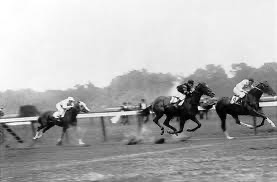
Man o’ War, bred by August Belmont owned by Sam Riddle, trained by Louis Fuestel, and ridden by Johnny Loftus, had swept through his first half-dozen races as if he would never lose. Truly a man among boys, Man o’ War had won a maiden race at Belmont Park on June 6 by six easy lengths and then proceeded to dominate five consecutive stakes races at Belmont, Jamaica, Aqueduct and Saratoga. It wasn’t that he was winning each race, or the margin of victory in each race, but it was the ease in which he was doing it that set him apart. “Eased final 16th” and “Never extended” were becoming familiar comments for the big, red youngster.
By his fourth lifetime start, Man o’ War was already being saddled with 130 pounds in an attempt to even out the playing field. It made little matter, and in his sixth race and win, he carried that impost while easily winning the U.S. Hotel Stakes at Saratoga on August the 2nd. On that afternoon, his closest pursuer in the ten-horse field was a Whitney Stable runner named Upset, who at 115, was in receipt of 15 pounds from the winner. Eleven days later the two colts would be back at the same track, and running at the same distance in the Sanford Memorial.
Unfortunately, it cannot be said that the race went off without a hitch. The most consistent account of how the race was run goes something like this: The regular starter was out sick, so a replacement starter, who was said to be up in years, would be in charge of getting the horses off from the barrier fairly. It did not happen. The heavily favored son of Fair Play was reportedly not facing the right direction when the field was sent on their way. With no chance of taking the early lead as accustomed, Man o’ War would need to rally if he were to remain perfect.
His well-regarded stablemate, and supposed main competition, Golden Broom, would make the early lead with Upset close behind. After his bad start, Man o’ War moved up to fourth after a quarter mile, of the 6th furlong race, was completed. As Golden Broom began to weaken, it was Upset, who took over early in the stretch. Man o’ War, who had encountered traffic throughout the race, and had been shut off on the rail, was now swung wide under Loftus for a final attempt to catch the leader, who again was getting 15 pounds from the big horse. It was not to be. The big upset was pulled off by Upset, who won by what the charts call a half-length, but many said was even less.
The enormity of the upset sprung by Upset only became larger as the true greatness of Man o’ War was revealed. He defeated Upset on numerous occasions after the loss, each time easily. In fourteen races after the Sanford, the great horse won each time, and was barely ever challenged in many of the biggest races on the American racing landscape. He has been voted as the greatest horse ever to grace a racetrack many times. His lifetime record reads: 21 races, 20 wins … and one narrow, troubling loss.
There has been much written about the Sanford since, that have raised many questions. How many lengths did Man o’ War lose at the start? How much trouble did Loftus get his mount into during the race? Did the jockeys have something stewed up to guarantee a loss for the prohibitive favorite? Nearly a hundred years later, it is hard to know for sure. What we do know is that on the afternoon of August 13, 1919, Upset won and Man o’ War lost, believe it or not.
THE MATCH RACE BETWEEN MAN O' WAR AND SIR BARTON
Excerpts from This Week In History:
Man o’ War’s Legacy Overshadows Sir Barton
By Natalie Voss, Editor-in-Chief, The Paulick Report, December 4, 2023
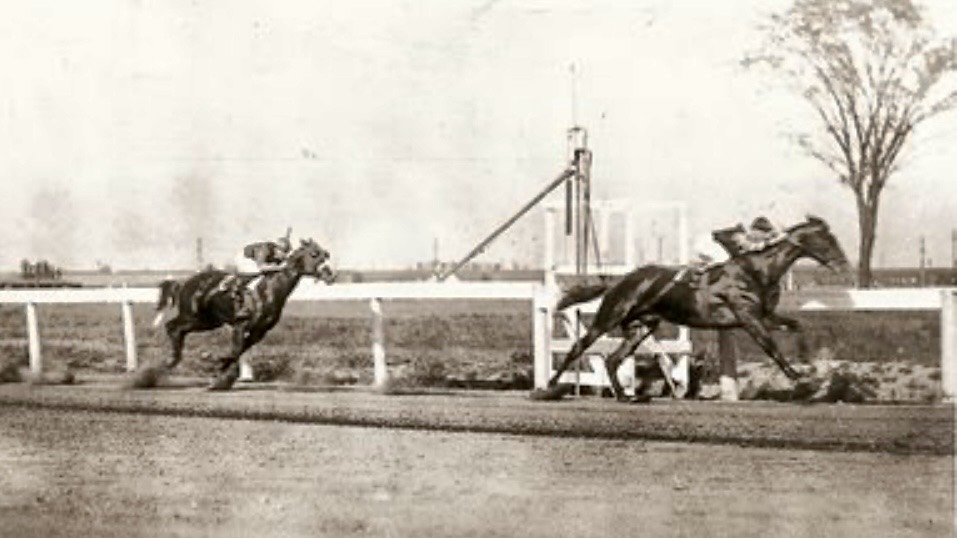
Man o' War wins match race against Sir Barton by 7 lengths
"December is often a quiet time in the racing season, a time for recovery for many racehorses and preparation for breeding and foaling season for those on the farm.
The situation was no different in December 1920, when the Daily Racing Form ran a short update on Man o’ War, who was getting some time off after a hugely successful 3-year-old campaign. That year, “Big Red” had run in 11 races, set seven track records, and become the first American Thoroughbred to amass more than $200,000 in career earnings. His 1920 season saw him win the Preakness and Belmont, and was also the year he entered the Lawrence Realization Stakes. All but one competitor scratched, and Man o’ War is famously said to have won by 100 lengths.
Man o’ War wrapped up his 1920 season with a match race against Sir Barton, and it was this race that was cited in the Form’s update.
The match race against Sir Barton, who would later be recognized as the first Triple Crown winner, was accompanied by a buzz among racing fans that was similar to the Seabiscuit/War Admiral match that would come years later. Similarly to that match race, fans had been clamoring for the two to meet, and it was A.P. Orpen, the chairman of Canada’s Kenilworth Jockey Club, who successfully negotiated with the connections of both horses and convinced them to go to Kenilworth in Windsor, Ontario, for a 10-furlong, $75,000 contest.
Originally, Orpen had also hoped Exterminator would join the field, but his connections preferred longer races and declined. [Once again the owners of Exterminator ducked facing Man o' War].
Sir Barton had finished his triumphant 3-year-old season in 1919 the leading money earner and was widely thought of as the best horse in training, despite his underdog status when he ran in both the Kentucky Derby and Preakness. A juvenile Man o’ War made his career debut five days before Sir Barton’s Belmont victory, and his legend grew with every subsequent race.
The Kenilworth Cup was the first horse race to ever be filmed in its entirety, and drew 25,000 fans to the track on the day. Man o’ War went to the lead easily and never looked back, finishing by open lengths over Sir Barton. It was the only time Man o’ War ran against an older horse.....
Since the match race had been the first to be committed to video recording, and was photographed extensively, those images flooded out to the public in the weeks and months after Man o’ War’s victory – what would prove to be his last. Reportedly, owner Samuel Riddle took issue with the notion the colt would be assigned even more weight in handicaps as a 4-year-old. The video of the race was released as a film titled “The Race of the Age.” Jennifer Kelly, author of ‘Sir Barton and the Making of the Triple Crown,’ said Sir Barton’s legacy was doubtlessly impacted by poor timing and popular press items touting his rival.
'In the weeks and months after the match race, two things happened: the film ‘The Race of the Age,’ which captured the preparations for and the running of the match race, and rotogravures sharing photos from the race spread through theaters and newspapers across the country,” said Kelly. “What people saw was Sir Barton trailing Man o’ War in literal perpetuity. That shift in perception from the best horse of 1919 to the horse perpetually behind Man o’ War had begun.
'Man o’ War’s accomplishments of 20 wins in 21 starts held sway over the sport, who saw that the only thing that could beat the colt were a bad start and a shortage of ground in the 1919 Sanford. The combination of Man o’ War’s fame and the images of Sir Barton in futile chase compromised the era’s perception of Sir Barton. Though obituaries for the horse in 1937 said that he 'was outmatched at his peak by only the great Man o’ War,' that assessment seems to have faded over time.
'When I started writing Sir Barton and the Making of the Triple Crown in 2014, my goal was to tell his story and restore the first Triple Crown winner to his rightful place as one of his era’s greats rather than the perpetual loser to the 20th century’s greatest racehorse."
MAN O' WAR'S GREATEST SON
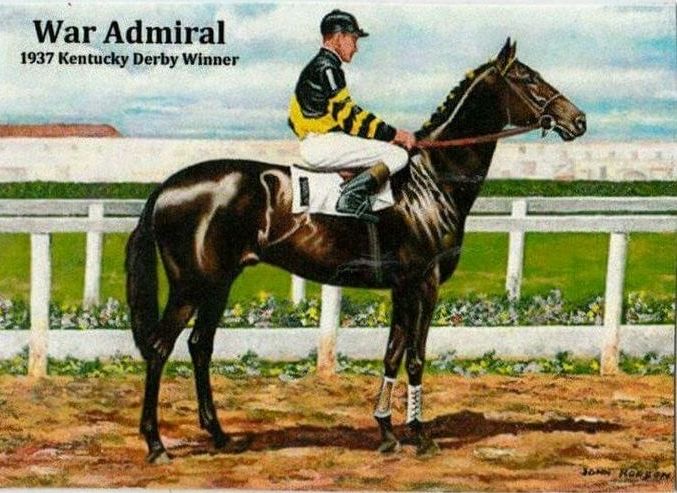
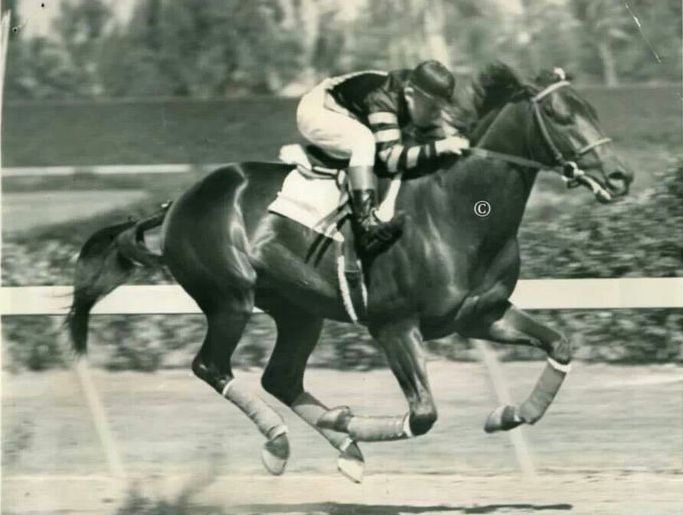
Excerpts from: Triple Crown Turning Point: How War Admiral Nearly Slipped Away From Owner Riddle, by Jennifer Kelly, March 15, 2023, LEGENDS, America's Best Racing:
"Man o’ War’s story is a familiar one for generations of racing fans. A century later, this son of Fair Play and Mahubah stands head and shoulders above nearly every horse that has come after him. Owner Samuel Riddle was proud of his great horse and was choosy about the mares Man o’ War covered, limiting outside owners’ access to the stallion and then upgrading his own broodmare band with imports from Europe, including a mare named Annette K.
Annette K. became part of the Riddle collective of broodmares at Faraway Farm, where Man o’ War stood stud, after her short and unsuccessful career on the racetrack. With only one race under her belt, Annette K. was retired and sent to the stallion Sweep, winner of the 1910 Belmont Stakes. From that pairing came the filly Brushup in 1929, who is notable not for her time on the racetrack, but for her turn in the breeding shed....Annette K. had produced multiple stakes winner War Glory when paired with Man o’ War, so Riddle decided to send her daughter Brushup to his immortal stallion in 1933. Their foal would make racing history as his sire’s best, but he almost did not wear the Riddle black and gold while doing it.
When Brushup foaled her colt by Man o’ War on May 2, 1934, the rich brown colt was more like his dam than his lauded sire, with a small and almost runtish physique that was the opposite of what Samuel Riddle looked for in Man o’ War’s offspring. Both American Flag and Crusader bore greater resemblance to their sire and raced like it, with Belmont and Withers Stakes wins on their resumes.....
[But] in a career that spanned four seasons, Brushup’s colt won 21 of 26 races, proving over and over that despite War Admiral’s diminutive size he was indeed a son of Man o’ War, worthy of wearing the Riddle black and gold – and a [triple]crown."
Excerpts from Dr. Fager: The World’s Greatest Racehorse?
Miles Henry, HORSE RACING SENSE, May 10, 2023
"Despite being the 1968 Horse of the Year, setting a world record for the mile, and uniquely holding four titles in a single year, Dr. Fager has seemingly vanished from public memory. Such an exceptional horse undoubtedly warrants admiration and acclaim.
Dr. Fager’s pedigree includes some of the most influential sires in thoroughbred history. To find these notable sires, we need to delve deep into his ancestry. His sire was Rough’n Tumble, whose grandsire was the legendary Man o’ War. Man o’ War was not only an outstanding racehorse but also a highly influential sire. He sired many exceptional racehorses, including the 1937 Triple Crown winner War Admiral, and his bloodline continues to impact thoroughbred breeding today.
Dr. Fager’s dam, Aspidistra, traces back to the famous sire Phalaris through her grandsire, the great stallion Sir Gallahad III. Phalaris was a dominant sire in the early 20th century and is the foundation stallion for many of today’s champion bloodlines. His descendants include prominent sires such as Nearco, Nasrullah, and Native Dancer.
Dr. Fager’s world record for the mile remained unbroken for almost three decades, highlighting the significance and rarity of his accomplishment. The record was finally broken in 1998 by Najran, who completed the mile in 1:32.00. [NOTE: This was later revised to 1:32.34. But as Steve Haskin pointed out in his BLOODHORSE article on 25 August, 2016: 'Yes it was equaled in 2003 by Najran, but he was carrying 21 pounds less than Dr. Fager (134 to 113), so pound for pound, Dr. Fager still has run the fastest mile ever, and still may have considering his record is recorded in fifths of a second while Najran’s is in one-hundredths of a second.' Moreover, if Dr. Fager had not been eased up at the end, world famous jockey Ted Atkinson said he would easily have gone '1:30 and change'].
During Dr. Fager’s record-setting mile race, he showcased his exceptional speed and talent by running the fastest quarter-mile split ever seen on a racetrack.....He ran the second quarter in an astonishing 20. 3/5 seconds, setting a new benchmark for speed in horse racing. Truly, he was an incredible horse.
One of the most remarkable aspects of Dr. Fager’s racing career was his rare combination of speed and stamina. This unique blend of attributes allowed him to excel in races of various distances, from sprints to longer races.
His powerful strides and swift acceleration enabled him to take command of the race early on. At the same time, his endurance allowed him to maintain a high pace throughout, often pulling away from the competition in the final stretch. In addition, he could win racing over any surface, dirt, mud, or grass.
Dr. Fager’s success on the racetrack translated into a significant impact on thoroughbred breeding. His strong pedigree allowed him to pass on his exceptional racing genes to future generations. As a sire, Dr. Fager produced numerous stakes winners and successful racehorses, cementing his influence on the breed and contributing to the continued success of his bloodline. Dr. Fager earned $1,002,642 with a record of 22: 18-2-1.
Dr. Fager may not be as widely known as some other racing greats, but his extraordinary accomplishments and indelible mark on the sport warrant him being in the conversation for 'The World’s Greatest Racehorse.'"
Man o' War's Race Record
Date | Track | Distance | Race | Finish | Margin | Time | Weight | Ref |
|---|---|---|---|---|---|---|---|---|
June 6, 1919 | Belmont Park | 5 furlongs | maiden | 1 | 6 lengths | 0:59 flat | 115 | [52] |
June 9, 1919 | Belmont Park | 5+1⁄2 furlongs | Keene Memorial Stakes | 1 | 3 lengths | 1:05 3/5 | 115 | [16] |
June 21, 1919 | Jamaica Race Course | 5+1⁄2 furlongs | Youthful Stakes | 1 | 2+1⁄2 lengths | 1:06 3/5 | 120 | [53] |
June 23, 1919 | Aqueduct | 5 furlongs | Hudson Stakes | 1 | 1+1⁄2 lengths | 1:01 3/5 | 130 | [54] |
July 5, 1919 | Aqueduct | 6 furlongs | Tremont Stakes | 1 | 1 length | 1:13 | 130 | [55] |
August 2, 1919 | Saratoga Race Course | 6 furlongs | United States Hotel Stakes | 1 | 2 lengths over Upset | 1:12 2/5[e] | 130 | [18] |
August 13, 1919 | Saratoga Race Course | 6 furlongs | Sanford Memorial | 2 | about a neck behind Upset | 1:11 1/5[f] | 130 | [22] |
August 23, 1919 | Saratoga Race Course | 6 furlongs | Grand Union Hotel Stakes | 1 | 2 lengths over Upset | 1:12[g] | 130 | [26] |
August 30, 1919 | Saratoga Race Course | 6 furlongs | Hopeful Stakes | 1 | 6 lengths over John P. Grier | 1:13 | 130 | [27] |
September 12, 1919 | Belmont Park | 6 furlongs | Belmont Futurity | 1 | 2+1⁄2 lengths | 1:11 3/5[h] | 127 | [28] |
May 18, 1920 | Pimlico Race Course | 1+1⁄8 miles | Preakness Stakes | 1 | 1+1⁄2 lengths over Upset | 1:51 3/5 | 126 | [32] |
May 29, 1920 | Belmont Park | 1 mile | Withers Stakes | 1 | 2 lengths | 1:35 4/5[i] | 118 | [33] |
June 12, 1920 | Belmont Park | 1+3⁄8 miles | Belmont Stakes | 1 | 20 lengths | 2:14 1/5[j] | 126 | [34] |
June 22, 1920 | Jamaica Race Course | 1 mile | Stuyvesant Handicap | 1 | 8 lengths | 1:41 3/5 | 135 | [35] |
July 10, 1920 | Aqueduct | 1+1⁄8 miles | Dwyer Stakes | 1 | 1+1⁄2 lengths over John P. Grier | 1:49 1/5[k] | 126 | [36] |
August 7, 1920 | Saratoga Race Course | 1+3⁄16 miles | Miller Stakes | 1 | 6 lengths | 1:56 3/5 | 131 | [37] |
August 21, 1920 | Saratoga Race Course | 1+1⁄4 miles | Travers Stakes | 1 | 3 lengths over Upset and John P. Grier | 2:01 4/5[l] | 129 | [40] |
September 4, 1920 | Belmont Park | 1+5⁄8 miles | Lawrence Realization Stakes | 1 | >100 lengths | 2:40 4/5[m] | 126 | [42] |
September 12, 1920 | Belmont Park | 1+1⁄2 miles | Jockey Club Gold Cup | 1 | 15 lengths | 2:28 4/5[n] | 118 | [44] |
September 18, 1920 | Havre de Grace | 1+1⁄16 miles | Potomac Handicap | 1 | 1+1⁄2 lengths | 1:44 4/5[o] | 138 | [45] |
October 12, 1920 | Kenilworth Park | 1+1⁄4 miles | Kenilworth Park Gold Cup | 1 | 7 lengths over Sir Barton | 2:03[p] | 120 | [13] |